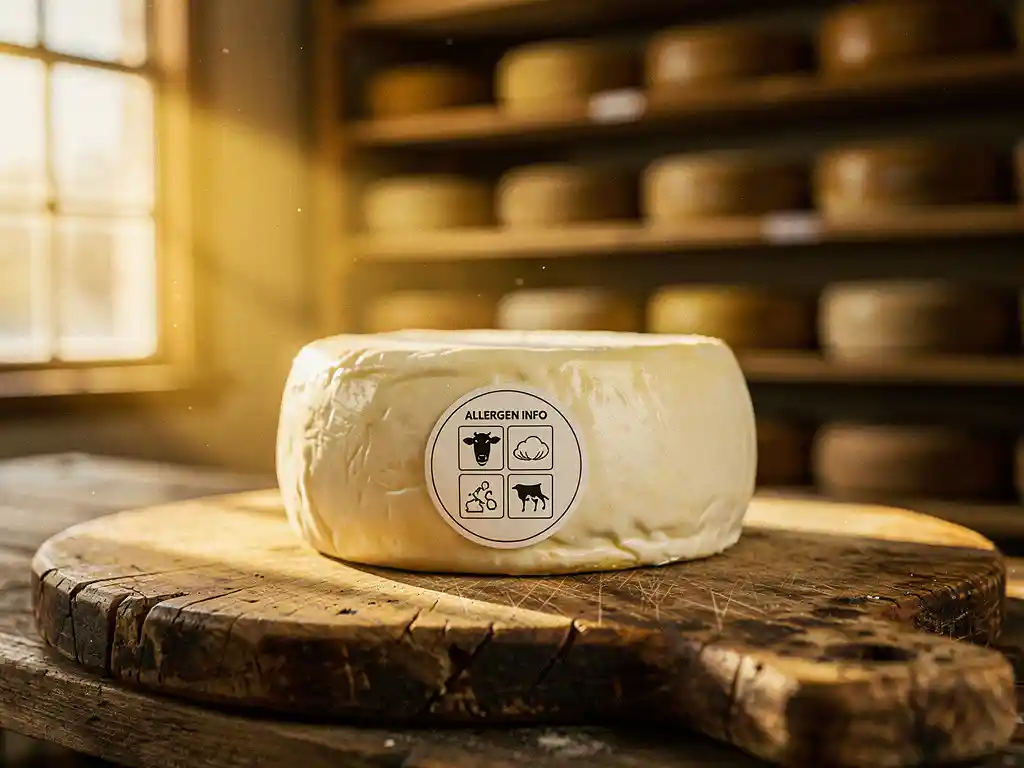
Allergen information is crucial for industrial goat cheese products. For buyers like Marco Visser, who are responsible for purchasing cheese products for the food industry, correct allergen declaration is essential for food safety and legal compliance. This article covers the key aspects of allergen information for industrial goat cheese products, from identification to documentation.
What are allergens and why is declaration mandatory for goat cheese products?
Allergens are substances that can cause allergic reactions in sensitive individuals. For goat cheese products, declaration is legally required under EU Regulation 1169/2011 to protect consumers with food allergies and prevent serious health risks.
Mandatory allergen declaration includes 14 main categories that must always be listed when present in a product. For industrial processors, this means they must provide complete transparency about all ingredients and possible cross-contamination. This information is important not only for the end consumer, but also for companies that process goat cheese in their own products, such as ready meals or pizzas.
Failure to correctly declare allergens can lead to product recalls, fines up to 450,000 euros and serious reputational damage. For industrial customers, reliable allergen information is therefore a critical factor in supplier selection.
Which allergens occur in industrial goat cheese?
Milk is the primary allergen in all goat cheese products, as goat cheese is by definition made from goat milk. Additionally, depending on the variant, other allergens may be present, such as nuts in special varieties or herbs that contain allergens.
For fresh goat cheese, such as Alphenaer products, milk is usually the only allergen. However, in composite products, additional allergens may occur:
- Nuts (for example in goat cheese with walnuts)
- Mustard (in herb mixes)
- Celery (in herb blends)
- Sesame (in toppings or coatings)
- Sulfite (as a preservative in dried fruits like cranberry)
For industrial variants such as goat cheese crumbles or spread, traces of other allergens may also be present during the production process due to cross-contamination in the production environment. This is especially relevant when products containing gluten or soy are also processed in the same facility.
How should you list allergen information on industrial packaging?
Allergen information must be clearly visible in the ingredient list, with allergens displayed in bold, underlined or in capital letters. For industrial packaging, specific requirements apply whereby the information must be on both the outer packaging and accompanying documentation.
The correct listing follows this structure:
- In the ingredient list: mark allergens with bold letters
- Separate allergen statement: “Contains: MILK” directly after the ingredient list
- Cross-contamination information: “May contain traces of…” if relevant
- On bulk packaging: clearly readable on at least one side
For industrial deliveries, this information must also be available digitally in product specifications and on delivery documents. This enables customers to correctly carry out their own labeling and adequately set up their HACCP systems.
What is the difference between ‘contains’ and ‘may contain traces’ for goat cheese?
‘Contains’ refers to ingredients that have been deliberately added to the product, while ‘may contain traces’ warns of possible cross-contamination during production, storage or transport despite preventive measures.
The distinction is crucial for risk assessment in industrial applications. ‘Contains MILK’ means that milk is a main ingredient in goat cheese. This declaration is mandatory and must always be stated. ‘May contain traces of NUTS’ means that despite cleaning procedures and separate production lines, minimal amounts of nuts may be present due to production in the same facility.
For industrial processors, this has different implications. For ‘contains’, the allergen must be included in their own allergen declaration. For ‘may contain traces’, they must conduct a risk analysis, based on the concentration in the final product and their own production environment.
What documentation must a goat cheese producer provide to industrial customers?
A goat cheese producer must provide product specifications, allergen declarations, analysis certificates and traceability documentation. These documents must be current, digitally available and linked to specific batches for complete transparency in the supply chain.
The complete documentation set includes:
- Technical product specifications with complete ingredient list
- Allergen matrix with present and absent allergens
- Microbiological and chemical analysis certificates
- HACCP certification and quality certificates (such as IFS Food)
- Traceability information per batch
- Cross-contamination declaration and prevention measures
This documentation must be available with each delivery and proactively communicated when recipes change. Modern producers often offer an online portal where customers have real-time access to the most recent documentation, which significantly simplifies the compliance process.
How do you prevent allergen incidents when processing industrial goat cheese?
Prevention of allergen incidents requires strict separation of production lines, thorough cleaning procedures between batches, staff training and regular validation of cleaning processes. A structured allergen management system significantly minimizes risks.
Effective prevention measures include:
- Physical separation: separate storage areas for allergens and allergen-free ingredients
- Time separation: first produce allergen-free products, then products with allergens
- Color coding: different colors for tools per allergen category
- Validation: regular swab tests to verify the effectiveness of cleaning
- Training: instruct all employees about allergen risks and procedures
- Documentation: register each cleaning process with time, method and responsible person
For processors of goat cheese, this also means attention to the transition between different cheese types. For example, when switching from plain goat cheese to a variant with nuts, a validated cleaning protocol must be followed to prevent cross-contamination.
How DeJong Cheese helps with allergen management
We at DeJong Cheese understand the complexity of allergen management in industrial applications. With our years of experience since 1995, we have developed robust systems that provide industrial customers like Marco Visser the certainty they need.
Our support includes:
- Complete digital documentation per product including allergen matrix
- IFS Food-certified production processes with strict allergen separation
- Proactive communication with every recipe or process change
- Dedicated account management for industrial customers
- Fast response time to documentation requests (within 24 hours)
For our industrial range, from fresh goat cheese logs to aged varieties, we provide complete traceability and transparency. Our traditional production method combined with modern quality systems ensures consistent, reliable allergen information.
Would you like to know more about how we can simplify your allergen management? View our complete foodservice range or contact our team directly through contact. For general information about our company and our working methods, you can visit our homepage. Also discover where you can find our products via our sales points page.
Veelgestelde vragen
How often should allergen declarations be updated for industrial deliveries?
Allergen declarations must be reviewed at least annually and updated immediately with any recipe or process change. For industrial customers, it is advisable to request an update quarterly, even if there are no changes, to keep documentation current. Modern suppliers automatically send notifications of changes via their portals or ERP systems.
What are the best practices for storing goat cheese to prevent cross-contamination with allergens?
Always store goat cheese in sealed packaging at a separate shelf location, preferably above products with other allergens to avoid dripping risks. Use FIFO principles and color-coded labels for different allergen categories. Ensure at least 30 cm distance between different allergen groups and use separate transport equipment or clean thoroughly between different products.
How do I integrate allergen information from goat cheese into my own HACCP system?
Start by incorporating all allergen data from supplier documentation into your ingredient database, including ‘may contain traces’ information. Create an allergen matrix for each end product in which goat cheese is processed and determine the concentrations. Implement validation points in your production process and train employees specifically on the allergen risks of dairy products. Document all decisions about threshold values and cross-contamination risks.
What allergen analyses can I request to verify the absence of cross-contamination?
You can request ELISA tests for specific allergens such as gluten, soy, egg or nuts, with detection limits from 2-5 ppm. PCR analyses are suitable for detecting DNA from allergenic sources. For milk proteins in goat cheese, specific immunoassays are available that distinguish between different milk types. Ask your supplier about their standard testing frequency and whether they can share swab test results from production lines.
What do I do if my customer has stricter allergen requirements than legal standards?
Communicate these specific requirements directly with your goat cheese supplier to determine if they can meet these stricter standards. Request additional guarantees, such as dedicated production lines or extra cleaning validations. Consider an audit at the supplier to verify their allergen control. Document all additional measures and agreements in a separate contract and ensure regular evaluation moments to monitor compliance.
How do I calculate allergen concentration when goat cheese makes up only a small percentage of my end product?
Use the recipe calculation: multiply the percentage of goat cheese in your end product by the allergen concentration in the cheese. For milk protein in goat cheese (approximately 25-30%), 10% goat cheese in your product means a milk protein content of 2.5-3%. For ‘may contain traces’ declarations, you usually use the VITAL 3.0 reference doses. Document all calculations and decisions about threshold values in your allergen risk analysis.
Gerelateerde artikelen
- Wat zijn de voordelen van een leverancier met eigen productiefaciliteiten?
- Hoe behoud je onderhandelingspositie bij afhankelijkheid van één kaasleverancier?
- Hoe controleer je of een leverancier voldoet aan HACCP-richtlijnen?
- Wat is het verschil tussen een block pallet en een EU pallet bij de levering van kaasproducten?
- Hoe vergelijk je geitenkaasproducenten op kwaliteit, prijs en leverbetrouwbaarheid?