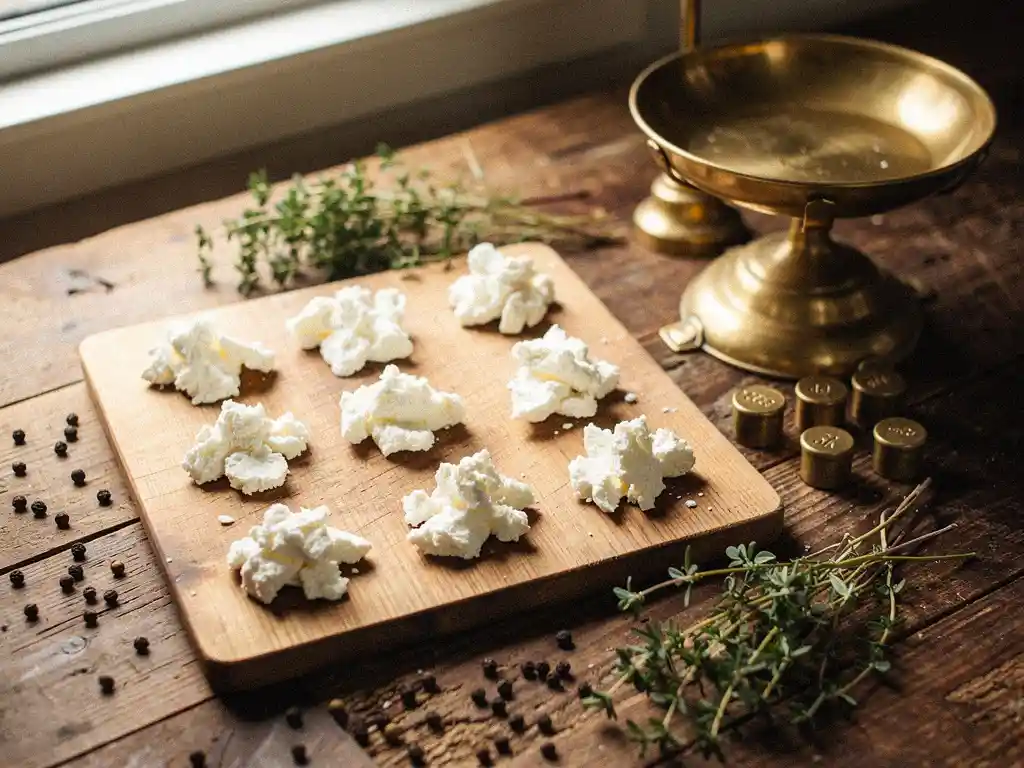
In the food industry, accurate cost calculation is essential for profitable production. For producers working with goat cheese crumbles as an ingredient, the difference between profit and loss can lie in precisely calculating the costs per end product. Whether you produce pizzas, salads, or ready-to-eat meals, understanding the true costs of goat cheese crumbles helps in making better purchasing decisions and optimizing your production processes.
What are goat cheese crumbles and why is cost calculation important?
Goat cheese crumbles are crumbled pieces of fresh or aged goat cheese, usually between 5-15 grams per piece, used as toppings or ingredients in food products. They offer consistent size and melting behavior, which is essential for standardized production in the food industry.
Cost calculation of goat cheese crumbles is crucial because this specialty cheese often makes up a significant portion of total ingredient costs. Unlike regular cheese products, goat cheese crumbles have specific properties that influence price. It’s not just about the purchase price per kilogram, but also factors like waste during processing, required storage conditions, and the impact on the shelf life of the end product.
For food industry buyers, accurate cost calculation means the difference between a competitively priced product and unexpected margin loss. Especially for products where goat cheese crumbles form a premium ingredient, such as artisanal pizzas or gourmet salads, an incorrect calculation can lead to prices the market won’t accept or unprofitable production.
Which cost factors determine the price of goat cheese crumbles?
The price of goat cheese crumbles is determined by five main factors: raw material costs (60-70%), production costs (15-20%), packaging costs (5-10%), transport costs (5-8%), and quality specifications (5-10%). These percentages vary depending on supplier, volume, and specific product characteristics.
Raw material costs form the largest component and are mainly influenced by the price of goat milk, which experiences seasonal fluctuations. Goat milk is more expensive than cow milk due to smaller production scale and higher feed costs for goats. With fresh goat cheese crumbles, the milk content is around 80-85%, which directly impacts the final price.
Production costs include the crumbling process, where the cheese is brought to a specific size. This often happens with specialized equipment that keeps the crumbles uniform. For industrial applications, consistent dimensions are crucial – for example, crumbles of exactly 13 grams for pizza applications ensure predictable melting behavior and even distribution.
Packaging costs differ significantly between bulk packaging for industry (5-10 kg bags) and smaller retail packaging. Modified Atmosphere Packaging (MAP) for longer shelf life increases costs by approximately 15-20% but can reduce total costs through less waste.
Quality specifications such as fat content, moisture percentage, and microbiological parameters influence not only direct costs but also processability. High-melt variants for hot applications cost on average 10-15% more due to adapted production processes.
How do you calculate the exact weight of crumbles per end product?
You calculate the exact weight of goat cheese crumbles per end product by multiplying the target weight by a correction factor for moisture loss and waste. For fresh crumbles, you typically use a factor of 1.05-1.10, meaning you need to purchase 105-110 grams for 100 grams in the end product.
The calculation begins with determining the desired end weight in your product. For a pizza with 80 grams of goat cheese crumbles after baking, you must account for moisture loss during heating. Fresh goat cheese crumbles lose approximately 8-12% moisture during baking processes at 200-250°C. This means you must start with approximately 88-90 grams of crumbles per pizza.
Waste during production forms a second important factor. When dosing and processing crumbles, some loss always occurs due to:
- Adhesion loss in dosing equipment (1-2%)
- Spillage during transport on the production line (0.5-1%)
- Quality control and sampling (0.5%)
- Crumbles that fall outside the product during application (2-3%)
For accurate calculations, it’s essential to monitor your own production line. Measure actual consumption versus theoretical consumption for at least one week. This provides insight into your specific waste percentage. Document different production runs to identify seasonal influences and batch variations.
What is the difference between purchase and processing costs?
Purchase costs are the direct costs for buying goat cheese crumbles from your supplier, while processing costs include all additional costs that arise from receipt to processing in the end product. Processing costs can amount to 15-25% on top of the purchase price.
Purchase costs consist of the invoice price per kilogram plus direct purchasing costs such as transport, import duties for imports, and any quality inspections upon receipt. For goat cheese crumbles in industrial packaging of 5-10 kg, the purchase price falls into different price classes, depending on volume, contract, and specifications.
Processing costs are more complex and include:
- Storage costs: Refrigerated storage at 2-4°C costs on average €0.15-0.25 per kg per week
- Handling: Receipt and dispatch, transport to production line (€0.10-0.15 per kg)
- Quality loss: Dehydration, discoloration, or spoilage during storage (2-5% of volume)
- Labor costs: Time for receipt, inspection, dosing (€0.20-0.30 per kg)
- Energy costs: Cooling, transport within facility (€0.05-0.10 per kg)
A practical example: with a purchase price of €8.50 per kg for fresh goat cheese crumbles, processing costs of approximately €1.70-2.10 per kg are added. This brings the actual costs to €10.20-10.60 per kg. For frozen crumbles, processing costs are lower due to longer shelf life and less waste, but the purchase price is often 5-10% higher due to the freezing process.
How do you prevent cost overruns with goat cheese crumbles?
You prevent cost overruns with goat cheese crumbles by implementing strict inventory controls, accurate dosing systems, and long-term contracts with fixed price agreements. A structured approach can reduce total costs by 10-15% without quality loss.
The most important preventive measure is accurate consumption forecasting. Analyze historical production data to identify seasonal patterns. Goat cheese consumption often peaks in spring and summer for salads and fresh applications. By knowing these patterns, you can:
- Optimize inventory levels to minimize overstock and waste
- Utilize volume discounts without risk of spoilage
- Plan production around optimal purchasing moments
Technical solutions play a crucial role in cost control. Invest in precision dosing equipment that can accurately weigh and dose crumbles. Modern systems with weight control and automatic correction reduce overdosing by 5-8%. For a production volume of 10,000 units per day with 80 grams of crumbles per unit, 5% savings means a reduction of 40 kg per day – approximately €400 in material costs.
Contractual agreements with suppliers offer stability. Consider quarterly or annual contracts with fixed volumes and prices. This protects against price fluctuations in the goat milk market. Also ask about flexible delivery schedules where you can call off weekly or biweekly within an established volume range.
How De Jong Cheese helps with cost optimization
As a traditional family business since 1995, we understand the challenges of cost calculation in the food industry. Our expertise in goat cheese crumbles helps producers like you make accurate calculations and optimize costs.
We offer concrete support for your cost calculations:
- Technical specifications: Exact data on moisture content, melting behavior, and waste of our crumbles (13g)
- Flexible packaging: Choice between 5kg and 10kg bags for optimal handling in your process
- Volume agreements: Fixed price contracts for stable cost calculations
- Fresh or frozen: Advice on the most cost-effective option for your application
- Test samples: Ability to test waste and processing in your production line
Our account managers are happy to share their knowledge about processing yields and help you establish accurate cost models. With our years of experience in supplying the industry worldwide, we know the specific challenges of different production processes.
Are you curious how our goat cheese crumbles can improve your cost calculation? Contact us for a personal consultation and receive detailed product specifications for your calculations. Visit our product page for the complete range or schedule an appointment directly via our contact page. For direct availability, you can also visit one of our sales points. Discover all possibilities at dejongcheese.nl.
Veelgestelde vragen
How can I extend the shelf life of goat cheese crumbles without extra costs?
Optimize your FIFO system and store crumbles in their original packaging until use. Consider dividing large batches into weekly portions immediately after receipt, and use vacuum packaging for opened bags. This can extend shelf life by 30-40% without significant additional costs.
Which dosing equipment gives the best yield for goat cheese crumbles?
Vibrating dosing systems with weight control give the best results for 13-gram crumbles. These systems reduce overdosing by 5-8% and minimize breakage. Invest in equipment with anti-stick coating and programmable portion sizes for different product lines.
What is the break-even point between fresh and frozen goat cheese crumbles?
The break-even point usually lies at an inventory rotation of 2-3 weeks. With faster turnover, fresh crumbles are more advantageous due to lower purchase price. With slower rotation, the lower waste costs of frozen crumbles compensate for the higher purchase price, especially for seasonal production.
How do I calculate the actual costs with changing recipes?
Create a spreadsheet with variable input fields for crumble weight per product. Calculate a weighted average based on production quantities per SKU. Update monthly waste percentages per production line and apply seasonal corrections for accurate annual budgets.
Which KPIs should I monitor for cost control of goat cheese crumbles?
Monitor weekly: actual consumption versus theoretical consumption, waste percentage per production line, inventory rotation, and overdosing per product. Set alarms for deviations >3% and analyze monthly trends in seasonal consumption for better purchasing and production planning.
Can I save costs by combining different qualities of crumbles?
Yes, for products with multiple cheese types you can combine premium goat cheese crumbles with cheaper alternatives. Use 60-70% standard crumbles with 30-40% premium for flavor retention. Always test melting behavior and flavor balance before switching.
How do I effectively negotiate long-term contracts for goat cheese crumbles?
Begin negotiations 3-4 months before contract renewal with concrete consumption data. Ask for tiered pricing at different volumes and flexible call-off within 80-120% of contract volume. Negotiate for free samples for new product development and technical support as added value.
Gerelateerde artikelen
- Hoe draagt de DGZK-certificering bij aan duurzame geitenkaasproductie?
- Hoe schaal je de inkoop van geitenkaas pucks op zonder kwaliteitsverlies?
- Hoe lang zijn geitenkaas crumbles houdbaar voor industriële verwerking?
- Hoe zorg je dat je leverancier altijd voldoet aan de laatste voedselveiligheidseisen?
- Hoe kies je tussen geitenkaas crumbles, parels en plakjes voor een geautomatiseerde pizzalijn?