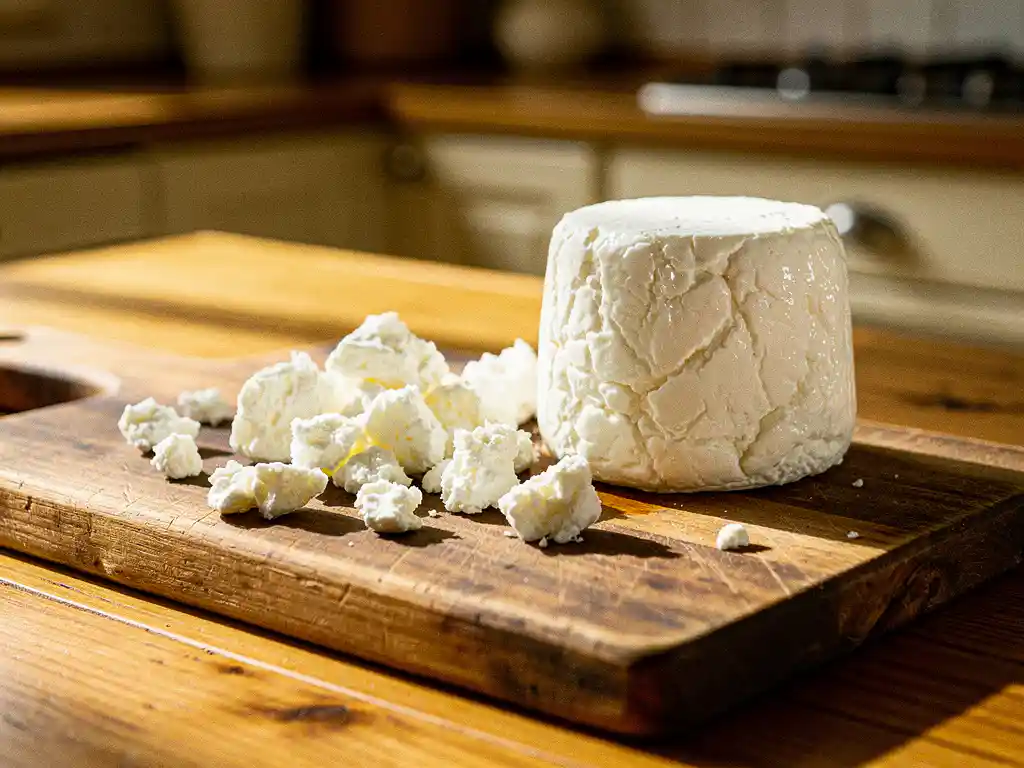
When purchasing goat cheese for industrial applications, you face important choices that go beyond just the purchase price. Whether you choose goat cheese crumbles or logs, both have their own cost structure and impact on your production process. The right choice depends on your specific situation: production volume, available workforce, storage facilities, and end product. In this article, we compare the total cost of ownership of both options, so you can make an informed decision that fits your business operations.
What is total cost of ownership in goat cheese purchasing?
Total cost of ownership (TCO) in goat cheese purchasing encompasses all costs throughout the entire lifecycle of the product, from purchase to processing into your end product. This means not only the purchase price, but also transport, storage, labor costs for processing, product loss, and quality control.
For industrial processors, TCO is a crucial concept because the cheapest option on paper is often not the most cost-effective in practice. A goat cheese log may have a lower price per kilo than crumbles, but when you factor in labor costs for crumbling, the total picture can look very different. Additionally, factors such as shelf life, storage space, and processing speed play an important role in the final costs.
Calculating TCO helps you identify hidden costs and make a fair comparison between different product forms. This is especially relevant in the food industry where margins are often small and efficiency makes the difference between profit and loss.
Which cost items determine the TCO of crumbles versus logs?
The main cost items in the TCO comparison between goat cheese crumbles and logs are: purchase price per kilo, labor costs for processing, product loss during processing, storage costs, transport costs, and the required equipment for processing.
With goat cheese logs, you typically pay a lower price per kilo, but substantial processing costs are added. Cutting or crumbling a log requires specialized personnel and time. An employee can process approximately 15-20 kilos per hour, which at an hourly wage of 25 euros amounts to 1.25-1.67 euros extra per kilo. Additionally, product loss of 2-5% occurs due to buildup on cutting equipment and scraps that are no longer usable.
Crumbles, on the other hand, have a higher purchase price but are ready to use immediately. The additional cost is often more than compensated by the elimination of labor costs and minimal product loss. Storage costs can also differ: logs take up less space per kilo of product, but crumbles in bags of 5 or 10 kilos are more efficient to handle in the production process.
Transport costs are relatively comparable, although the volume-efficiency advantage of logs may outweigh the practical advantages of pre-packaged crumbles. Finally, you must account for investments in cutting or crumbling equipment for logs, while crumbles require no additional equipment.
How do you calculate the processing costs of goat cheese logs?
You calculate the processing costs of goat cheese logs by adding together labor costs, product loss, energy consumption, and equipment depreciation. For an accurate calculation, divide these total costs by the number of kilos of end product you extract from the logs.
Start by calculating labor costs. Measure how much time an employee needs to process a log into the desired form. Manual crumbling takes approximately 3-4 minutes per kilo, which at an all-in hourly wage of 30 euros amounts to 1.50-2.00 euros per kilo. With machine processing, this is lower, but then you must include the purchase and maintenance of the equipment.
Product loss is the next important item. When cutting or crumbling logs, you lose an average of 3-5% of the product due to:
- Buildup on knives or equipment
- Unusable end pieces
- Product lost during transport within your facility
- Quality loss due to air exposure during processing
Energy costs for cooling during processing and any cutting machines amount to approximately 0.10-0.15 euros per kilo. Equipment depreciation varies greatly but typically lies between 0.20-0.40 euros per kilo, depending on your production volume and chosen equipment.
What are the advantages of ready-to-use crumbles for production processes?
Ready-to-use goat cheese crumbles offer immediate time savings, consistent product quality, minimal product loss, and improved hygiene in the production process. These advantages translate into lower operational costs and higher production efficiency, despite the higher purchase price.
The biggest advantage is time savings in your production line. Crumbles can be processed directly from the packaging into your product, without employee intervention for processing. This means your employees can focus on other tasks and the lead time of your production becomes significantly shorter. In a pizza production line, for example, using crumbles can shorten preparation time per pizza by 30-45 seconds.
The consistency of pre-packaged crumbles is another important advantage. Each crumble has the same size and shape, ensuring:
- Even melting and texture in the end product
- Predictable dosing without weighing errors
- Consistent appearance of your end product
- Easier quality control
In terms of food safety, crumbles also offer advantages. The product is handled less in your facility, reducing the risk of cross-contamination. Additionally, crumbles are often packaged in portions that align with your production batches, so you don’t need to store opened packages.
When is a goat cheese log more advantageous than crumbles?
A goat cheese log is more advantageous than crumbles when you process large volumes (more than 500 kg per week), have access to inexpensive labor, already have the equipment in-house, and need flexibility in the shape and size of your cheese component.
With very large production volumes, the fixed costs of equipment and training are spread over more kilos, significantly reducing costs per unit. If you process 1000 kg per week and already have a professional cheese cutting machine, processing costs can drop to under 0.50 euros per kilo. In this scenario, the lower purchase price of logs can make the total TCO more advantageous.
Logs also offer more flexibility in your production. You can decide whether you want to:
- Make fine or coarse crumbles
- Need slices, cubes, or other shapes
- Adjust size to specific recipes
- Make different products from the same raw material
For companies with seasonal production, logs can also be more advantageous. During peak periods, you can deploy extra staff for processing, while during quiet periods you order fewer logs. The longer shelf life of unprocessed logs (often 7-10 weeks) gives you more flexibility in inventory management than pre-packaged crumbles.
How do you optimize TCO in goat cheese purchasing?
TCO optimization in goat cheese purchasing is achieved by choosing the right product for your situation, setting up efficient processes, minimizing waste, and forming strategic partnerships with suppliers who collaborate on cost savings.
Start with a thorough analysis of your current situation. Document exactly how much time and money you spend on each step in the process. Measure not only direct costs, but also indirect factors such as:
- Production waiting times due to cheese processing
- Quality problems due to inconsistent processing
- Overtime during peak periods
- Costs of product rework
Then consider hybrid solutions. Many successful companies use a combination of logs for special products or small batches, and crumbles for their standard high-volume production. This provides the best balance between flexibility and efficiency.
Collaborate with your supplier on process optimization. A good supplier can, for example:
- Adjust packaging sizes to your batch sizes
- Optimize delivery schedules to reduce inventory costs
- Advise on the most efficient product form for your application
- Develop new product forms that better suit your process
How DeJong Cheese helps with TCO optimization
As specialists in goat cheese products since 1995, we at DeJong Cheese understand that every customer has unique needs. That’s why we not only offer a wide range of product forms, but also actively collaborate on the most cost-effective solution for your specific situation.
Our industrial range offers maximum flexibility:
- Fresh goat cheese logs (2.6 kg) for large volumes and flexible processing
- Ready-to-use crumbles in 5 kg bags for direct processing
- Freezable variants with 2-year shelf life for optimal inventory management
- Custom packaging sizes tailored to your production batches
Our experts are happy to analyze the total cost structure together with you and advise on the optimal product choice. With our years of experience in foodservice and industry, we know the challenges of large-scale processing and can offer practical solutions that really work.
Would you like to know exactly what the TCO impact is of different goat cheese forms in your production process? Contact us for a no-obligation analysis. Visit our homepage for more information about our complete range or find one of our sales points near you.
Veelgestelde vragen
How long does it take to switch from logs to crumbles in my production process?
The switch from logs to crumbles can be realized within 1-2 weeks. The most important thing is adjusting your recipe cards and training employees on the new dosing. Start with a test batch to determine exact quantities, as crumbles may have a slightly different density than self-crumbled cheese.
Can I sell my existing cutting equipment if I switch to crumbles?
Yes, there is an active second-hand market for professional cheese cutting equipment. However, consider keeping the equipment for special orders or new product lines. Many companies use a hybrid model where they use crumbles for standard production and logs for specialties or seasonal products.
What is the break-even point where logs become more advantageous than crumbles?
The break-even point typically lies around 400-500 kg per week, but this strongly depends on your labor costs and available equipment. With a labor cost price of $25 per hour and manual processing, the tipping point is higher (600-700 kg). With automated equipment and low labor costs, this can drop to 300 kg per week.
How do I prevent quality loss when storing opened goat cheese logs?
Wrap opened logs immediately airtight in new food-grade foil and store at 2-4°C. Use within 48 hours for optimal quality. Mark the packaging with date and time of opening. For longer storage, you can crumble the remnants and freeze them, but this again increases your labor costs.
Which hidden costs are often overlooked in TCO calculation?
The most missed costs are: training time for new personnel ($150-300 per employee), product loss due to human error (1-2% extra with logs), cleaning costs of cutting equipment (15-20 minutes per day), and opportunity costs when the production line has to wait for cheese processing during peak hours.
Is it possible to get a trial period for different product forms?
Most professional suppliers, including DeJong Cheese, offer test samples or small starter orders so you can evaluate both options. Ask for a trial delivery of both logs and crumbles for a realistic comparison in your own production environment. Document time, costs, and quality for at least a week for reliable data.
Gerelateerde artikelen
- Hoe stel je een longlist op van geitenkaasproducenten voor de voedingsindustrie?
- Wat zijn de voordelen van een Nederlandse geitenkaasproducent voor Europese afnemers?
- Welke Europese wetgeving geldt voor geitenkaas in de voedingsindustrie?
- Hoe controleer je of een kaasleverancier voldoet aan Europese hygiënenormen?
- Wat zijn de beste geitenkaasmerken om mee te koken?