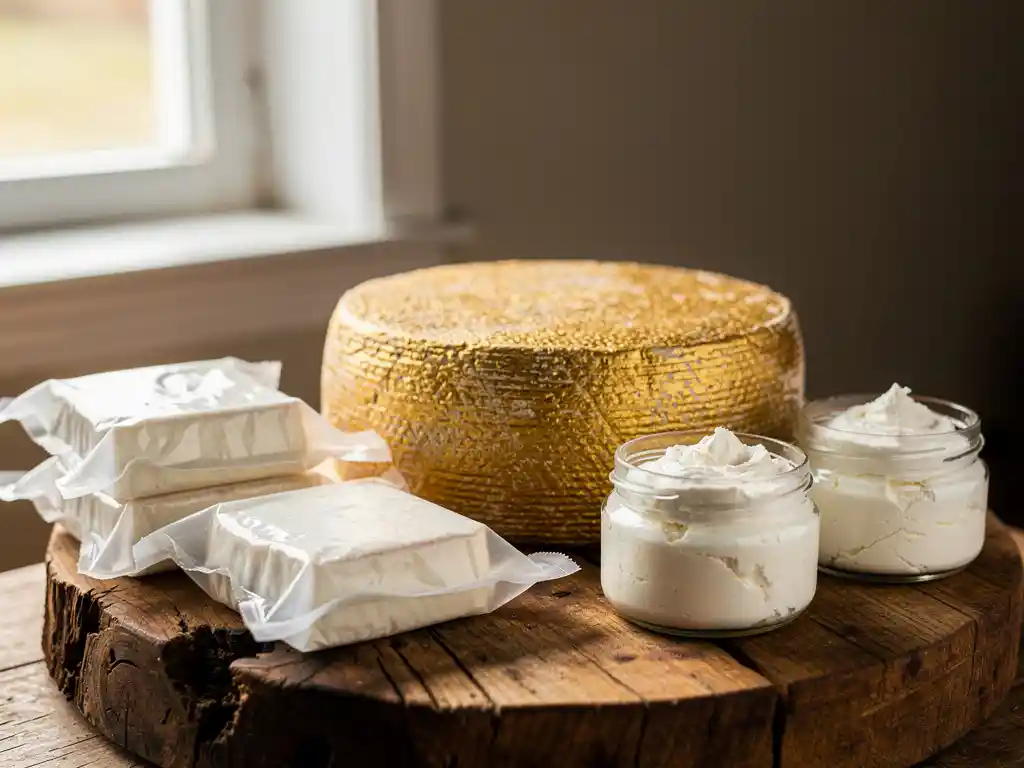
In the food industry, the shelf life of goat cheese plays a crucial role in production planning and inventory management. Different packaging formats offer unique advantages for industrial applications, where the choice of packaging directly affects storage duration, product quality, and processability. For buyers working with goat cheese in production processes, it is essential to understand the differences between packaging options.
What is the difference in shelf life between vacuum-packed and foil-wrapped goat cheese?
Vacuum-packed goat cheese typically has a shelf life of 12 to 23 weeks, while foil-wrapped variants usually last 6 to 10 weeks. The difference comes from the complete removal of oxygen in vacuum packaging, which significantly reduces bacterial growth and oxidation.
In vacuum packaging, all air is extracted from the package before it is hermetically sealed. This process creates an oxygen-poor environment in which aerobic bacteria cannot multiply. For fresh goat cheese products like our Alphenaer Specials, this means that the characteristic flavor and texture are preserved longer. The vacuum technique is particularly effective for soft goat cheeses with higher moisture content, where the vacuum pressure keeps the cheese structure intact without moisture loss.
Foil packaging, on the other hand, provides a protective barrier against external contamination but still allows minimal air exchange. This makes foil packaging suitable for shorter distribution chains or products that are processed more quickly. For industrial applications where goat cheese is used directly in production processes, foil packaging can be more practical due to easy opening and processing.
How does packaging size affect the shelf life of goat cheese in bulk packages?
Larger bulk packages of 5 to 10 kilograms typically offer 2 to 4 weeks longer shelf life than smaller consumer packages. This is because the surface-to-volume ratio is more favorable, exposing less product to potential quality deterioration.
In bulk packages, goat cheese has less contact surface with packaging materials per kilogram of product. This significantly reduces the chance of oxidation and moisture loss. For industrial processors, this means they can benefit from longer storage periods when purchasing larger quantities. A 10-kilogram bulk package of fresh goat cheese can, for example, remain fresh for up to 16 weeks under optimal conditions, while the same cheese in 200-gram portions might only last 10 weeks.
Package size also affects temperature stability during storage. Larger masses of cheese react more slowly to temperature fluctuations, which benefits product quality. For production environments where goat cheese is processed into pizzas or ready meals, bulk packages therefore mean not only cost efficiency but also better quality control.
What role does modified atmosphere packaging (MAP) play in goat cheese shelf life?
Modified atmosphere packaging extends the shelf life of goat cheese by 50 to 100 percent by replacing the atmosphere in the package with an optimal gas mixture, usually carbon dioxide and nitrogen. This technique inhibits microbial growth and maintains freshness without preservatives.
MAP technology works by replacing the natural atmosphere in the package with a carefully composed gas mixture. For goat cheese, a combination of 30-40% CO2 and 60-70% N2 is often used. The carbon dioxide has an antimicrobial effect that is particularly effective against molds and yeasts, while nitrogen serves as an inert filler gas that prevents oxidation. This gas composition is specifically tailored to the type of goat cheese and the desired shelf life profile.
For fresh goat cheese products like spreadable varieties, MAP offers the advantage that the creamy texture is preserved without moisture being extracted, as can happen with vacuum packaging. The technology makes it possible to keep products fresh longer during transport to processing facilities, which is especially important for international deliveries. Our experience shows that MAP-packaged goat cheese can remain fresh for up to 23 weeks while retaining all organoleptic properties.
What are the key factors that determine shelf life regardless of packaging format?
Temperature control, initial microbiological quality of the milk, acidity (pH), moisture content, and hygienic production conditions are the five main factors that determine shelf life. These factors work together and influence each other, with temperature being the most critical variable.
Temperature control throughout the entire chain is essential: every degree above the optimal 4°C can shorten shelf life by days. For industrial customers, this means that an uninterrupted cold chain from production to processing is crucial. The microbiological starting quality of goat milk determines the potential maximum shelf life – milk with low bacterial counts results in cheese that inherently stays fresh longer.
Acidity plays a protective role against unwanted bacterial growth. Fresh goat cheese typically has a pH between 4.2 and 4.6, which forms a natural barrier against pathogens. Moisture content varies by cheese type but is around 60-70% for fresh goat cheese. The higher the moisture content, the shorter the shelf life usually is, unless this is compensated by other preservation techniques.
Hygienic production conditions according to HACCP and IFS standards form the basis for long shelf life. This includes everything from equipment cleaning to personal hygiene of employees and air quality in production spaces.
How can you estimate the remaining shelf life of goat cheese after delivery to industry?
Remaining shelf life is calculated by subtracting the elapsed time since production from the total shelf life, with temperature history and packaging integrity serving as correction factors. A practical rule of thumb is that 70% of the original shelf life remains upon delivery to industrial processors.
For accurate estimation, cold chain documentation is essential. Modern transport systems use data loggers that enable continuous temperature recording. With our deliveries, a temperature log is provided as standard, allowing recipients to determine exactly whether the cheese has been transported under optimal conditions. A temperature deviation of 2 degrees for 24 hours can reduce remaining shelf life by 10-15%.
Visual inspection upon receipt provides additional information: intact packaging without gas bubbles or moisture development indicates good storage conditions. For MAP packages, it is important to check whether the packaging still fits tightly around the product – loose packaging may indicate gas leakage and reduced protection.
Industrial processors can also use accelerated shelf life testing, where samples are stored at elevated temperatures to predict remaining shelf life. This method is especially useful for large batches where maximum utilization of shelf life is crucial for production planning.
What innovations in packaging technology are currently improving goat cheese shelf life?
Active packaging with antimicrobial coatings, intelligent packaging with time-temperature indicators, and bio-based barrier materials are the three main innovations. These technologies can extend shelf life by 30-50% while improving sustainability and food safety.
Active packaging contains components that interact with the product or environment. For goat cheese, antimicrobial coatings are being developed based on natural substances like chitosan or plant extracts. These coatings gradually release antimicrobial substances that specifically inhibit yeasts and molds without affecting cheese flavor. Tests show that this technology is particularly effective for soft cheeses with high moisture content.
Intelligent packaging communicates information about product status. Time-temperature indicators (TTIs) change color when the product has been stored above safe temperature for too long. For industrial applications, RFID chips with integrated sensors offer real-time monitoring of temperature, humidity, and even pH. This data can be directly linked to inventory management systems for optimal FIFO application.
Bio-based barrier materials made from milk proteins or plant polymers offer a sustainable alternative to traditional plastics. These materials often have better oxygen barrier properties than conventional packaging and are fully compostable. For the cheese industry, this means that packaging can be developed specifically tailored to the breathing needs of different cheese types.
How De Jong Cheese helps with optimal shelf life for industrial applications
At De Jong Cheese, we understand that consistent shelf life is crucial for your production processes. Our approach combines traditional cheese making with modern packaging technology to guarantee maximum freshness upon delivery to industrial partners.
Our solutions for optimal shelf life include:
- Standardized shelf life profiles per product line – for example, 23 weeks for our Alphenaer Specials
- Flexible packaging options adapted to your processing process
- Complete traceability with temperature logging from production to delivery
- Technical support for shelf life optimization in your specific application
- Customized delivery schedules that align with your production planning
For industrial processors working with goat cheese in pizzas, ready meals, or other applications, we offer detailed product specifications including shelf life information on our foodservice page. Our team is ready to answer your specific questions about shelf life and packaging options.
Would you like to know more about how our packaging formats can contribute to more efficient production processes? Contact us for a personal consultation. Also visit our sales points page for more information about direct delivery options, or discover our complete range on our homepage.
Veelgestelde vragen
How can I determine which packaging format best suits my production process?
The choice depends on your processing speed, storage capacity, and degree of automation. For daily processing of large volumes, bulk packages of 5-10 kg are ideal, while for flexible production with varying recipes, smaller MAP packages are more practical. Request an analysis of your production volume versus shelf life needs to determine the optimal package size.
What are the cost-benefit trade-offs between different packaging technologies for goat cheese?
MAP packages have higher initial costs but offer 50-100% longer shelf life, which reduces inventory risks and write-offs. Vacuum packaging is cheaper but requires faster processing. Bulk packages offer the lowest cost per kilo with sufficient processing capacity. Calculate your break-even point by weighing packaging costs against savings on product loss and inventory costs.
How do I prevent quality loss when repackaging bulk goat cheese into smaller portions?
Work in a cooled environment below 10°C, use sterile equipment and minimize exposure to air. Implement a first-in-first-out system and package directly after portioning in new MAP or vacuum packaging. Train personnel in hygienic work procedures and use disposable gloves. Consider investments in semi-automatic portioning and packaging lines for consistent quality.
What documentation and certifications should I request from my goat cheese supplier?
Request at minimum IFS/BRC certification, HACCP documentation, and specification sheets with microbiological parameters. For traceability, batch numbers, production dates and temperature logs are essential. For export, veterinary certificates and declarations of origin are needed. Also ask for shelf life studies and challenge tests for your specific application to guarantee product safety.
How do I integrate shelf life data into my ERP system for optimal inventory management?
Implement barcode or RFID scanning upon receipt to automatically register production date and shelf life. Set alerts at 30% remaining shelf life for priority processing. Link temperature data from storage areas to your system for dynamic shelf life calculation. Use predictive analytics to determine optimal order quantities based on historical processing speed.
What are the consequences of brief power outages or temperature fluctuations on shelf life?
A temperature rise from 4°C to 8°C for 4 hours shortens shelf life by approximately 5-7%. With longer outages (>8 hours) this can increase to 20-30% reduction. Install emergency power supply and temperature alarms with SMS notification. Document all incidents and adjust shelf life data in your system. When in doubt, perform an accelerated shelf life test on representative samples.
Can different goat cheese varieties be stored together without cross-contamination of aromas?
Store soft and hard goat cheeses separately, especially with foil packaging that allows more aroma transfer. Vacuum and MAP packages offer better isolation but place strongly flavored variants (herbs/garlic) separately. Use airtight containers for opened bulk packages and prevent direct contact between different cheese types. Implement zoning in your cold room based on aroma intensity.
Gerelateerde artikelen
- Welke KPI's gebruik je om een geitenkaasproducent te beoordelen op leverbetrouwbaarheid?
- Wat is het verschil in houdbaarheid tussen verse en ingevroren geitenkaas spread?
- Hoe zorg je voor continuïteit in de levering van geitenkaas spread bij seizoensschommelingen?
- Wat is het Kwaligeit-keurmerk en wat zegt het over de melkkwaliteit van geitenkaas?
- Is Boursin geitenkaas?