Industrial goat cheese curd offers unique opportunities for food producers seeking high-quality cheese components for their products. As a traditional family business since 1995, we at DeJong Cheese understand the specific needs of the food industry. Whether it’s pizzas, ready meals, or other applications, custom goat cheese curd can make the difference between a standard product and a distinctive specialty. In this article, we explore the various customization options available for industrial processors.
What exactly is industrial goat cheese curd?
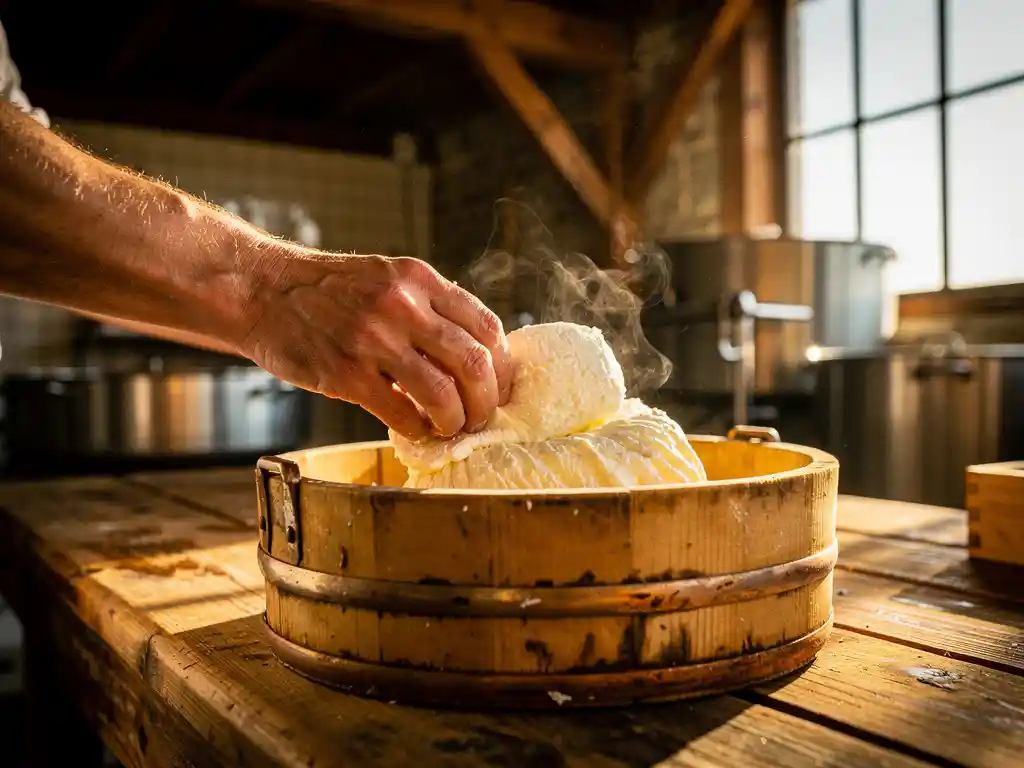
Industrial goat cheese curd is the basic raw material of fresh goat cheese before it is pressed into its final form. It consists of coagulated and drained goat milk with a crumbly, moist texture that is ideal for further processing in food products. This curd forms the basis for various cheese applications in the industry.
The curd is created during the traditional cheese-making process when milk is acidified and coagulated. After cutting and stirring the coagulated mass, a product emerges with specific properties that perfectly align with industrial processing processes. The moisture content, grain size, and acidity can be adjusted to the specific requirements of the end application.
For food producers, curd offers several advantages over ready-made cheese. The product is easier to dose in production processes, mixes better with other ingredients, and offers more flexibility in the final texture of the product. Moreover, curd is often more cost-effective than pre-formed cheese products.
What custom specifications are possible with goat cheese curd?
Various parameters can be adjusted in goat cheese curd: moisture content (60-80%), fat content (15-25% on dry matter), pH value (4.2-4.8), grain size, and texture. These specifications determine how the curd behaves during heating, mixing, and other processing processes in the food industry.
Moisture content is a crucial factor that affects processability and shelf life. For applications where the curd is further heated, such as in pizzas or casseroles, a lower moisture content is often desired to prevent excessive moisture release. For cold applications like spreads or dips, a higher moisture content can actually provide a creamier texture.
The pH value affects not only the taste but also the functional properties of the curd. A lower pH provides a fresher, more acidic taste that is characteristic of fresh goat cheese, while a higher pH gives a milder taste. Grain size varies from fine (for smooth applications) to coarse (for products where texture is desired).
Specific additions such as salt, herbs, or natural preservatives can also be customized. For producers working with spreadable goat cheese applications, we can optimize the curd for maximum spreadability and stability.
How does the customization process for industrial curd work?
The customization process begins with a technical intake where we analyze the exact application requirements, followed by laboratory tests and trial productions. After approval of the prototype, scaling up to industrial volumes follows with continuous quality control and the possibility to adjust specifications during the collaboration.
During the technical intake, we discuss the following aspects:
- The end application of the curd in the product
- Processing temperatures and times
- Desired shelf life and storage conditions
- Flavor profile and texture requirements
- Volume and delivery frequency
In our laboratory, we then develop various prototypes that meet the specified requirements. These are tested under realistic production conditions. We can produce small batches for testing in the customer’s own production line, allowing any adjustments to be made before large-scale production begins.
The entire process takes an average of 4 to 8 weeks, depending on the complexity of the specifications. During this period, we work closely with the customer’s quality department to ensure that all parameters perfectly align with production requirements.
What are the minimum purchase volumes for custom curd?
The minimum purchase volumes for custom goat cheese curd start at 500 kilograms per delivery, with a contractual purchase of at least 2,000 kilograms per month. These volumes guarantee economically responsible production while offering flexibility for test phases and seasonal fluctuations in demand.
For new customers, we offer the possibility to start with smaller test volumes of 100-200 kilograms for initial product development. This test phase allows producers to evaluate the curd in their own production environment without large upfront investments. After successful tests, volumes can be gradually scaled up.
Delivery frequency can be adjusted to production planning:
- Weekly deliveries for high-volume producers (minimum 500 kg per week)
- Bi-weekly deliveries for medium-sized customers (minimum 1,000 kg per delivery)
- Monthly deliveries for seasonal production (minimum 2,000 kg per delivery)
For very large volumes above 10,000 kilograms per month, special pricing agreements can be made. We understand that consistent delivery is crucial for industrial processes and therefore guarantee fixed delivery agreements with backup production capacity.
What packaging options are available for industrial curd?
Industrial goat cheese curd is packaged in food-grade plastic containers of 10, 20, or 200 kilograms, vacuum bags of 5 or 10 kilograms, or bulk packaging in IBC containers of 1,000 kilograms. All packaging is optimized for hygienic handling, maximum shelf life, and efficient processing in production environments.
The choice of the right packaging depends on various factors within the production process. Smaller packages of 5 or 10 kilograms are ideal for production lines where precision dosing is important or where different products are made. Vacuum packaging ensures optimal shelf life and prevents oxidation of the product.
For large-scale continuous production, the 200-kilogram containers or IBC containers are most efficient. These can be directly connected to dosing systems, which saves labor costs and minimizes the risk of contamination. All containers are equipped with:
- Food-grade inner bags for extra hygiene
- Stackable designs for efficient storage
- Clear labeling with batch and traceability information
- Optional Modified Atmosphere Packaging (MAP) for extended shelf life
We can also develop customer-specific packaging solutions, for example for automated production systems that require specific connections or dimensions.
How does DeJong Cheese guarantee consistent quality with custom products?
Consistent quality is guaranteed through strict process control according to IFS Food standards, daily laboratory analyses of each batch, fixed milk suppliers with DGZK certification, and standardized production protocols. Each delivery is provided with an analysis certificate with exact specifications and microbiological values.
Our quality system begins with milk selection. We work exclusively with fixed suppliers from the region who meet the highest quality requirements. The milk is tested upon arrival for composition, microbiological parameters, and absence of antibiotics. This strict incoming control forms the basis for a consistent end product.
During the production process, we continuously monitor critical control points:
- Temperature during pasteurization and fermentation
- pH development during the acidification process
- Moisture content after draining
- Microbiological safety at various production stages
- Organoleptic properties (taste, smell, texture)
For industrial customers, we offer additional services such as trending analyses of quality parameters over time, warning systems for deviations, and monthly quality reports. This transparent approach enables customers like Marco Visser to confidently process our curd in their end products.
How DeJong Cheese helps with industrial goat cheese curd
As a specialist in goat cheese products since 1995, we at DeJong Cheese offer complete custom solutions for industrial processors. We combine our expertise in traditional cheese-making techniques with modern production technology to deliver curd that perfectly aligns with your specific processing requirements.
Our approach for industrial customers includes:
- Personal technical support during product development
- Flexible delivery schedules adapted to your production cycle
- Consistent quality guaranteed by IFS Food certification
- Complete traceability from milk to end product
- Competitive prices through efficient production processes
For more information about our industrial curd solutions, you can visit our product page. Here you will find additional technical specifications and application possibilities. Are you interested in a non-committal conversation about your specific needs? Please contact us for a personal appointment.
Also discover where our products are available through our sales points, or visit our homepage for the complete overview of our range of fresh and aged goat cheese specialties.
Veelgestelde vragen
How long is the shelf life of industrial goat cheese curd and how should it be stored?
The shelf life of goat cheese curd varies from 14 to 28 days, depending on the packaging method and specifications. Always store the curd at 2-4°C in the original packaging. With vacuum packaging or Modified Atmosphere Packaging, the shelf life can be extended to 6 weeks. After opening, the curd should be processed within 3-5 days for optimal quality.
Can I as a small producer also order custom curd without the minimum purchase of 2,000 kg per month?
For starting producers, we offer flexible startup options with test volumes from 100 kg. After a successful test phase, you can gradually scale up to the regular minimum purchase. We understand that new product development takes time and are happy to work with a growth trajectory that fits your business development.
What certifications does DeJong Cheese have for delivery to the food industry?
DeJong Cheese is IFS Food certified, which is the highest standard for food safety in the industry. In addition, we work according to HACCP principles and all our milk suppliers have the DGZK certification. Upon request, we can facilitate additional certifications such as BRC or specific customer audits for international deliveries.
How do I prevent goat cheese curd from releasing too much moisture during baking in my product?
For baking applications, we recommend curd with a lower moisture content (60-65%) and a slightly higher pH value (4.6-4.8). Pre-drainage of the curd before use can also help, as well as adding binding agents. Our technical specialists can develop a curd specification that performs optimally at your specific baking temperatures and times.
Is it possible to have organic or lactose-free goat cheese curd produced?
Yes, we can produce organic goat cheese curd provided sufficient organic goat milk is available in the region. For lactose-free variants, we use lactase enzymes during the production process, reducing the lactose content to below 0.1%. Both options require adjusted minimum volumes and delivery times due to the specific raw materials.
What are the main differences between goat cheese curd and cow milk curd for industrial processing?
Goat cheese curd has a finer grain structure, a naturally lower lactose content, and a characteristic white color without the use of colorants. The smaller fat globules in goat milk provide better emulsion properties and a creamier texture. Moreover, goat cheese curd is more digestible and has a unique, mild flavor profile that combines well with Mediterranean ingredients.
Gerelateerde artikelen
- Hoe beïnvloedt het rijpingsproces van gerijpte geitenkaas de smaak in een eindproduct?
- Wat is de snelste manier om een leverancier van industriële wrongel te kwalificeren?
- Hoe werkt palletlevering van geitenkaas wrongel voor de voedingsindustrie?
- Welke vragen stel je een producent van wrongel bij een eerste kennismaking?
- Welke geitenkaassoorten uit het pizza-assortiment zijn geschikt als industriële topping?