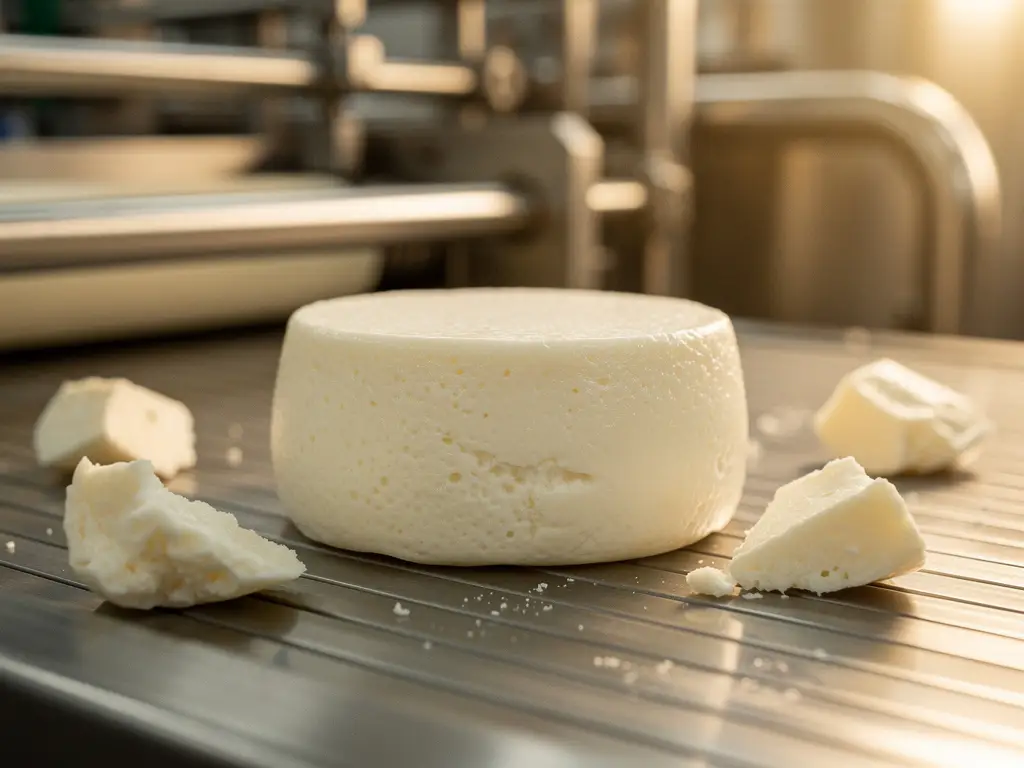
In the modern food industry, everything revolves around efficiency and quality. For producers working with goat cheese in their production lines, choosing the right cheese puck format can make the difference between a profitable operation and costly waste. As a traditional family business since 1995, we at DeJong Cheese have seen how the right puck format directly affects the productivity and waste streams of our industrial clients.
What are goat cheese pucks and why are they used in production lines?
Goat cheese pucks are pre-portioned, round discs of fresh or aged goat cheese with standardized weight and diameter, specially developed for efficient processing in industrial production lines. These uniform portions eliminate manual portioning and guarantee consistent product quality in end products such as pizzas, salads, and ready-to-eat meals.
Using pucks instead of blocks or logs offers multiple advantages for the food industry. First, the uniform shape ensures predictable melting characteristics, which is essential for products that undergo heating. The consistent dimensions enable automatic dosing via conveyor belts and dosing machines, which drastically reduces labor costs.
In our experience, producers choose pucks because of improved hygiene – no direct hand contact is needed during the production process. Additionally, the individual nature of pucks provides better traceability and quality control. A producer can determine exactly how many portions are used per batch, which simplifies inventory management.
The technical properties of goat cheese pucks are specifically tailored to industrial applications. The fat content, moisture percentage, and pH value are optimized for machine processing. This means that the pucks maintain their shape during transport on the production line, while still displaying the desired melting properties in the end product.
How does the size of cheese pucks affect the amount of waste?
The size of cheese pucks has a direct impact on waste through three main factors: over-portioning with oversized pucks, breakage with overly thin formats, and production loss due to incompatible dimensions in dosing systems. Studies show that the right puck format can reduce total product waste by 15-25%.
Oversized pucks lead to systematic over-portioning. When a recipe requires, for example, 20 grams of goat cheese per portion, but the available pucks weigh 25 grams, there is structurally 25% more product use than necessary. This may seem small, but with production of thousands of units per day, this quickly adds up to significant costs.
On the other hand, pucks that are too small or too thin cause breakage during transport and handling. Broken pieces can jam in machines, causing production stops. These fragments are often no longer usable and must be disposed of as waste. Our measurements at customer sites show that pucks thinner than 5mm lead to 40% more breakage during automatic processing.
The format also affects the accuracy of dosing systems. When pucks don’t fit exactly into the openings of dosing machines, incomplete portions or double dosing occurs. This leads to inconsistent end products that may be rejected by quality control.
Which size specifications are most efficient for different production lines?
For pizza production lines, pucks of 15-20 grams with a diameter of 35-40mm are most efficient, while salad lines function better with smaller pucks of 5-7 grams and 20-25mm diameter. The optimal thickness varies between 7-12mm, depending on processing speed and the type of dosing system.
Pizza production lines require larger pucks because they must melt evenly across the surface. The ideal specifications for pizza applications are:
- Weight: 15-20 grams per puck for standard pizzas, 25-30 grams for premium variants
- Diameter: 35-40mm for optimal coverage without overlap
- Thickness: 10-12mm for stable transport and even melting
- Shape: Slightly convex for better stackability in dosing containers
Salad lines and ready-to-eat meals have different requirements:
- Weight: 5-7 grams for individual portions
- Diameter: 20-25mm for visual appeal
- Thickness: 7-8mm for structure retention in cold applications
- Shape: Flat top for stable presentation
For sandwich production lines, elongated “ovals” often work better than round pucks. These typically have dimensions of 30x40mm at 8mm thickness, which perfectly matches the shape of rolls. Processing speed also plays a crucial role: higher speeds require thicker pucks for more stability during transport.
What are the main causes of waste with incorrect puck formats?
The main causes of waste with incorrect puck formats are mechanical breakage due to incompatibility with equipment, quality deviations due to uneven portioning, production stops due to blockages, and excessive trim loss during manual adjustments. These factors together can cause up to 30% product loss.
Mechanical breakage occurs when pucks are not aligned with the conveyor belts and transfer points in the production line. Pucks that are too thin break at drop points between conveyor belts, while pucks that are too thick can tip over or get stuck. Specific bottlenecks are:
- Transfer points between conveyor belts where height differences occur
- Curves in transport lines where centrifugal forces occur
- Dosing hoppers where pucks can get stuck or break
- Packaging stations where pressure is applied
Quality deviations manifest mainly in end products with uneven cheese distribution. When pucks are too large for the available space, they overlap or are forcibly placed, leading to:
- Uneven melting in ovens
- Visually unappealing products
- Inconsistent taste experience for consumers
- Rejection by quality control
Production stops due to blockages cost not only product, but also valuable production time. A single blockage can cause 15-30 minutes of downtime, where not only the blocked pucks are lost, but also the product already in the line may need to be discarded.
How can producers choose the right puck format for minimal waste?
Producers can determine the optimal puck format by conducting a systematic analysis of their production line, evaluating product specifications, machine characteristics, processing speeds, and end product requirements. A pilot test with different formats over at least one production week provides the most reliable data for the right choice.
The selection process begins with mapping the complete production line:
- Identify all transfer points and potential bottlenecks
- Measure the exact dimensions of dosing systems and transport openings
- Document processing speeds at various points
- Analyze temperature zones and their effect on product consistency
Next, it’s essential to define the end product requirements. How much cheese should be present per portion? What is the desired coverage? How should the product look after heating? These parameters determine the basic specifications for the pucks.
A practical approach is to conduct a phased test:
- Start with standard formats that are close to the desired specifications
- Run small batches through the production line and document all problems
- Measure breakage percentages, dosing variations, and production speed
- Adjust formats incrementally based on results
- Validate the optimal format with a full production run
It’s also important to consider future flexibility. A format that works perfectly for the current product may be problematic for new product variants. Therefore, we advise choosing formats that offer some adjustment room without major investments in new equipment.
What measurement methods do companies use to monitor waste due to puck format?
Companies monitor puck format-related waste primarily through weight measurements of waste streams, digital image recognition for breakage detection, inline checkweighers for portion control, and systematic data analysis of production efficiency. Modern systems combine these methods for real-time insight into waste percentages.
Weight measurements of waste streams form the basis of waste monitoring. Producers weigh daily:
- Broken pucks collected at transfer points
- Rejected end products due to portion deviations
- Remnants from trimming processes
- Product lost during cleaning and changeover
Digital image recognition is increasingly used for preventive monitoring. Cameras placed at strategic points in the production line detect:
- Damaged pucks before they cause problems
- Deviating shapes or sizes that indicate wear of cutting equipment
- Overlapping or incorrectly placed pucks on end products
- Trends in breakage patterns that indicate structural problems
Inline checkweighers provide continuous feedback on portion size and consistency. These systems weigh each end product and immediately signal when the cheese portion falls outside tolerance limits. The data is used for:
- Direct adjustment of dosing systems
- Identification of systematic over- or under-portioning
- Quality assurance and traceability
- Calculation of material efficiency per batch
The collected data is analyzed using statistical process control (SPC). Key Performance Indicators (KPIs) for puck format optimization include breakage percentage per shift, portion variation within batches, downtime due to blockages, and total material efficiency. Trends are evaluated weekly to identify structural improvements.
How DeJong Cheese helps optimize puck formats
At DeJong Cheese, we understand like no other the challenges of industrial cheese processing. With our years of expertise in goat cheese pucks, we offer not only high-quality products, but also technical support in selecting the optimal format for your production line.
Our approach to minimizing waste includes:
- Free technical advice on ideal puck specifications for your specific application
- Test batches in various formats to determine the optimal size
- Flexible production of customer-specific formats from relatively small volumes
- Consistent quality thanks to our IFS Food certification and strict process control
- Technical documentation with exact product specifications for your quality system
Our Goat Cheese Pucks are available in both plain and honey varieties, with a shelf life of 23 weeks. Through our local milk purchasing and efficient production, we can switch and deliver quickly, which is essential for minimizing inventory costs and waste in your supply chain.
Would you like to discover how the right puck format can reduce your production waste? Contact our team of specialists via our contact page. For more information about our complete range of industrial cheese solutions, visit our foodservice page. Are you looking for our products for your own testing? Check out our sales points or visit our homepage for a complete overview of our capabilities.
Veelgestelde vragen
How can I test the breakage sensitivity of goat cheese pucks before ordering large volumes?
Request test batches from your supplier in various thicknesses (for example 5mm, 8mm and 10mm) and simulate your production conditions by running the pucks through your conveyor belts at normal speed. Measure the breakage percentage at transfer points and document which thickness offers the best balance between stability and desired product properties. A test of at least 100 pucks per format provides statistically reliable results.
What are the costs of switching to a different puck format for my production line?
Switching costs vary greatly depending on your equipment. Usually only adjustments to dosing hoppers and format plates are needed (€2,000-€10,000). Larger investments are rarely needed if you stay within reasonable format limits. The payback time through reduced waste typically lies between 3-6 months. Ask your supplier for formats that are compatible with standard dosing systems to minimize costs.
Can different puck formats go through the same production line without changeover time?
This is possible with modern multi-format dosing systems that have programmable settings for different puck diameters and thicknesses. Invest in dosing hoppers with adjustable openings and conveyor belts with variable guides. Limit variation to maximum 20% in diameter and 30% in thickness to avoid mechanical adjustments. Train operators in quick changeover procedures to minimize downtime.
How do I prevent goat cheese pucks from sticking together during storage and transport to the production line?
Store pucks at a constant temperature between 2-4°C and use anti-stick paper between layers. Choose pucks with a slightly drier surface (lower moisture percentage on the outside) or ask for a light coating of edible anti-stick agents. Avoid temperature fluctuations during internal transport and use perforated transport containers for optimal air circulation. Plan just-in-time delivery to the production line to avoid long intermediate storage.
What data should I collect to demonstrate the ROI of puck format optimization?
Document before and after optimization: daily waste weight per production line, number of production stops due to blockages, percentage of rejected end products, labor hours for manual corrections, and exact raw material costs per end product. Measure at least 4 weeks for baseline data and 4 weeks after implementation. Calculate the savings in euros per month and compare this with any investment costs for a clear ROI calculation.
What are alternatives if standard puck formats don't fit my unique production line?
Consider co-packing where a specialized processor cuts your specific formats, or invest in your own ultrasonic cutting installation (ROI at >500kg/day). Other options are using crumbles for certain applications, or working with pre-formed cheese blocks that you portion yourself. Some suppliers also offer flexible production from 200-300 kg per format, making custom solutions more accessible.
Gerelateerde artikelen
- Welke vragen ontbreken vaak in een eerste gesprek met een kaasproducent?
- Welke KPI's leg je vast in een leveringscontract voor geitenkaas?
- Wat zegt een fabrieksaudit over de betrouwbaarheid van een kaasproducent?
- Hoe schaal je de inkoop van geitenkaas pucks op zonder kwaliteitsverlies?
- Hoe bouw je vertrouwen op met een nieuwe leverancier van geitenkaas spread?