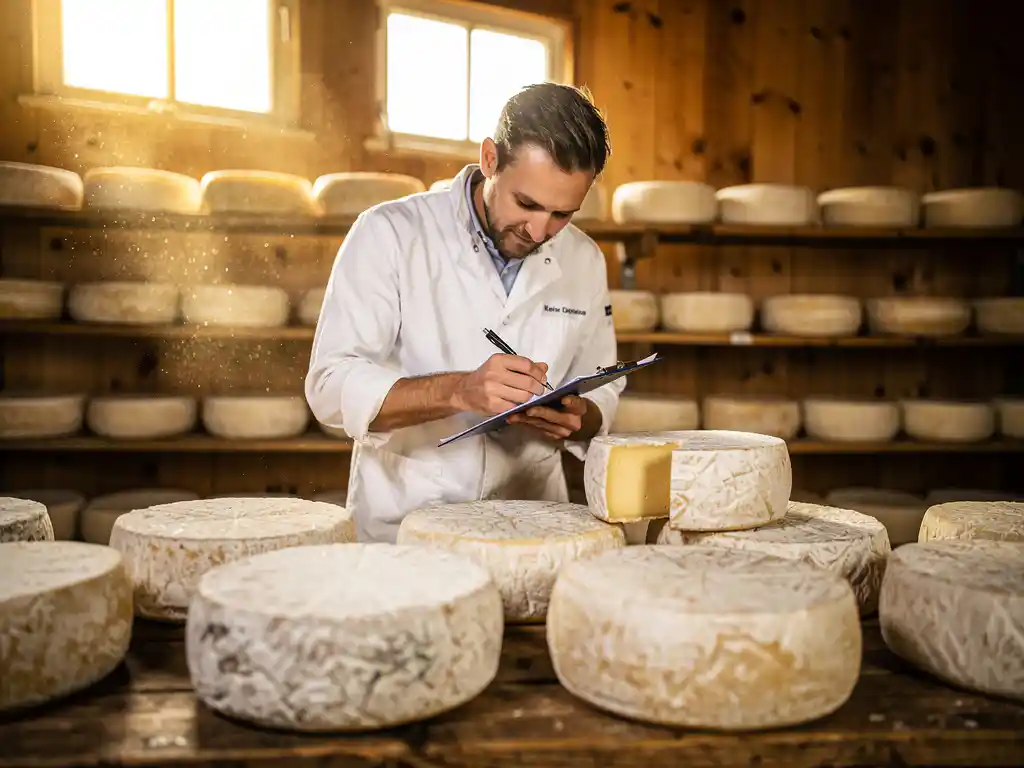
As a purchaser in the food industry, you face an important task when evaluating a product catalog from a goat cheese producer. A thorough evaluation of this catalog can make the difference between a reliable supply partner and costly production disruptions. For companies looking to use goat cheese in pizzas, ready meals, or other industrial products, it is essential to work systematically when evaluating supplier information.
What should a professional product catalog from a goat cheese producer contain?
A professional product catalog must contain at minimum product specifications, shelf life data, packaging formats, certifications, technical properties such as melting behavior and fat content, and clear order codes. This information forms the basis for a business evaluation of the supplier.
For industrial purchasers, the following elements are particularly indispensable in a catalog:
- Exact product dimensions and weights per unit
- Packaging information including boxes per pallet
- Shelf life from delivery, both fresh and frozen
- Minimum order quantity (MOQ) per product
- Delivery times and availability
- Technical specifications such as dry matter content and pH value
- Application possibilities per product type
A catalog that presents this information clearly, for example with clear tables and product categories, shows professionalism. Also look for version numbers of the catalog, which indicates that the producer actively works on current information provision. Pictograms for special properties, such as a snowflake for freezing possibilities, make scanning the catalog more efficient.
How do you recognize quality indicators in a goat cheese catalog?
Quality indicators in a goat cheese catalog include IFS Food certification, EC accreditation, traceability information such as company numbers, animal welfare certifications such as DGZK, and specific quality systems for milk suppliers. These elements point to structured quality assurance.
When evaluating quality, you must look beyond just the certificates. Look for:
- Oval labels with EC numbers on products (for example NL Z1977 EU)
- Mention of control authorities such as COKZ
- Chain certifications such as Kwaligeit for milk suppliers
- Additional certifications such as Halal, Kosher, GMP+ or VLOG
- Information about the origin of milk and transport distances
- Sustainability certifications and ESG policy according to EU Taxonomy
A producer who is transparent about all these aspects and actively invests in multiple quality systems shows commitment to consistent product quality. Pay special attention to the combination of legally required certifications and voluntary quality systems, which indicates a proactive attitude towards quality assurance.
Which technical specifications are important for industrial applications?
For industrial applications, melting behavior, fat content, dry matter percentage, freeze stability, pH value, and functional properties such as stirability and pumpability are crucial. These specifications determine whether a goat cheese is suitable for heating, mixing, or other processing processes in the production line.
Specifically for different applications, the following technical properties are important:
For pizza applications:
- Melting characteristics and browning possibilities
- Availability of high-melt variants for specific applications
- Different shapes such as crumbles (13g), pearls (78g), or slices (17g)
- Possibility to freeze without quality loss
For ready meals and fillings:
- Stability during heating and cooling
- Adaptability of dry matter content (35-45%)
- Possibility for Modified Atmosphere Packaging (MAP)
- Addition of preservatives without flavor impact
A good catalog explicitly mentions which products are suitable for specific industrial processes. Look for terms like “freeze stable,” “stirrable,” “pumpable,” or “suitable for heating.” These functional properties are essential for smooth integration into your production process.
What are the differences between fresh and aged goat cheese specialties for industrial use?
Fresh goat cheese has a soft, creamy texture with a mild flavor and a shelf life of 4-23 weeks, while aged goat cheese develops a firmer structure with a more complex flavor and a shorter shelf life of 7-10 weeks. For industrial processing, fresh cheese offers more processing flexibility.
The main differences for industrial applications are:
Fresh goat cheese characteristics:
- Neutral flavor base, ideal for flavor additions
- Longer shelf life (up to 23 weeks for some formats)
- Better freeze stability without texture loss
- Suitable for spreads, fillings, and toppings
- Available as curd for maximum processing flexibility
Aged goat cheese characteristics:
- Developed flavor profile from mild to spicy
- Shorter shelf life (7-10 weeks)
- Limited freezing possibilities
- Suitable for premium applications where flavor is central
- Requires more careful handling during processing
For large-scale industrial processing, fresh goat cheese is often more practical due to the longer shelf life and greater processing possibilities. Aged variants are interesting for niche segments or premium products where the characteristic flavor offers added value.
How do you evaluate delivery reliability from a product catalog?
Delivery reliability is evident from clear MOQ mentions, realistic delivery times per product, availability of stock products versus production on request, and flexibility in packaging formats. A catalog that transparently mentions this information indicates a reliable supplier.
Concrete indicators for delivery reliability in a catalog:
- Specific MOQ per product (for example “MOQ 300” or “full pallet”)
- Differentiated delivery times (standard 3 weeks, specials 4 weeks)
- Clear pallet configurations (block pallet vs EU pallet)
- Mention of test phase products with contact person
- Flexibility with combined orders
- Availability in multiple packaging sizes (5kg, 10kg, 15kg)
Also pay attention to subtle signals such as the mention that products are “currently in test phase,” with the instruction to contact the account manager. This shows transparency about availability. A producer who explicitly mentions that hard cheeses can be individually added to pallet orders understands the practical needs of industrial customers.
The presence of both fresh and frozen options for the same products indicates flexibility in the supply chain. A shelf life of 2 years for frozen products provides security for long-term planning and inventory management.
How DeJong Cheese helps with evaluating goat cheese products for your industry
As a traditional family business since 1995, we at DeJong Cheese understand the complexity of industrial purchasing. Our extensive product catalog is specifically developed to provide purchasers like you with all the information needed for a well-informed decision.
What makes our catalog valuable for industrial purchasers:
- Complete technical specifications for all 50+ product variants
- Clear MOQs and flexible packaging options from 5kg to 15kg
- Transparent information about shelf life fresh and frozen
- IFS Food certification and complete traceability
- Dedicated industrial product lines for pizzas and ready meals
- Personal account managers for test products and customization
Our Alphenaer goat cheese specialties are delivered worldwide to retail, foodservice, and industry. With 100% DGZK-certified milk suppliers and an active sustainability policy, we guarantee consistent quality and reliable delivery.
Request our complete product catalog V2026-3-1 today and discover how our traditional goat cheese products perfectly align with your industrial needs. Contact our team for a personal consultation, visit our foodservice page for more product information, or find one of our sales points near you. Visit our homepage for the complete overview of all our possibilities.
Veelgestelde vragen
How can I as a purchaser best request samples to test the quality of goat cheese?
Start by requesting small test samples of 2-3 product variants that best align with your application. Ask specifically for functional tests such as melting tests or freeze tests if relevant. Discuss with the account manager the possibility for a pilot run with smaller quantities before moving to large orders, and ask for technical support during the test phase.
What are the main cost factors when purchasing industrial goat cheese?
Besides the product price, transport costs, packaging efficiency, shelf life, and processing yield are important cost factors. Choose products with longer shelf life to minimize waste, consider frozen variants for lower transport frequency, and calculate the total cost including handling and storage. Also pay attention to the yield after processing – some goat cheeses lose more moisture during heating than others.
How do I prevent quality problems when processing goat cheese in my production line?
Ensure strict temperature control during transport and storage (2-7°C for fresh cheese), plan processing within the optimal use period, and ask the supplier for specific processing guidelines per product type. Train your personnel in proper handling of goat cheese, especially when thawing frozen products, and implement first-in-first-out procedures for inventory rotation.
What alternatives are there if my desired goat cheese product is not in stock?
Ask your supplier for functionally comparable alternatives with the same technical properties, consider switching between fresh and frozen variants for better availability, or discuss the possibility of long-term contracts for guaranteed delivery. Many producers can also deliver customization with sufficient volume, where you can have specific properties adapted to your production process.
How do I integrate sustainability requirements into my goat cheese purchasing?
Ask for ESG reports and sustainability certifications such as DGZK for animal welfare, evaluate transport distances between milk suppliers and producer, and inquire about packaging optimization and recyclable materials. Consider suppliers who invest in CO2 reduction and local milk purchasing, and ask for concrete sustainability goals and progress reports for long-term partnerships.
What should I do if the technical specifications in the catalog are not complete for my application?
Contact the technical department of the supplier directly with your specific questions about for example emulsifiability, syneresis, or interaction with other ingredients. Ask for additional technical data sheets, laboratory analyses, or application tests. Many producers have extensive technical knowledge that is not fully in the catalog and can provide customized advice for your specific production process.
Gerelateerde artikelen
- Wat zegt bedrijfsgrootte van een producent over leverzekerheid op lange termijn?
- Welke certificeringen versterken de geloofwaardigheid van een premium geitenkaasconcept?
- Hoe bewaak je de leveranciersprestaties van een producent van industriële geitenkaas?
- Hoe lang zijn geitenkaas crumbles houdbaar voor industriële verwerking?
- Wat betekent EC-accreditatie voor een producent van industriële geitenkaas?