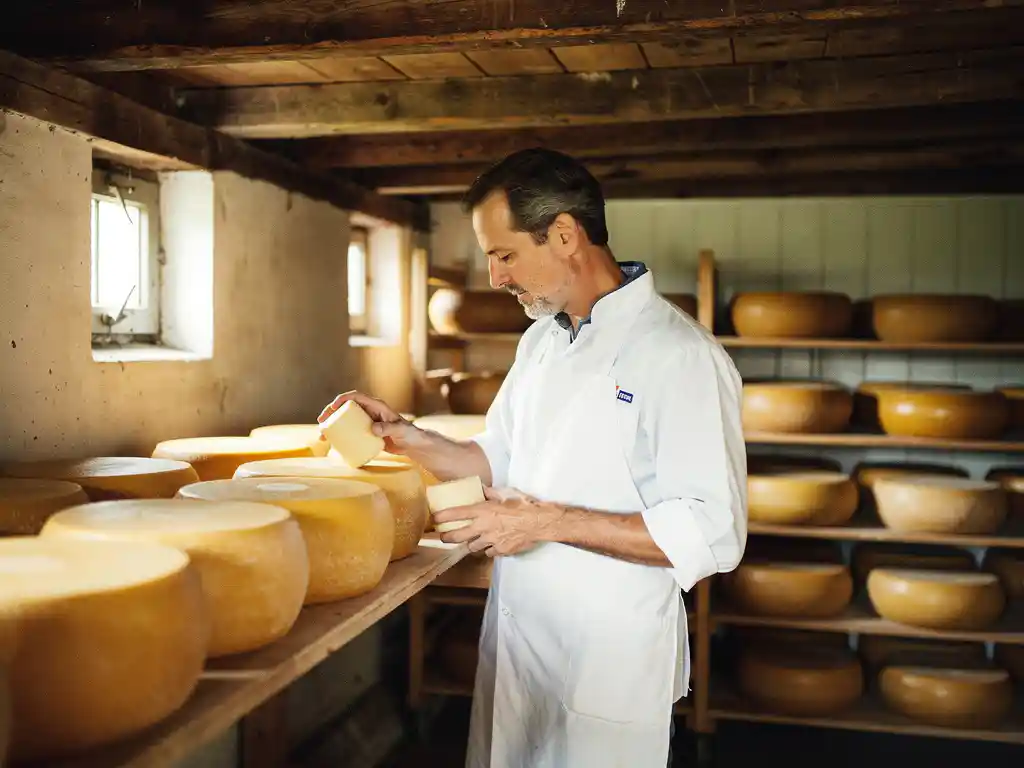
When selecting a supplier for high-melt goat cheese for industrial applications, delivery capacity is a crucial factor. Whether you’re producing pizzas, ready meals, or other heated products, the reliability and volume of your cheese supplier partly determines the success of your production line. In this article, we discuss the key questions you should ask to determine whether a goat cheese producer can meet your industrial needs.
What is high-melt goat cheese and why is delivery capacity important?
High-melt goat cheese is a special type of goat cheese that retains its structure when heated and doesn’t completely melt like regular cheese. This cheese has a higher melting point due to specific production techniques and protein structures, making it ideal for hot applications such as pizzas, gratins, and industrial meals.
Delivery capacity is crucial because industrial food producers work with fixed production schedules and large volumes. An interruption in cheese delivery can lead to complete production line shutdowns, missed deadlines, and lost revenue. Moreover, many industrial processes require consistent quality and specifications – variations in fat content, moisture content, or melting behavior can negatively affect the end product.
For companies in the food industry, a reliable supplier of high-melt goat cheese means the difference between smoothly running operations and costly disruptions. This makes it essential to thoroughly inquire about their capacity, flexibility, and track record when selecting a producer.
What production volumes can a goat cheese producer typically deliver?
An established goat cheese producer can typically deliver between 500 kilograms and 5,000 kilograms of fresh goat cheese per week, depending on their production facilities and milk supply. For specialized high-melt variants, these volumes are often lower due to specific production processes.
The actual capacity depends on various factors. First, the size of the production facility plays a role – artisanal producers often work with smaller batches of 100-500 kg per day, while larger industrial players can produce several tons daily. Second, the availability of goat milk is a limiting factor, especially in seasons when goats produce less milk.
For industrial customers, it’s important to ask about:
- Maximum weekly production in peak season
- Minimum guaranteed capacity in low season
- Possibilities for scaling up with growing demand
- Buffer inventory for peak periods
A professional producer can provide these figures directly and often has contractual agreements with milk suppliers to ensure continuity.
How do you check if a producer can deliver reliably?
You check reliability by verifying certifications, requesting references from existing industrial customers, and visiting production facilities. Ask specifically about their on-time delivery percentage, complaint history, and how they handle emergencies or supply chain disruptions.
Start by requesting quality certifications such as IFS Food, BRC, or FSSC 22000. These certifications demonstrate that the producer works according to international standards for food safety and process control. Also ask about the DGZK quality mark for goat cheese, which provides specific quality guarantees.
Specific questions you should ask are:
- What is the percentage of on-time-in-full deliveries over the past 12 months?
- How many industrial customers do they currently serve?
- What backup plans exist in case of production or transport failure?
- How is communication handled for possible delays?
- Are there long-term contracts with milk suppliers?
A visit to the production facility provides insight into the professionalism of the operation. Pay attention to hygiene protocols, organization of the production process, and the presence of modern equipment. A transparent producer will gladly give tours and offer openness about their processes.
What are the minimum order quantities for industrial purchase?
Minimum order quantities for industrial goat cheese typically vary between 200 and 500 kilograms per delivery, depending on the product type and packaging format. For specialized high-melt variants, MOQs may be higher due to specific production processes and shelf life.
The MOQ is determined by various factors. Production efficiency plays a major role – starting up a production line for small quantities is not economically viable. Packaging formats also influence minimum purchase: bulk packaging of 5 or 10 kilograms has lower MOQs than pre-packaged portions.
Typical MOQ structures in the industry:
- Fresh goat cheese in bulk (5-10 kg): 200-300 kg per order
- Pre-portioned products: 400-600 kg per order
- Special flavor variants: 300-500 kg per order
- Private label products: often 1000+ kg per order
For new customers, producers are sometimes willing to accept lower volumes for test orders, but structural deliveries require respecting the MOQ. Also ask about volume discounts – significant price advantages may apply when purchasing above certain thresholds.
What are realistic delivery times for large volumes of goat cheese?
Realistic delivery times for large volumes of industrial goat cheese range between 5 and 15 working days from order confirmation, depending on inventory levels and production planning. For specific high-melt variants or private label products, delivery times can extend to 3-4 weeks due to customized production processes.
Delivery time is influenced by multiple factors. Standard products kept in stock can often be delivered within a week. For products made to order, production time, aging time (if applicable), and logistics planning must be considered.
Important aspects of delivery times:
- Standard fresh goat cheese: 5-7 working days
- Aged variants: 10-15 working days (depending on aging degree)
- First orders: often 2-3 weeks due to administrative processes
- Seasonal influences: longer delivery times in spring due to milk scarcity
- Rush deliveries: possible at extra cost within 48-72 hours
A professional producer communicates transparently about delivery times and offers real-time updates on order status. Ask about their track-and-trace system and the ability to schedule deliveries according to your production schedule.
How does a producer guarantee consistent quality at large volumes?
Consistent quality is guaranteed through standardized production processes, continuous quality controls, and strict specifications for raw materials. Professional producers work with HACCP systems, laboratory testing per batch, and document all critical control points to ensure uniformity.
The quality assurance system begins with milk reception. Each delivery is tested for microbiological parameters, fat content, and protein composition. During production, automated systems monitor temperature, pH values, and humidity. For high-melt goat cheese, protein structure and calcium content are particularly critical for consistent melting behavior.
Essential quality guarantees include:
- Certificate of analysis with each delivery
- Traceability to individual milk deliveries
- Microbiological testing according to legal standards
- Organoleptic controls by trained panels
- Retention samples from each production for at least 6 months
- Specification sheets with tight tolerances for fat, moisture, and salt content
Ask specifically about their quality manual and the frequency of external audits. A reliable producer gladly shares their test results over multiple months to demonstrate consistency. For industrial processing, it’s crucial that each batch has identical properties – variations in melting behavior or texture can disrupt production processes and affect end product quality.
How De Jong Cheese helps with delivery security for industrial goat cheese
As a traditional family business since 1995, we at De Jong Cheese understand the crucial role of reliable deliveries for industrial food producers. Our years of experience in supplying retail, foodservice, and industry worldwide has taught us what is truly important for professional customers like you.
Our approach to delivery security includes:
- Fixed contracts with local goat milk suppliers for guaranteed raw material supply
- Modern production facilities in Alphen with ample capacity for industrial volumes
- IFS Food certification and DGZK quality mark as proof of our quality processes
- Flexible packaging options from bulk to pre-portioned
- Dedicated account management for industrial customers
- Private label possibilities according to your specifications
We deliver fresh goat cheese, aged variants, and special high-melt formulations for pizza applications. With shelf life up to 28 weeks for certain products and minimum order quantities from 266 pieces, we offer the flexibility that modern food producers need.
Want to know more about our industrial delivery possibilities and how we can support your production? View our complete foodservice assortment or directly contact us for a personal conversation about your specific needs. Also discover our sales points or visit our homepage for more information about our family business.
Veelgestelde vragen
How can I test if high-melt goat cheese is suitable for my specific production process?
Most professional producers offer test samples of 5-10 kg to evaluate in your production line. Ask for technical support during the testing phase – a good supplier will send a specialist to determine optimal processing temperatures and times. Test at least three production runs to assess consistency and document melting behavior, texture, and taste under your specific conditions.
What are typical shelf life guarantees for industrial high-melt goat cheese?
Fresh high-melt goat cheese typically has a shelf life of 4-8 weeks under refrigerated conditions (2-6°C). Vacuum-packed variants can be shelf-stable for up to 12 weeks, while specially treated products can even reach 20-28 weeks. Always ask about remaining shelf life at delivery – professional producers guarantee at least 75% of total shelf life at delivery for optimal processing time.
Which packaging options are most cost-effective for large-scale processing?
Bulk packaging of 10-15 kg in food-grade plastic containers is most cost-effective for industrial processing, with savings up to 15% compared to smaller packaging. For automated production lines, pre-portioned blocks of 2.5 kg in flow pack are ideal. Also consider IBC containers (200-500 kg) for very large volumes – these reduce handling time by 60% and minimize packaging waste.
How do I prevent quality loss when storing large volumes of goat cheese?
Implement a first-in-first-out system and store goat cheese at constant temperature between 2-4°C with 80-85% humidity. Avoid temperature fluctuations by not placing cheese directly near cooling doors. For volumes above 500 kg, invest in temperature loggers and alarms. Check weekly for condensation in packaging and rotate inventory at least twice per week for optimal quality retention.
What are the main differences between regular and high-melt goat cheese for industrial applications?
High-melt goat cheese contains 20-30% less moisture and has an adapted protein structure through specific starter cultures and calcium addition. This results in 40% less moisture loss during heating and shape retention at temperatures up to 180°C. Regular goat cheese melts at 65°C and loses structure, while high-melt variants maintain their texture. For pizza toppings, this means no pooling and better browning properties.
What technical support can I expect when implementing goat cheese in new products?
Professional suppliers offer application specialists who help with recipe development, process optimization, and troubleshooting. Expect support in determining optimal dosage (usually 8-15% for flavor impact), processing parameters, and shelf-life testing. Many producers have test kitchens where you can develop new products together and offer training for your production team on handling and processing goat cheese.
Gerelateerde artikelen
- Wat zijn de mogelijkheden van lokale sourcing als unique selling point?
- Wat zijn de kosten van een leverancierswissel bij industriële geitenkaas wrongel?
- Wat zijn de voordelen van een kaasproducent die 70% windenergie gebruikt?
- Wat zijn de trends in geitenkaasgebruik op pizza's in de Europese voedingsindustrie?
- Welke vragen stel je een producent van wrongel bij een eerste kennismaking?