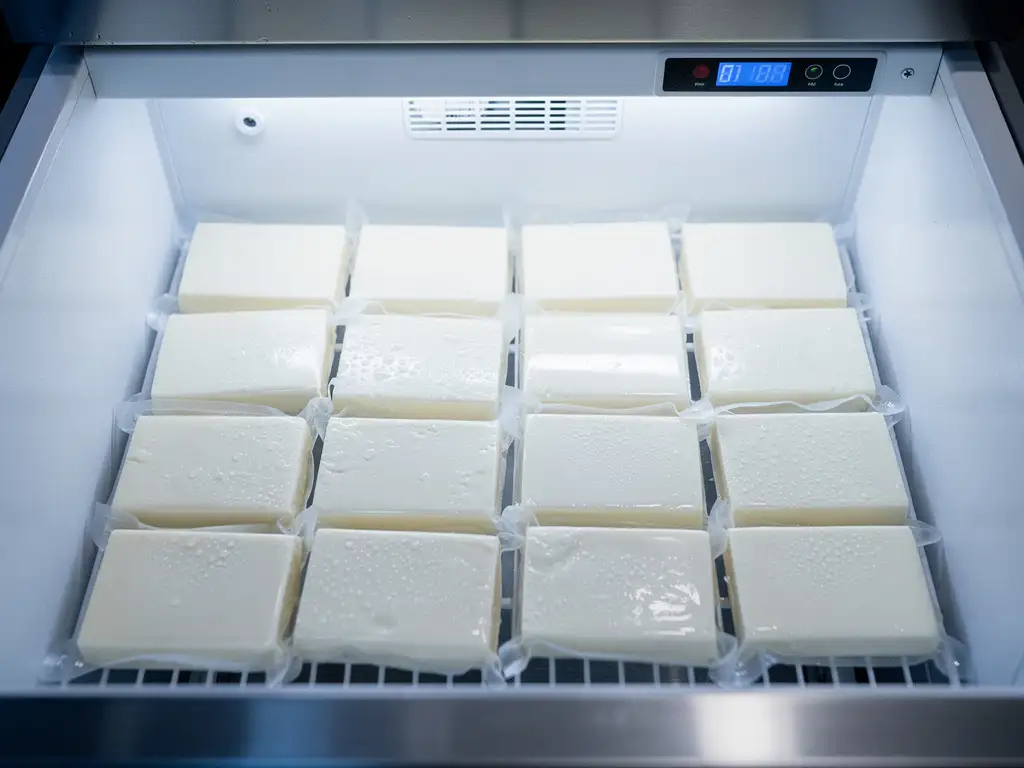
Freezing goat cheese curd is an essential practice in the modern cheese industry that provides flexibility in production and delivery. For businesses in the food industry, freezing curd offers the opportunity to handle seasonal fluctuations and guarantee consistent quality. At DeJong Cheese, we have built expertise since 1995 in optimally storing goat cheese products, where proper storage conditions make the difference between a premium end product and quality loss.
What is goat cheese curd and why is it frozen?
Goat cheese curd is the coagulated milk mass that forms after adding starter culture and rennet to goat milk, before it is further processed into cheese. Freezing curd is done to regulate seasonal production, extend shelf life, and create flexibility in processing planning for industrial applications.
The curd forms the basis for all fresh goat cheese products. After coagulating the milk, a soft, granular mass is created that still needs to be pressed, salted, or further processed. This semi-solid substance contains all proteins and fats from the milk but does not yet have the final structure of the finished cheese.
Freezing curd offers various advantages for the food industry. First, producers can benefit from seasonal peaks in milk production by freezing excess curd for later use. Second, it ensures a constant raw material supply throughout the year, independent of natural production fluctuations. For companies that process goat cheese in ready meals, pizzas, or other products, this means a reliable supply without quality variations.
What are the ideal freezing temperatures for goat cheese curd?
The ideal freezing temperature for goat cheese curd is between -18°C and -24°C, with a constant temperature of -20°C being optimal for long-term storage. This temperature prevents enzymatic activity and bacterial growth while preserving the structure of the curd.
Achieving and maintaining the right temperature begins with the freezing process itself. Quick freezing is crucial to prevent the formation of large ice crystals that can damage the delicate curd structure. Professional freezing installations use blast freezers that bring the curd to core temperature within 2-4 hours.
Temperature fluctuations are the greatest enemy of frozen curd. Every fluctuation can lead to recrystallization, where small ice crystals merge into larger crystals that break through the protein structure. This results in moisture loss and texture change after thawing. Modern freezer storage systems therefore use dual cooling systems and emergency power supplies to guarantee constant temperatures.
For small-scale storage in standard freezers, it is important to place the curd in the coldest part of the freezer, usually at the back and not in the door. A separate freezer specifically for curd storage, without frequent opening and closing, significantly increases quality preservation.
How long can you store frozen goat cheese curd?
Frozen goat cheese curd can be stored at a constant temperature of -20°C for up to 12 months without significant quality loss. After 6 months, regular quality control is recommended, with functional properties potentially declining after 12 months despite the product remaining food safe.
The exact shelf life depends on various factors. The initial quality of the curd plays a crucial role: curd made from fresh, high-quality goat milk with a low bacterial count has a longer potential shelf life. Fat content also affects storage time, with curd having higher fat content being more sensitive to oxidation during long-term storage.
For optimal traceability, a detailed registration system is essential. Each batch of curd must be labeled with production date, freezing date, milk origin, and any quality parameters such as pH value and fat content. This first-in-first-out system prevents curd from being stored too long and helps in production planning.
After 6 months of storage, subtle changes can occur in the curd. While still microbiologically safe, enzymatic processes can lead to slight flavor changes or texture differences. For applications where the curd is processed in composite products, these changes are usually acceptable, but for premium fresh goat cheese, it is recommended to use curd within 6 months.
Which packaging methods best protect curd against freezer burn?
Vacuum packaging combined with moisture-resistant barrier film offers the best protection against freezer burn for goat cheese curd. This method completely removes air and prevents moisture loss, with double-layer packaging providing extra security for long-term storage.
The choice of packaging material is crucial for preventing freezer burn. High-quality EVOH (ethylene vinyl alcohol) or PA/PE (polyamide/polyethylene) multilayer films provide excellent oxygen and moisture barriers. These materials prevent moisture from the curd from sublimating to the environment, which is the main cause of freezer burn.
For large-scale industrial storage, curd is often packaged in blocks of 10-20 kilograms. These are first placed in food-grade plastic bags, vacuum-sealed, and then packaged in a second protective layer. The double packaging provides redundancy: should the outer layer be damaged during transport or handling, the inner barrier remains intact.
Modified Atmosphere Packaging (MAP) forms an alternative to vacuum packaging, especially when the curd structure is fragile. With MAP, air is replaced with a protective gas mixture, usually nitrogen, which prevents oxidation without the pressure of vacuum pulling. This method is especially suitable for curd with higher moisture content that is sensitive to compression.
Portion packaging deserves special attention for companies that process curd in smaller quantities. Dividing into portions of 1-5 kilograms prevents repeated freezing and thawing of large blocks. Each portion must be individually airtight packaged, where it is important to leave as little air as possible in the packaging.
How do you thaw goat cheese curd without quality loss?
Goat cheese curd is best thawed slowly in refrigeration at 2-4°C for 24-48 hours, depending on block size. This gradual temperature rise prevents moisture separation and maintains the original texture and processing properties of the curd.
The thawing process requires planning and patience. For a 10-kilogram block, a minimum of 36 hours is needed for complete thawing in the center. Smaller portions of 1-2 kilograms can thaw within 12-24 hours. It is essential to leave the curd in the original packaging during thawing to prevent moisture loss and contamination.
Temperature monitoring during thawing ensures product quality. The core temperature must not exceed 8°C to prevent bacterial growth. Using data logging thermometers helps document the thawing process, which is especially important for HACCP compliance in industrial environments.
Accelerated thawing at room temperature or in warm water must be avoided at all times. These methods lead to uneven temperature distribution where the outside becomes too warm while the center is still frozen. This creates ideal conditions for bacterial growth and results in irreparable texture damage.
After thawing, the curd must be processed immediately. Thawed curd has a limited shelf life of maximum 5 days at 2-4°C. Refreezing thawed curd is strongly discouraged due to cumulative damage to the protein structure and increased risk of quality loss.
What are the key quality controls for storing frozen curd?
The key quality controls for frozen curd include temperature monitoring, visual inspection for freezer burn, pH measurement after thawing, and texture analysis. These controls should be performed monthly with extra attention to microbiological parameters during longer storage periods.
Temperature registration forms the basis of quality assurance. Continuous monitoring with calibrated sensors and alarm systems warns of deviations. Logbooks must be kept for at least two years for traceability. With temperature fluctuations greater than 2°C, the relevant batch must be additionally checked.
Sensory evaluation after thawing provides immediate insight into product quality. Check for abnormal odors, discoloration, or texture changes. Healthy curd has a fresh, slightly acidic odor and a uniform white to light yellow color. Gray discoloration or rancid odors indicate oxidation or quality loss.
Functional tests determine the processability of the curd:
- Moisture content: may deviate maximum 2% from the original value
- pH value: must remain within 0.2 units of the starting value
- Melting behavior: essential for applications in hot dishes
- Emulsifying behavior: important for spreads and creamy products
Microbiological monitoring becomes more critical as storage duration increases. Standard tests include total plate count, yeasts and molds, and pathogens such as Listeria monocytogenes. Although growth at -20°C is minimal, damaged packaging or temperature fluctuations can create risks.
How DeJong Cheese helps with optimal storage of goat cheese curd
At DeJong Cheese, we combine 30 years of experience with modern technology to deliver the highest quality frozen goat cheese curd. Our expertise in traditional cheese production, combined with advanced freezing technology, guarantees consistent quality for industrial processors.
Our support for customers includes:
- Customized technical specifications: We provide detailed product information including optimal thawing and processing protocols
- Flexible packaging options: From bulk packaging to portion divisions, adapted to your production line
- Quality guarantee: IFS Food-certified processes with complete traceability
- Personal guidance: Our team is ready with practical advice for your specific applications
Our curd is produced according to traditional recipes with milk from local goat farms within 100 kilometers. This guarantees not only freshness but also a low CO2 footprint. With our 100% DGZK-certified milk suppliers, you are assured of the highest standards in animal welfare and sustainability.
Are you looking for a reliable partner for high-quality goat cheese curd? Contact us for a personal conversation about your specific needs. Visit our foodservice page for more information about our complete range, or see where you can find our products on our sales points page. Discover on our website how we have been setting the standard in goat cheese specialties since 1995.
Veelgestelde vragen
Can I refreeze thawed goat cheese curd if I have thawed too much?
No, refreezing thawed curd is strongly discouraged. This causes irreversible damage to the protein structure, results in moisture loss and texture change, and increases the risk of bacterial growth. Therefore, carefully plan how much curd you need and only thaw what you will process immediately.
How do I recognize if my frozen curd is still of good quality after longer storage?
First check visually for signs of freezer burn such as dry, discolored spots or ice crystal formation in the packaging. After thawing, the curd should have a fresh, slightly acidic odor without rancid notes, show a uniform white to light yellow color, and maintain a cohesive texture without excessive moisture separation. When in doubt, you can heat a small amount to test the melting behavior.
What investments are needed for freezing curd myself in my business?
For professional freezing you need at minimum a blast freezer (investment from €15,000), constant freezer storage at -20°C with emergency power supply, and vacuum or MAP packaging equipment (from €5,000). Additionally, temperature monitoring systems, calibrated thermometers and adequate packaging materials are essential. For smaller volumes, you might consider working with a specialized supplier like DeJong Cheese.
What is the difference in quality between fresh and thawed curd for end products?
With correct freezing and thawing, the differences are minimal for most applications. Thawed curd may have a slightly looser structure with 1-2% more moisture loss, but fully retains its functional properties such as melting behavior and taste. For processed products like pizzas, sauces or spreads, the difference is negligible, while for premium artisanal cheeses, fresh curd is sometimes preferred due to optimal texture.
How do I prevent condensation formation during thawing that can spoil the curd?
Always let the curd thaw in the original, closed packaging to prevent direct contact with condensation. Place the packaged curd on a rack or perforated tray so any condensation water can drain away without contact with the product. Ensure adequate air circulation in the cooling space and avoid stacking thawing products to ensure even temperature distribution.
Can seasonal differences in goat milk affect the freezability of curd?
Yes, seasonal variations in milk composition affect the freeze stability of curd. Winter milk often has higher fat and protein content which gives better freezing properties, while summer milk with more unsaturated fatty acids can be more sensitive to oxidation. Adjust your storage protocols by possibly storing winter curd longer (up to 12 months) and processing summer curd within 6-9 months for optimal quality.
Gerelateerde artikelen
- Wat zijn de mogelijkheden van private label geitenkaasconcepten voor retailpartners?
- Hoe werk je samen met een geitenkaasproducent aan de ontwikkeling van nieuwe pizza-ingrediënten?
- Wat zijn de MOQ-vereisten voor geitenkaas pizza-assortiment in de voedingsindustrie?
- Hoe werkt COKZ-controle bij een Nederlandse geitenkaasproducent?
- Bevat geitenkaas probiotica?