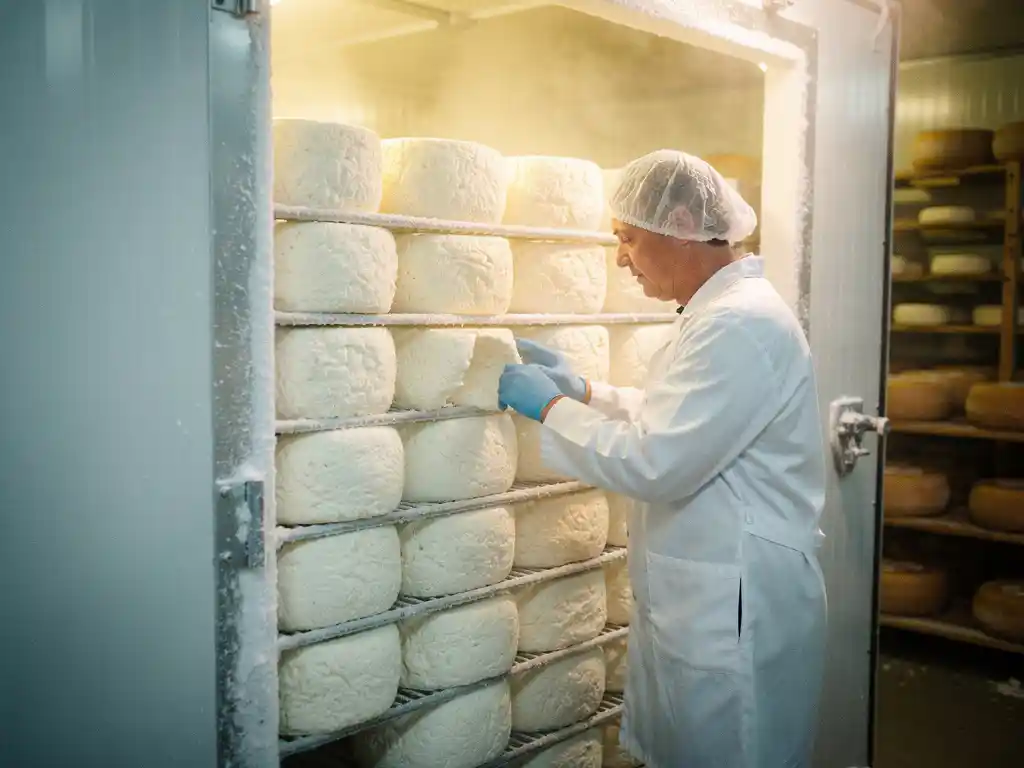
In the food industry, buyers are constantly looking for ways to save costs without compromising on quality. For producers of pizzas, ready meals and other food products where cheese plays an important role, frozen curd offers an interesting solution. This semi-finished product can deliver significant financial benefits, especially with large-scale purchasing. In this article, we answer the key questions that buyers have about the financial impact of this raw material on their production processes.
What is frozen curd and why is it relevant for large-scale buyers?
Frozen curd is the coagulated milk mass that forms after adding rennet to milk, before it is further processed into cheese. This semi-finished product is frozen immediately after production and can later be thawed for further processing in industrial applications such as pizzas, sauces and ready meals.
For large-scale buyers in the food industry, curd offers several advantages. First, it gives producers more control over the final product, as they can determine how the curd is further processed. This makes it possible to create specific textures and melting behaviors that perfectly align with their production processes. Additionally, curd is often cheaper than fully finished cheese, because fewer processing steps are required at the supplier.
The relevance for large-scale buyers lies mainly in flexibility and cost efficiency. Curd can be adapted to specific production lines and recipes, which is especially important for companies that process large volumes. Moreover, the longer shelf life in frozen state provides more flexibility in production planning and inventory management.
How much does frozen curd cost compared to ready-made cheese?
Frozen curd costs on average 20 to 35 percent less than comparable ready-made cheese products. This cost saving stems from the fact that curd is a less processed product, where steps such as aging, packaging and specific shaping are omitted.
The exact price differences depend on various factors. The type of milk plays an important role: goat curd is for example more expensive than cow curd due to higher raw material costs. The fat content and specifications of the curd also influence the price. With larger purchase volumes, the savings can increase further through volume discounts that suppliers often offer.
Besides the direct purchase price, processing costs in your own production line must also be considered. Although curd is cheaper to purchase, it does require additional processing steps in your own factory. For most large-scale producers, however, the savings far outweigh these additional processing costs, especially when the production line is already set up for processing curd.
What storage advantages does frozen curd offer for production companies?
Frozen curd offers significant storage advantages because it remains fresh for up to 12 months at -18°C, while fresh cheese often only lasts a few weeks. This extended shelf life reduces waste and makes it possible to maintain larger inventories without quality loss.
The compact form of curd blocks ensures more efficient space usage in frozen storage. Curd can be stacked in standard freezer blocks, which allows up to 40 percent more product per cubic meter compared to packaged cheese products. This translates directly into lower storage costs per kilogram of product.
Another important advantage is flexibility in production planning. With frozen curd, production companies can better respond to seasonal fluctuations without worrying about shelf life. They can thaw curd when needed for production, which supports just-in-time manufacturing. Moreover, frozen storage eliminates many of the risks associated with fresh products, such as mold formation or unwanted aging during storage.
How does frozen curd affect the cash flow of food producers?
Frozen curd improves cash flow because producers can benefit from bulk purchases during price drops and the longer shelf life prevents working capital from being lost to spoilage. This gives companies more financial flexibility and reduces pressure on short-term financing.
The ability to purchase larger volumes when market prices are favorable creates significant savings. Food producers can strategically purchase during periods of milk surpluses, when curd prices are typically 15 to 25 percent lower. This inventory can then be used throughout the year, providing protection against price fluctuations.
Additionally, curd reduces the need for frequent deliveries, which saves transportation costs and lowers administrative burdens. Where fresh cheese products require weekly or even daily deliveries, curd deliveries can take place monthly or quarterly. This results in fewer invoices, simpler inventory management and lower transaction costs. The improved cost predictability also enables more accurate budgeting, which is especially valuable for companies with tight margins.
What are the quality guarantees for frozen curd for industrial processing?
Quality guarantees for frozen curd include standardized specifications for fat content, moisture content, pH value and microbiological parameters. Professional suppliers provide certificates of analysis with each delivery and guarantee consistent quality that meets pre-agreed industrial standards.
The key quality parameters are strictly controlled during the production process. The fat content is for example kept within a margin of maximum 2 percent, which is essential for consistent melting and processing properties. The moisture content is also precisely regulated, as this directly affects the texture and processability of the final product. Microbiological safety is guaranteed through rapid freezing immediately after production, where the core temperature is brought to -18°C within 4 hours.
Traceability is another crucial aspect of quality assurance. Each batch of curd receives a unique identification number with which the origin of the milk, production date and all relevant process parameters can be traced. This is not only important for quality control, but also essential for meeting food safety requirements and potential recalls. Suppliers with IFS Food or comparable certifications provide additional security through their audited quality management systems.
When is switching to frozen curd financially most advantageous?
Switching to frozen curd is financially most advantageous when a production company processes at least 5,000 kilograms of cheese per month and has adequate frozen storage capacity. At these volumes, the lower purchase costs amply compensate for investments in adapting production processes.
Various factors determine the optimal time for switching. Companies dealing with strong seasonal fluctuations in their sales benefit extra from curd, because they can decouple their purchasing from their production. Also when the current cheese supplier regularly implements price increases or has delivery problems, the business case for curd becomes stronger. The presence of free freezing capacity is crucial: if this is already available, the investment costs largely disappear.
The financial benefits are maximized when companies can standardize their production processes around curd processing. This means that multiple product lines can use the same curd base, which generates economies of scale. Companies that are willing to adapt their recipes and invest in staff training typically see a positive return on their switch to curd within 6 to 12 months.
How DeJong Cheese helps with curd solutions for industry
As a specialist in goat cheese products since 1995, we at DeJong Cheese also offer high-quality goat curd for industrial processing. Our curd is produced according to the same traditional methods as our renowned Alphenaer cheeses, but specifically tailored to the needs of large-scale food producers.
Our industrial curd solutions offer concrete advantages:
- Guaranteed consistent quality through our IFS Food certification
- Flexible delivery volumes from full pallet loads
- Technical support in optimizing your processing processes
- Possibility for private label and customer-specific curd formulations
- Direct delivery from our production location in Alphen, North Brabant
For buyers like Marco Visser, who are looking for reliable partners for their cheese needs, we offer not only products but also expertise. Our team understands the challenges of industrial food production and can think along about the best curd solution for your specific applications.
Are you curious about the possibilities of goat curd for your production process? Contact our team via our contact page for a non-binding consultation. Discover more about our complete range for foodservice and industry, or visit our homepage for general information about DeJong Cheese. For direct products you can also visit one of our sales points.
Veelgestelde vragen
What investments are needed to switch from ready-made cheese to curd processing?
The main investments involve adapting production equipment for processing frozen curd, such as thawing installations and possibly additional mixing or melting equipment. Additionally, training of production personnel is essential. The total investment varies between €50,000 and €200,000, depending on the current production line, but is usually recouped within 12-18 months through lower raw material costs.
How do I prevent quality loss when thawing large quantities of curd?
Controlled thawing is crucial for maintaining quality. Plan the thawing process 24-48 hours in advance in cold rooms at 2-4°C. Avoid rapid thawing methods that lead to uneven temperature distribution. Use the curd within 72 hours after thawing and implement a first-in-first-out system to guarantee freshness.
Can I combine different types of curd in one production run?
Yes, but pay attention to compatibility in melting behavior and flavor profile. For example, don’t mix goat and cow curd without testing first, as these have different fatty acid profiles. Start with small test batches and document the ratios carefully. Consider different pH values that can influence the texture of the final product.
What administrative adjustments are needed when switching to curd?
Adapt your HACCP plan with new critical control points for curd receipt, storage and thawing. Update recipe cards with exact processing steps and times. Arrange for new purchase codes in your ERP system and train buyers on specifications such as fat content and pH values. Also implement a tracking system for batch numbers due to the longer storage times.
How do I calculate the actual ROI of curd versus ready-made cheese?
Calculate not only the price difference per kilo, but also include: reduced transportation costs through less frequent deliveries, lower waste percentages due to longer shelf life, freed working capital through more efficient inventory rotation, and any energy costs for frozen storage. A realistic ROI calculation usually shows 15-25% total cost savings after the first year.
What are the biggest pitfalls when working with curd in industrial production?
The most common mistakes are: thawing too quickly causing moisture loss, insufficient mixing after thawing leading to texture differences, and not adjusting salt levels in recipes (curd contains less salt than aged cheese). Prevent these problems by developing standard operating procedures and regularly performing quality controls during the production process.
Gerelateerde artikelen
- Waarom is een houdbaarheid van 23 weken bij geitenkaas crumbles een voordeel voor inkopers?
- Wat is het verschil in houdbaarheid tussen verse en ingevroren geitenkaas spread?
- Hoe verschilt de houdbaarheid van geitenkaas per verpakkingsformaat in de industrie?
- Wat zijn de MOQ-vereisten voor geitenkaas pizza-assortiment in de voedingsindustrie?
- Hoe verkort je het zoekproces naar de juiste leverancier van high-melt geitenkaas?