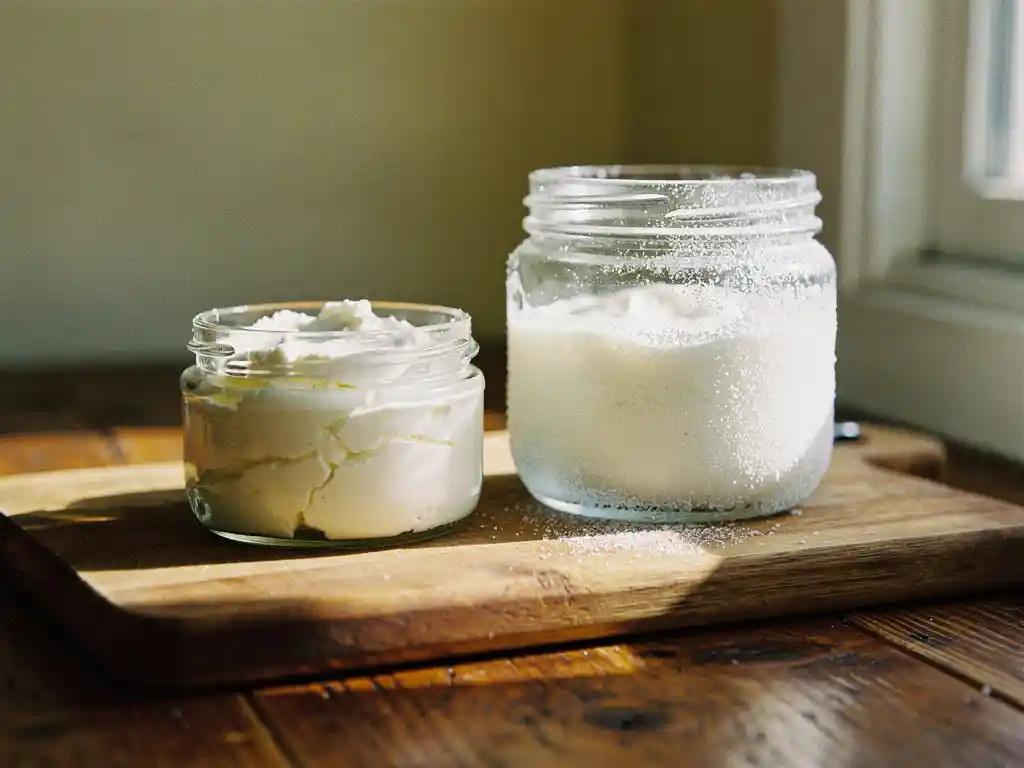
As a specialist in goat cheese products since 1995, we at DeJong Cheese understand how important proper storage is for optimal quality. Fresh and frozen goat cheese spread both have their place in professional kitchens and food production, but their shelf life differs significantly. In this article, we answer the most frequently asked questions about storing goat cheese spread, so you can make the best choice for your specific application.
What is the difference in shelf life between fresh and frozen goat cheese spread?
Fresh goat cheese spread has a shelf life of 4 weeks from delivery when stored at refrigerator temperature, while frozen goat cheese spread can be stored for up to 2 years at -18°C. This means that frozen spread lasts 26 times longer than the fresh variant, which is essential for inventory planning in industrial applications.
The difference in shelf life stems from how bacteria and enzymes develop at different temperatures. At refrigerator temperature (2-7°C), microbiological processes remain active, albeit slowed down. This means that fresh goat cheese spread must be consumed within a few weeks to maintain optimal flavor and texture. At freezing temperatures, these processes stop almost completely, allowing the spread to remain stable for months.
For industrial processors such as bakeries and ready-meal manufacturers, the longer shelf life of frozen spread offers important advantages. It reduces waste, simplifies inventory planning, and makes it possible to handle seasonal fluctuations in demand. Our industrial goat cheese curd is specially developed to be freeze-stable, without whey loss or quality loss after thawing.
How long does fresh goat cheese spread stay good after opening?
After opening, fresh goat cheese spread stays good for 5 to 7 days when properly stored in the refrigerator at 2-4°C. The packaging must be sealed airtight and the product must be protected against cross-contamination by using clean spoons or knives.
The shelf life after opening depends heavily on the hygienic conditions during use. Each time the packaging is opened, bacteria can enter the product. Therefore, it is important to use only clean kitchen utensils and not consume the spread directly from the packaging. For professional kitchens, we recommend dividing larger quantities into smaller portions, so that not the entire stock is exposed to air and possible contamination.
Watch for changes in smell, taste, or texture as indicators that the spread is no longer optimal. A slightly sour smell that becomes stronger or visible mold formation are signs that the product should no longer be used. When in doubt, it is always better to discard the product to ensure food safety.
What are the advantages and disadvantages of freezing goat cheese spread?
Freezing goat cheese spread offers as its main advantage an extended shelf life of up to 2 years, while the biggest disadvantage is a possible slight texture change after thawing. Professionally produced freeze-stable variants minimize this effect through special recipes and production techniques.
Advantages of freezing:
- Extended shelf life from 4 weeks to 2 years
- Ability to purchase large volumes at favorable prices
- Reduced waste through better inventory planning
- Flexibility in production and menu planning
- Preservation of nutritional value and flavor with proper freezing techniques
Disadvantages of freezing:
- Possible slight texture change after thawing
- Freezer space needed with constant temperature of -18°C
- Thawing time must be planned for use
- Once thawed, cannot be refrozen
- Energy costs for long-term frozen storage
Our industrial goat cheese curd is specifically developed to be freeze-stable. This variant retains its stirability and pumpability after thawing, which is essential for automated production processes in the food industry.
How do you best store goat cheese spread for optimal quality?
Store fresh goat cheese spread in the refrigerator at 2-4°C in the original packaging or an airtight sealed container. Place the product in the coldest part of the refrigerator, usually the bottom drawers, and avoid temperature fluctuations by not storing it in the door.
For optimal quality preservation, consistent temperature and protection from air are the most important factors. Modified Atmosphere Packaging (MAP), which we use for certain products, helps extend shelf life by replacing the air in the packaging with a protective gas mixture. After opening MAP packages, it is extra important to seal the product well.
Storage tips for professional users:
- Use the FIFO principle (First In, First Out) for inventory rotation
- Label opened packages with opening date
- Store different flavors separately to prevent cross-contamination of aromas
- Check refrigerator temperature daily with calibrated thermometers
- Keep a log of temperature measurements for HACCP compliance
For frozen goat cheese spread, a constant freezing temperature of -18°C or lower is crucial. Avoid repeatedly opening freezers and place new inventory behind older products to ensure proper rotation.
When is it better to use fresh goat cheese spread instead of frozen?
Fresh goat cheese spread is the best choice for direct consumption, delicate applications such as fine pastry, and when the authentic creamy texture is essential. Frozen variants are ideal for industrial processing, long-term storage, and applications where the product is further processed or heated.
In hospitality and retail where customers directly taste the product, fresh goat cheese spread offers the optimal flavor experience. The soft, creamy texture and delicate aroma come into their own best when the product has not been frozen. For applications such as bread spread, salads, or as part of a cheese platter, fresh is therefore always preferred.
For industrial applications such as fillings for pastries, pizzas, or ready meals, the difference between fresh and frozen often matters less. Here, factors such as availability, consistent delivery, and cost efficiency play a larger role. Our freeze-stable curd is specifically developed for these applications and retains its functionality completely after thawing.
The choice also depends on your production cycle and storage possibilities. Companies with limited refrigerated space but sufficient freezer space can benefit from the longer shelf life of frozen products. Companies with high turnover and frequent deliveries may better choose fresh products.
What quality controls are important when storing goat cheese spread?
Daily temperature control, visual inspection for mold or discoloration, and odor control are the three most important quality controls. Document all controls in a logbook for traceability and to comply with food safety requirements such as HACCP and IFS Food certification.
Essential control points:
- Temperature monitoring: Check refrigerator or freezer temperature at least twice daily with calibrated thermometers
- Visual inspection: Check for mold formation, abnormal discoloration, or moisture development in the packaging
- Odor control: A deviant, strongly sour, or ammonia-like smell indicates spoilage
- Texture control: Unwanted hardening, granulation, or softening may indicate quality loss
- Package integrity: Check for damage, air leaks, or bulging packages
For professional users in the food industry, systematic controls according to an established protocol are necessary. This includes not only product characteristics but also the entire cold chain from receipt to use. Our products are delivered with clear expiration dates and storage instructions to guarantee optimal quality.
Implement a clear system for marking opening dates and train all staff in recognizing quality indicators. When in doubt about quality, it is always better not to use the product, especially in professional settings where food safety is crucial for your reputation and business continuity.
How De Jong Cheese helps with optimal storage of goat cheese spread
At DeJong Cheese, we understand that consistent quality and reliable shelf life are essential for your business operations. That’s why we offer not only high-quality goat cheese spreads, but also complete support for optimal storage and use.
Our solutions for your storage challenges:
- Freeze-stable industrial curd with 2-year shelf life in frozen state
- Modified Atmosphere Packaging (MAP) for extended fresh shelf life
- Technical specifications and storage advice for each product
- Flexible packaging sizes from 120g to 15kg for different applications
- IFS Food certified production for guaranteed food safety
Whether you are looking for fresh goat cheese spread for direct consumption or freeze-stable variants for industrial processing, we deliver customized solutions according to your specifications. Our specialists are happy to advise on the best storage methods for your specific situation and help you optimize your inventory planning.
Contact our team via our contact page for personal advice on shelf life and storage. Visit our foodservice page for more information about our complete range and technical specifications. For direct purchase, you can visit our sales points or visit our homepage for the latest news about our products and services.
Veelgestelde vragen
Can I freeze fresh goat cheese spread myself at home or in my restaurant?
Yes, fresh goat cheese spread can be frozen, but the result is often less good than professionally frozen products. For optimal results: freeze in small portions, use airtight packaging, freeze as quickly as possible and use within 3 months. Keep in mind that the texture after thawing can become grainy, which is fine for hot applications but less suitable for bread spread.
How do I best thaw frozen goat cheese spread for use?
Always thaw frozen goat cheese spread slowly in the refrigerator for 24-48 hours, depending on the quantity. Avoid thawing at room temperature or in the microwave, as this can cause uneven thawing and bacterial growth. After thawing, stir well to mix any moisture loss back in. Use thawed spread within 5 days and never refreeze.
What are the costs of long-term frozen storage compared to frequent fresh deliveries?
Energy costs for frozen storage average $0.15-0.25 per kg per month, depending on your energy rate and freezer efficiency. Against this are savings from bulk purchasing (often 15-20% cheaper), reduced delivery costs and less waste. For companies with consumption of more than 50kg per month, frozen storage is usually more cost-effective. Ask our specialists for a calculation for your specific situation.
What HACCP documentation must I maintain for goat cheese spread in my business?
For HACCP compliance you must document at minimum: incoming goods control with temperature measurement, daily refrigerator/freezer temperature registrations, opening dates on products, periodic shelf life checks, and disposal of expired products. Use a standard form with date, time, temperature, and initials of the controller. Keep these documents for at least 1 year for inspection purposes.
How do I recognize quality loss in goat cheese spread before it is actually spoiled?
Early signs of quality loss are: a slightly bitter aftertaste, minimal texture change (slightly drier or wetter), reduced spreading on bread, and a vaguer goat flavor. These signals usually appear 2-3 days before actual spoilage occurs. For professional applications where top quality is crucial, do not use the product anymore at these first signs.
Are there seasonal differences in shelf life of goat cheese spread?
Yes, in summer the shelf life can be shorter due to higher ambient temperatures during transport and more frequent opening of refrigerators. In winter, milk quality is often better due to more stable feeding of the goats, which can result in 2-3 days extra shelf life. Adjust your inventory planning accordingly: order smaller quantities more frequently in summer and take advantage of bulk benefits in winter.
Gerelateerde artikelen
- Wat zijn de gevolgen van een mislukte audit bij een kaasleverancier?
- Hoe voorkom je budgetoverschrijdingen door onvoorspelbare grondstofprijzen?
- Wat is het verschil tussen een block pallet en een EU pallet bij de levering van kaasproducten?
- Hoe betrek je R&D bij de inkoop van nieuwe geitenkaassoorten voor pizzatoepassingen?
- Wat zijn de kwaliteitsnormen voor geitenkaas in de voedingsindustrie?