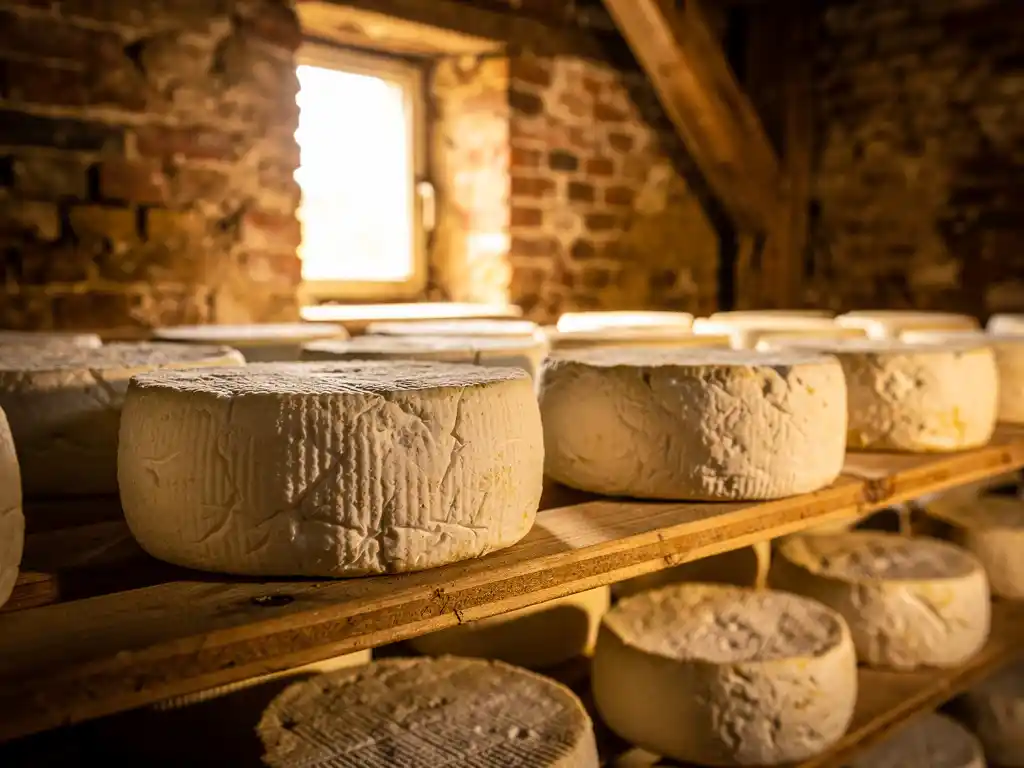
In the food industry, supply reliability is crucial for smooth production. For buyers like Marco Visser, who are responsible for purchasing goat cheese for industrial applications, evaluating suppliers based on measurable performance indicators is essential. A reliable goat cheese producer not only ensures consistent quality, but also predictable deliveries that don’t disrupt production processes. This article covers the key KPIs (Key Performance Indicators) you can use to objectively evaluate the supply reliability of a goat cheese producer.
What are the key KPIs for supply reliability in cheese production?
The key KPIs for supply reliability in cheese production are delivery reliability (percentage of orders delivered on time), order accuracy (correct quantity and specifications), lead time consistency, inventory turnover and response time for urgent orders. These metrics provide direct insight into your supplier’s operational performance.
For evaluating a goat cheese producer, these KPIs are particularly relevant, because fresh goat cheese has limited shelf life and often requires specific storage and transport conditions. A delivery reliability of at least 95% is industry standard, with top producers often achieving 98% or higher. Order accuracy must be at least 99%, given the impact of errors on production processes.
Lead time consistency measures variation in delivery times. For fresh goat cheese with a shelf life of 4 to 23 weeks, a maximum deviation of 24 hours is acceptable. Inventory turnover, expressed in days of stock, must be optimally aligned with the product’s shelf life. For aged goat cheese with 7 weeks shelf life, a turnover of maximum 14 days is ideal.
Response time for urgent orders is an often underestimated KPI. In the food industry, unexpected demand spikes or production problems can arise. A producer who can respond to urgent requests within 24 hours and deliver within 48-72 hours offers significant added value for industrial customers.
How do you measure consistency in goat cheese product quality?
You measure consistency in goat cheese product quality through systematic monitoring of physical parameters (fat content, moisture content, pH value), sensory properties (taste, texture, color) and microbiological values. Deviations of maximum 2% from specifications are industry standard for high-quality suppliers.
For industrial applications such as pizzas or ready meals, technical specifications are crucial. Fat content must remain consistent within a margin of ±1% for optimal melting behavior. Moisture content determines processability and shelf life, with a deviation of maximum ±1.5% being acceptable. pH value affects both taste and preservation and may deviate maximum ±0.1 from specification.
Sensory consistency is measured via standardized tasting panels. Color is objectively measured with colorimeters, where L*a*b* values must remain within predetermined ranges. Texture measurements are done with penetrometers or texture analyzers, monitoring parameters such as hardness, elasticity and cohesiveness.
Microbiological monitoring includes regular tests for total plate count, lactic acid bacteria, yeasts and molds. Strict standards apply for fresh goat cheese, with batch-to-batch variation needing to be minimal. A good producer tests every batch and maintains detailed records of all quality parameters for at least 12 months.
Practical measurement methods for quality consistency
Implement incoming goods inspection where every delivery is sampled and tested for core parameters. Use statistical process control (SPC) to identify trends before they lead to problems. Ask your supplier for certificates of analysis (CoA) with every delivery and systematically compare these with your own measurements.
Which delivery metrics are critical for the food industry?
Critical delivery metrics for the food industry are on-time-in-full (OTIF) percentage, average delivery time and variation, fill rate per order line, transport temperature compliance and traceability completeness. These metrics directly determine the continuity of your production process and product quality.
OTIF combines timeliness and completeness of deliveries in one metric. For goat cheese in industrial packaging (5-15 kg), OTIF must be at least 95%. This means that 95% of all orders arrive exactly at the agreed time with the complete order. Any deviation can lead to production standstill or quality loss.
Transport temperature compliance is essential for fresh and aged goat cheese. The entire cold chain must remain between 2-4°C, with maximum deviations of ±1°C. Modern suppliers use real-time temperature loggers that you can monitor online. For frozen goat cheese products with 2 years shelf life, a stricter standard of -18°C without interruption applies.
Fill rate per order line measures the percentage of order lines that can be delivered directly from stock. For standard products like fresh natural goat cheese, this must be at least 98%. For specialties with longer delivery times (3-4 weeks), 95% is acceptable. Track this metric per product category for nuanced insight.
Traceability completeness is becoming increasingly important for compliance and quality assurance. Every delivery must be fully traceable from milk supplier to end product, including all intermediate process steps. A score of 100% is the standard here, without exceptions.
How do you evaluate the documentation and compliance of a cheese producer?
Evaluation of documentation and compliance happens through systematic audits of certifications (IFS, BRC, FSSC), document completeness per delivery, response time to information requests and accuracy of technical specifications. A professional producer scores at least 95% on documentation audits.
Certifications form the basis of compliance. IFS Food certification is minimally required for suppliers to the food industry. Check validity, scope and audit scores. Scores above 95% indicate excellent compliance. GFSI-recognized schemes like BRC or FSSC 22000 offer comparable assurance. For goat cheese, the DGZK quality mark may be additionally relevant.
Document completeness per delivery includes at minimum: waybill, packing slip, certificate of analysis, allergen declaration and shelf life information. For industrial customers, technical data sheets with melting behavior, pH curves and nutritional values are also essential. Missing documents must be provided within 24 hours.
Response time to information requests tests the professionalism of the organization. Standard questions about specifications or certificates must be answered within one working day. More complex questions about for example new product development or modified specifications may take maximum three working days.
Compliance checklist for goat cheese producers
Use a structured checklist for supplier evaluation:
- Valid certifications with scope covering your products
- Documented HACCP system specific for goat cheese production
- Allergen management system with cross-contamination prevention
- Complete traceability systems (one step back, one step forward)
- Validated cleaning procedures with verification
- Document control system with revision management
What are realistic benchmarks for supply reliability in the cheese sector?
Realistic benchmarks for supply reliability in the cheese sector are: 97% on-time delivery, 99% order accuracy, maximum 2% quality deviations, 98% fill rate for standard products and 100% traceability. Top producers in the goat cheese sector consistently achieve these values or better.
These benchmarks are based on industry standards for fresh dairy products with limited shelf life. For fresh goat cheese with 4-23 weeks shelf life, 97% on-time delivery is realistic and achievable. This means maximum 3 late or early deliveries per 100 orders. Producers with shorter delivery times (1-3 weeks) can even achieve 98-99%.
Order accuracy of 99% means maximum one error per 100 order lines. For industrial volumes where often the same products are ordered in large quantities, this is a minimum standard. Errors in weight, quantity or product variant directly disrupt the customer’s production process.
Quality deviations may concern maximum 2% of deliveries, with minor deviations (within tolerance but outside ideal) and major deviations (outside specification) tracked separately. For critical parameters like microbiological safety, a zero-tolerance policy applies.
Sector-specific differences in benchmarks
Benchmarks vary by product type within the goat cheese sector:
- Fresh goat cheese: 97% OTD, 99% accuracy due to standardized production
- Aged specialties: 95% OTD acceptable due to natural ripening variation
- Frozen industrial products: 98% OTD due to longer shelf life and storage possibilities
- Private label/customized: 93% OTD acceptable for small batches and specific recipes
How De Jong Cheese helps with supply reliability
We at De Jong Cheese understand that supply reliability is essential for your production process. With our years of experience since 1995, we have developed systems that consistently achieve high scores on all critical KPIs for the food industry.
Our approach for optimal supply reliability includes:
- Guaranteed delivery times of 3-4 weeks for standard products, with 98% on-time delivery
- Real-time inventory monitoring for fresh goat cheese with 23 weeks shelf life
- Complete batch traceability via our digital tracking system
- IFS Food certification with consistent scores above 95%
- Dedicated account management for quick response to questions and urgent orders
- Flexible packaging options from 5 to 15 kg for industrial processing
For industrial customers such as pizza producers, we offer specific solutions such as our complete pizza range in both fresh and frozen variants. With shelf life up to 2 years for frozen products, we can guarantee buffer stock for your critical production moments.
Are you looking for a reliable partner for your goat cheese needs? Contact us for a no-obligation conversation about how we can guarantee your specific supply reliability requirements. Visit our foodservice page for more information about our complete range and services. You can also meet us personally in our store – check the sales points for opening hours. Discover more about our tradition and working methods on our homepage.
Veelgestelde vragen
How can I as a buyer best start monitoring supply reliability KPIs?
Start by setting up a simple dashboard for the five basic KPIs: on-time delivery, order accuracy, quality deviations, documentation completeness and response time. Use Excel or a simple ERP system to collect data weekly. After three months you have sufficient data for trend analysis and can discuss concrete improvement goals with your supplier based on objective figures.
What are the biggest pitfalls when switching goat cheese producers due to supply reliability problems?
The biggest pitfalls are insufficient transition time planning (minimum 8-12 weeks needed), no parallel deliveries during changeover, and ignoring seasonal influences on availability. Always plan an overlapping test period where both suppliers deliver, build safety stock, and preferably switch outside peak season (September-December) when milk production is lower.
How do I effectively negotiate supply reliability guarantees in contracts?
Focus on measurable SLAs (Service Level Agreements) with concrete penalty clauses for underperformance, but also offer bonuses for consistently good performance. Ask for monthly performance reports, set joint improvement goals, and include escalation procedures for critical situations. Important is that both parties invest in the relationship – a win-win situation leads to better results than penalties alone.
Which technological tools help with automating supply reliability monitoring?
Modern ERP systems like SAP or Microsoft Dynamics offer standard supplier scorecards. For smaller companies, cloud solutions like Vendorful or SupplierSelect are affordable alternatives. IoT sensors for real-time temperature monitoring during transport are essential for fresh goat cheese. Also consider blockchain solutions for traceability and automated EDI (Electronic Data Interchange) for error-free order processing.
What do I do if my current supplier structurally performs below benchmarks?
Start with a formal improvement process: analyze root causes together, establish a time-bound improvement plan (maximum 3 months), and monitor progress weekly. Involve their quality manager and operations director. If no significant improvement is visible after three months, start the selection process for a new supplier in parallel. Document everything carefully for potential contractual consequences.
How do I weigh supply reliability against price in supplier selection?
Calculate the Total Cost of Ownership (TCO) where you include not only purchase price but also costs of production standstill, quality deviations, extra inventory and administrative burden. A supplier with 99% reliability at 5% higher price is often cheaper than one with 93% reliability. For critical products like goat cheese for ready-to-eat products, reliability weighs heavier than for commodity applications.
Are there seasonal influences on goat cheese supply reliability I should account for?
Yes, goat milk production has strong seasonal fluctuations with peak production from March to August and a low in November-January. This affects availability and possibly delivery times of fresh goat cheese. Plan larger inventories in autumn, consider frozen alternatives for winter months, and discuss your annual planning with suppliers timely (at least 3 months in advance) to avoid disappointments.
Gerelateerde artikelen
- Welke total cost of ownership factoren mis je vaak bij kaasinkoop?
- Wat zijn de mogelijkheden van private label geitenkaasconcepten voor retailpartners?
- Wat zijn de MOQ-vereisten voor geitenkaas pizza-assortiment in de voedingsindustrie?
- Hoe gebruik je geitenkaas spread als ingrediënt in industriële sauzen en dressings?
- Wat betekent EC-accreditatie voor een producent van industriële geitenkaas?