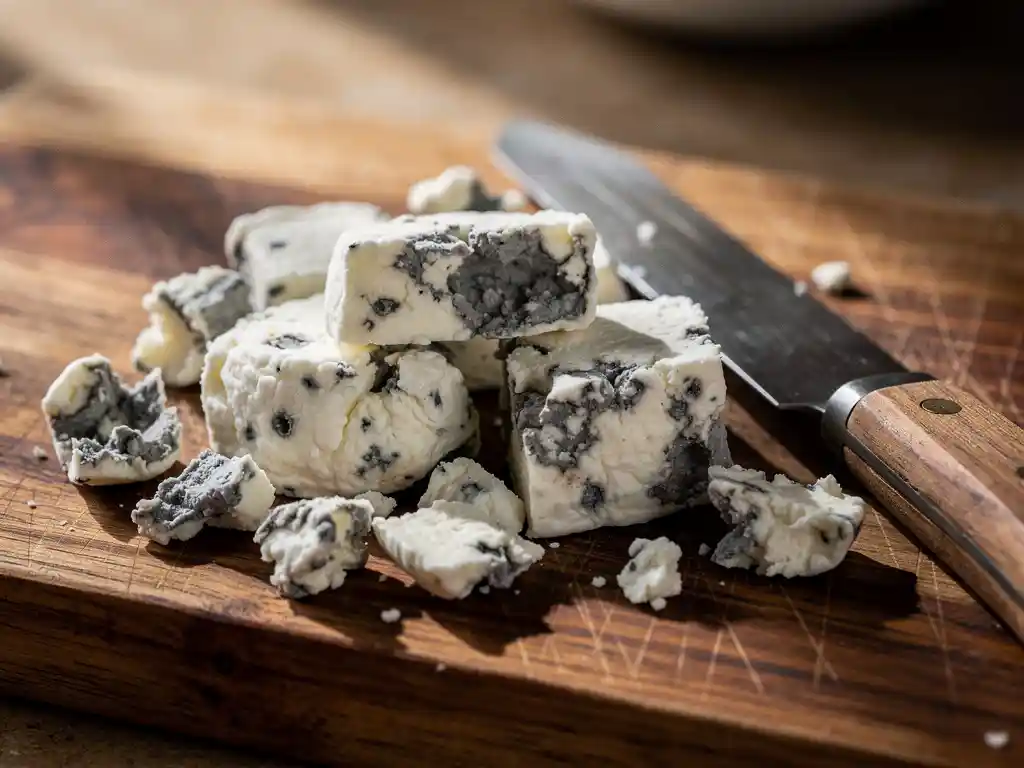
As a purchaser in the food industry, you rely on consistent quality and reliable deliveries from your suppliers. With goat cheese crumbles, a popular ingredient for salads, pizzas and ready meals, unreliable suppliers can seriously disrupt your production process. In this article, we discuss the key warning signs to look out for with your current or potential goat cheese crumble suppliers.
What are the key quality indicators for goat cheese crumbles?
The key quality indicators for goat cheese crumbles are consistent grain size, uniform color, proper moisture content and stable melting behavior. A reliable supplier delivers crumbles with a fixed specification of approximately 13 grams per piece, a shelf life of at least 23 weeks and a fat content suitable for your specific application.
When evaluating quality, you should pay particular attention to the structure of the crumbles. High-quality goat cheese crumbles have a loose, crumbly texture that doesn’t stick together or clump. The color should be evenly white to light cream, without yellow discoloration or dark spots. This indicates fresh milk and correct production processes.
Melting behavior is crucial for industrial applications. Good crumbles melt evenly without oil separation or burning. Test this by heating a sample to the temperature you use in your production process. The cheese should become liquid without releasing moisture or fat.
Also pay attention to taste and aroma. Fresh goat cheese crumbles have a mild, slightly acidic taste without sharp or bitter aftertaste. Too strong a goat flavor may indicate old milk or poor hygiene during production. The aroma should be fresh and clean, without ammonia-like or musty notes.
How do you recognize inconsistent deliveries of cheese crumbles?
You recognize inconsistent deliveries by varying product specifications between batches, such as differences in grain size, moisture, color or melting behavior. Document each delivery systematically by storing samples and measuring properties such as pH value, fat content and texture to identify patterns in quality variations.
A clear sign of inconsistency is when your production staff regularly need to make adjustments to recipes or processes to achieve the same end results. If one batch of crumbles contains more moisture than another, you need to adjust baking time or temperature, which can lead to production problems.
Visual differences between deliveries are often the first warning sign. Always compare new deliveries with reference samples. Differences in grain size may indicate varying production processes at your supplier. If fine crumbles are delivered one time and coarse pieces the next, the supplier probably doesn’t have good process control.
Shelf life dates that vary greatly between deliveries also indicate inconsistency. A reliable supplier should be able to consistently guarantee the same shelf life, for example 23 weeks for fresh crumbles. If this fluctuates between 15 and 25 weeks, there are likely problems with production quality or packaging processes.
What certifications should a reliable goat cheese supplier have?
A reliable supplier of goat cheese crumbles should have at least IFS Food certification, EC accreditation for export within Europe, and certification according to national food safety standards such as COKZ in the Netherlands. For specific markets, additional certifications such as Halal, Kosher or VLOG (without genetically modified organisms) are often required.
IFS Food certification is the international standard for food safety that demonstrates that a producer meets strict hygiene and quality requirements. This certification includes regular audits of production processes, traceability and risk management. Always ask for the certificate number and check validity through the official IFS database.
For sustainability, certifications such as DGZK (Sustainable Goat Dairy Chain) that guarantee animal welfare, environmental impact and transparency are increasingly requested. Suppliers who source their milk from certified farms with quality systems like Kwaligeit show that they take the entire chain seriously.
Industry-specific certifications such as GMP+ Feed Safety Assurance are important if your end products are also processed into animal feed. For export outside Europe, additional certifications may be required. A professional supplier has a current overview of all certifications readily available and can provide copies upon request.
What are warning signs in communication with cheese suppliers?
Warning signs in communication are slow response times to questions about specifications, vague answers about production processes, inability to provide technical data sheets, and evasion of questions about delivery guarantees. A reliable supplier responds within 24 hours to business inquiries and provides concrete, documented information.
A major red flag is when a supplier doesn’t assign a clear contact person or account manager. Professional suppliers understand that industrial customers need consistent communication with someone who knows their specific needs. If you constantly have to speak with different people who aren’t aware of your requirements, that’s problematic.
Watch out for suppliers who only want to talk about price and not about quality or specifications. A reliable partner first asks about your technical requirements, applications and quality standards before prices are discussed. They should be willing to provide samples for testing and be open about their production capacity and processes.
Be alert when suppliers make promises that seem too good to be true, such as extremely long shelf lives without preservatives or unrealistic delivery times. Also, refusing company visits or unwillingness to share references from other industrial customers are serious warning signs.
How do you test the suitability of goat cheese crumbles for industrial applications?
Test suitability by conducting production trials under your specific process conditions, paying attention to melting behavior, heat resistance, flavor stability and interaction with other ingredients. Perform tests with at least three different batches to verify consistency and document all results systematically for objective comparison.
Start with small-scale laboratory tests. Check the fat content, moisture percentage and pH value of the crumbles. These basic parameters largely determine how the product behaves in your recipe. For pizza applications, for example, a specific melting point is crucial, while for salads, maintaining structure after mixing is more important.
Then perform practical tests in your production line. Test how the crumbles react to your specific processing temperatures and times. Pay attention to color change, texture loss and flavor retention. For frozen products, you should also test freeze stability by freezing and thawing products.
Important test parameters include:
- Melting temperature and speed for different applications
- Oil separation during heating
- Flavor retention after processing
- Compatibility with preservatives in your product
- Shelf life in your end product
Ask your supplier for technical support during these tests. A professional supplier can advise on optimal applications and has experience with similar industrial processes.
When is it time to switch suppliers?
It’s time to switch when quality problems are structural despite repeated complaints, delivery reliability drops below 95%, price increases are not proportional to market conditions, or when the supplier doesn’t grow with your technical requirements. Document problems for at least three months before making a final decision.
Concrete signs that a switch is necessary:
- More than two quality incidents per quarter causing production disruptions
- Delivery delays leading to production shutdowns
- Insufficient response to complaints or quality issues
- Refusal to adjust specifications to your changing needs
- Loss of important certifications without recovery plan
Start by documenting all problems in a log. Note dates, batch numbers, specific problems and the impact on your production. This documentation is essential for discussions with your current supplier and for briefing potential new suppliers.
Before switching definitively, give your current supplier one last chance with a clear improvement plan and measurable objectives. Set a deadline of, for example, three months. If no improvement occurs, then start evaluating alternative suppliers in parallel to ensure continuity.
How De Jong Cheese helps with reliable deliveries of goat cheese crumbles
At De Jong Cheese we understand the challenges that purchasers in the food industry face. With our tradition since 1995 and focus on consistent quality, we offer reliable solutions for your goat cheese crumble needs.
Our approach is characterized by:
- Guaranteed specifications with consistent grain size of 13 grams
- Shelf life of 23 weeks for fresh crumbles
- IFS Food certification and EC accreditation for complete traceability
- Flexible packaging from 500g to 5kg bags for industrial processing
- Possibility of freezing with 2 years shelf life
- A personal account manager who knows your specific processes
We deliver both natural and honey variants, suitable for various applications from pizzas to ready meals. Our technical specialists are happy to support you with product testing and process optimization.
Would you like to know more about our goat cheese crumbles for industry? Contact us for samples and technical specifications. Also discover our sales points or visit our website for the complete range.
Veelgestelde vragen
How can I test the quality of goat cheese crumbles before placing a large order?
Always ask for samples from at least three different production batches and test these under your exact production conditions. Especially check the melting behavior at your specific temperatures, stability after mixing with other ingredients, and perform a shelf life test with your end product. Document all results and compare these with your current supplier before making a decision.
What are the most common mistakes when switching suppliers for cheese crumbles?
The biggest mistake is insufficient preparation time – plan at least 3-6 months for a smooth transition. Other common mistakes are not testing multiple batches, underestimating differences in product specifications that require recipe adjustments, and not arranging a back-up supplier for emergencies. Also ensure that all departments (quality, production, logistics) are involved in the evaluation.
How much safety stock of goat cheese crumbles should I maintain with supplier uncertainty?
Maintain at least 2-4 weeks extra stock when in doubt about delivery reliability, depending on your production volume and shelf life. For fresh crumbles (23 weeks shelf life), 2-3 weeks is usually sufficient, but for critical production lines we recommend 4 weeks. With frozen crumbles (2 years shelf life), you can consider a larger buffer of 6-8 weeks without quality loss.
What technical support can I expect from a professional cheese supplier?
A professional supplier offers technical data sheets with all specifications, support with product development, troubleshooting with processing problems, and regular updates on product innovations. Also expect proactive communication about possible process improvements, access to their R&D team for complex questions, and willingness to develop customized specifications for unique applications.
How do I negotiate effectively on prices without compromising on quality?
Focus negotiations on total costs including quality risks, not just on price per kilo. Calculate the costs of production disruptions, waste from poor quality, and extra labor with inconsistent deliveries. Ask for volume discounts on long-term contracts, but link these to guaranteed quality specifications and delivery reliability of at least 98%. Also consider seasonal contracts when milk prices are lower.
What are alternative solutions if goat cheese crumbles are temporarily unavailable?
With delivery problems, you can temporarily switch to blocks of goat cheese that you crumble yourself, although this requires extra labor. For some applications, sheep cheese crumbles can be an alternative with comparable melting behavior. Also consider strategically freezing crumbles during periods of good availability – with 2 years shelf life this provides a solid back-up without quality loss.
Gerelateerde artikelen
- Welke garanties kun je vragen aan een leverancier over levertijden?
- Hoe stel je een longlist op van geitenkaasproducenten voor de voedingsindustrie?
- Welke vragen stel je over leveringscapaciteit bij een producent van high-melt geitenkaas?
- Wat is het verschil tussen een block pallet en een EU pallet bij de levering van kaasproducten?
- Hoe beoordeel je een productcatalogus van een geitenkaasproducent als inkoper?