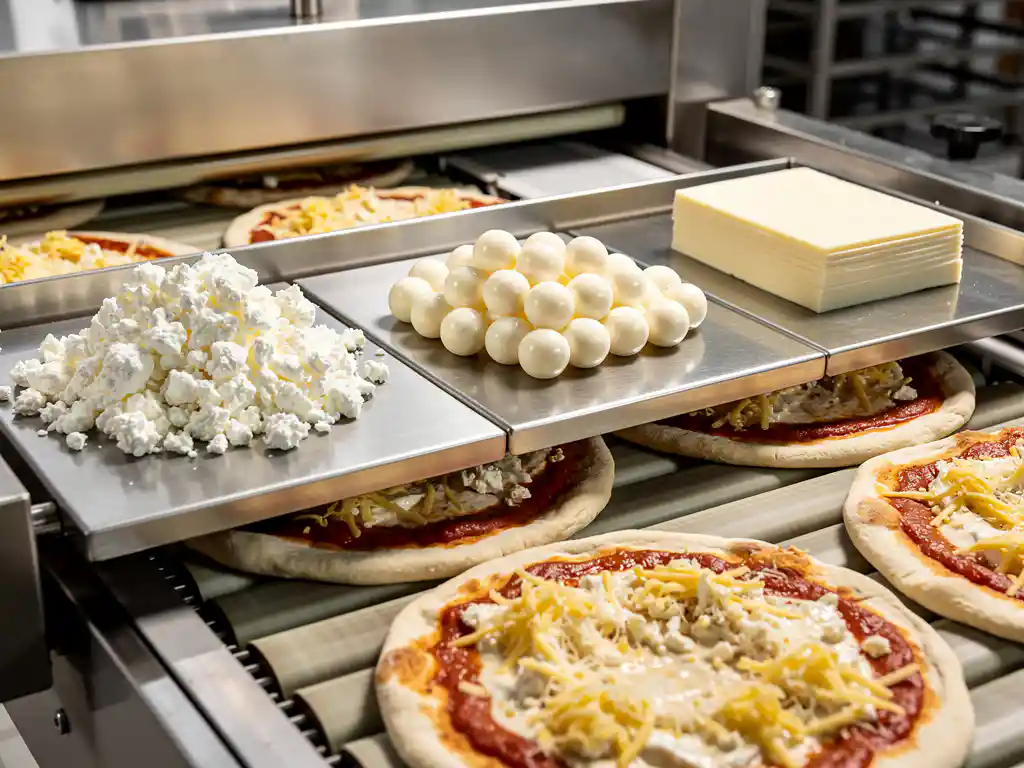
When choosing the right goat cheese variant for your automated pizza line, you face important decisions that directly impact your production quality and efficiency. The choice between crumbles, pearls, and slices determines not only the final result on your pizzas, but also affects the operation of your dosing systems, production costs, and ultimate flavor experience. In the modern food industry, where consistency and automation are central, it is essential to thoroughly understand the technical properties of each goat cheese variant.
What are the differences between goat cheese crumbles, pearls, and slices for pizza production?
Goat cheese crumbles are loose crumbs 3-8 mm in size that are excellently dosable in automatic systems, while pearls are spherical pieces 5-10 mm in size with a protective coating, and slices are pre-cut discs of uniform thickness that are applied manually or semi-automatically. These three forms differ fundamentally in structure, handling, and application possibilities within automated pizza lines.
Crumbles are produced by crumbling fresh goat cheese into small, irregular pieces. This form offers maximum flexibility in dosing and distribution over the pizza surface. The crumbly structure provides a natural, artisanal appearance on the final product. Our Alphenaer goat cheese crumbles are available in both natural and honey variants, with a shelf life of up to 23 weeks in industrial 5 kg packaging.
Pearls, on the other hand, are specially formed into uniform spheres, often with a coating of oil and herbs that ensures better separation and longer shelf life. This form prevents clumping and enables very precise dosing. The spherical shape ensures even distribution during the baking process, with each pearl melting individually.
Slices are pre-cut discs of consistent thickness, typically 3-5 mm for pizza applications. This form is ideal for specific placement on premium pizzas or when a uniform cheese layer is desired. Slices do require different handling systems than loose forms, often with pick-and-place technology or manual placement.
How does the shape of goat cheese affect melting behavior on pizzas?
The shape of goat cheese directly determines the melting speed and distribution during the baking process: crumbles melt fastest due to their large surface-to-volume ratio, pearls retain their shape longer and create characteristic melting points, while slices form a uniform cheese layer with predictable melting behavior. These differences are crucial for the final result of your pizza.
Crumbles have the largest contact surface with hot air in the oven due to their irregular shape and small dimensions. This results in fast and even melting, usually within 3-4 minutes at 250°C. The crumbs flow together into a natural-looking cheese layer with small browning spots. This melting pattern is ideal for pizzas that need a rustic, artisanal appearance.
Pearls exhibit phased melting behavior due to their compact, round shape. The outside begins to melt while the core remains solid, creating texture variation in the final product. This creates visually attractive “cheese islands” on the pizza. The coating on pearls can further influence the melting point, where herb oil, for example, provides slower initial melting but contributes to better browning.
Slices offer the most predictable melting behavior due to their uniform thickness. They melt evenly from top to bottom, with the bottom making contact with the tomato sauce and the top browning. This results in a consistent cheese layer without holes or uncovered spots. The melting time for slices typically lies between that of crumbles and pearls, depending on the exact thickness.
The fat content and moisture content of the specific goat cheese variant also play an important role. Fresh goat cheese with higher moisture content will melt differently than aged variants. For optimal results, it is important to adjust the baking process to the chosen shape and composition.
Which goat cheese forms work best with dosing systems in automated lines?
Crumbles are by far the most suitable for fully automated dosing systems due to their excellent flow properties and consistent dosing, followed by specially coated pearls that work well in vibration dosing systems, while slices require specific pick-and-place equipment and are therefore less suitable for high-speed lines. The choice strongly depends on your specific production line configuration.
Crumbles excel in standard volumetric and gravimetric dosing systems. Their loose structure ensures natural flow through funnels and dosing screws without bridging. The irregular shape prevents particles from hooking together, guaranteeing a constant product stream. Modern dosing systems can dose crumbles with an accuracy of ±2% at speeds up to 120 pizzas per minute.
For optimal operation with crumbles, some technical adjustments are important:
- Funnel angle of 60-70 degrees for optimal flow
- Vibrating funnel bottom to prevent bridging
- Temperature-controlled storage between 2-4°C directly at the dosing line
- Stainless steel surfaces with food-grade coating against caking
Pearls require adapted dosing systems with vibrating chutes or vibration transport. The round shape ensures good rolling properties, but the coating can become sticky at higher temperatures. Successful implementation requires precise temperature control and possibly adapted coatings specifically developed for mechanical processing. Our goat cheese pearls in herb oil, for example, are optimized for shelf life but require extra attention during mechanical handling.
Slices are the least compatible with traditional dosing systems and require specialized equipment such as robotic arms with vacuum grippers or mechanical pick-and-place systems. These systems are significantly more expensive and have lower production speeds, typically 30-60 pizzas per minute. Slices are therefore especially suitable for premium lines or semi-automatic production where the added value of perfectly placed cheese discs justifies the extra investment.
What are the cost differences between crumbles, pearls, and slices for large-scale production?
Crumbles offer the lowest total production costs through efficient processing and minimal product loss (2-3%), pearls are 15-20% more expensive due to additional production processes and coating, while slices have 25-35% higher costs due to labor-intensive processing and more complex handling equipment. These cost differences are amplified at volumes above 1000 kg per week.
The cost structure of crumbles is favorable due to multiple factors. The production process is relatively simple: fresh goat cheese is mechanically crumbled without further processing. This results in lower processing costs per kilogram. Additionally, product loss is minimal because all crumbs, regardless of size, can be used. Transport and storage are efficient due to compact packaging in 5 kg bags that fit optimally in boxes.
A cost calculation for a pizza producer processing 5000 kg of goat cheese per month:
- Crumbles: base price + 2% loss + standard dosing equipment = reference costs
- Pearls: base price +18% + 3% loss + adapted dosing = +21% total costs
- Slices: base price +30% + 5% loss + pick-and-place system = +38% total costs
Pearls justify their premium price through specific advantages such as longer shelf life and unique presentation. The coating process adds production costs, as well as the need for controlled environmental conditions during production. The investment in adapted dosing equipment must be depreciated over the production volume.
Slices have the highest cost price due to labor-intensive cutting processes and the need for individual handling. Packaging costs are higher due to the fragility of the slices requiring protective interlayers. Moreover, shelf life is often shorter, leading to higher depreciation. The return on investment is only positive for premium pizzas where consumers are willing to pay a premium for visible quality.
How do you prevent clumping of goat cheese in automatic dosing systems?
You prevent clumping through strict temperature control between 2-4°C, use of anti-caking agents such as cellulose (0.5-1%) with crumbles, maintaining low humidity (<60%) in storage areas, and regular vibration or stirring in storage funnels. These measures are essential for consistent product quality in automated systems.
Temperature management is the most important factor. Goat cheese begins to soften at 8°C, with natural fat coming to the surface and particles sticking together. An integrated cooling system covering the entire production line is therefore necessary. This includes cooled storage silos, insulated transport lines, and active cooling at dosing points. The investment in adequate cooling pays for itself through reduced product loss and consistent dosing quality.
Specific anti-clumping strategies per product form:
For crumbles, addition of food-grade anti-caking agents is very effective. Microcrystalline cellulose or rice starch in concentrations of 0.5-1% prevents particles from clumping together without affecting taste. These additions absorb excess moisture and create a microscopically thin layer between the crumbs. Our industrial crumbles can be supplied with these anti-caking agents upon request.
Pearls already have natural protection against clumping due to their coating, but do require specific handling. The oil coating must maintain the right viscosity, meaning temperature fluctuations must be absolutely avoided. Excessive vibration can damage the coating, causing pearls to stick anyway.
Mechanical solutions include:
- Vibrating grids in funnels with adjustable frequency (30-50 Hz)
- Stirring mechanisms with silicone blades that activate every 10-15 minutes
- Pneumatic knockers on funnel walls
- Sloped funnel designs with Teflon coating
Preventive maintenance is crucial. Daily cleaning of dosing systems prevents buildup of cheese residues that can function as clumping cores. Weekly inspection of seals prevents moisture intrusion. A well-trained team that recognizes early signs of clumping can prevent problems before they disrupt production.
How DeJong Cheese helps with your pizza production optimization
We understand the unique challenges of automated pizza production and therefore offer not only high-quality goat cheese products, but complete solutions for your production line. With our 30 years of experience in the cheese industry, we have developed specific variants that perfectly match modern dosing systems.
Our industrial solutions for pizza producers include:
- Goat cheese crumbles in 5kg packaging, optimized for automatic dosing
- Custom anti-caking formulations upon request
- Technical support during implementation in your production line
- Flexible deliveries from full pallets with shelf life up to 23 weeks
- Private label possibilities for your own pizza brand
Our team of specialists can analyze your production line and advise on the optimal goat cheese variant for your specific situation. We provide test samples so you can evaluate the different options in your own production environment. With our IFS Food certification and consistent quality, you are assured of a reliable partner for your pizza production.
Contact us today for a no-obligation consultation on how our industrial goat cheese solutions can optimize your pizza production. Visit our contact page or request information about direct delivery possibilities in your region. Discover the complete range of Alphenaer goat cheese products for the food industry on our website.
Veelgestelde vragen
Can I combine different goat cheese forms on the same pizza for a unique texture?
Yes, combining for example crumbles for the base with strategically placed pearls creates an interesting texture variation and visual appeal. This approach does require two separate dosing systems, but can deliver a distinctive premium product where the crumbles provide coverage and the pearls provide characteristic melting points with extra bite.
How long can I store goat cheese crumbles in the dosing funnel without quality loss?
At constant temperature of 2-4°C, crumbles can remain in the dosing funnel for a maximum of 8 hours without significant quality loss, provided the funnel is equipped with adequate cooling and anti-condensation measures. For optimal quality, we recommend completely emptying and cleaning funnels at the end of each production day, and adding fresh product at the start of the next shift.
What pizza baking times and temperatures are optimal for the different goat cheese forms?
For crumbles, 240-250°C for 4-5 minutes is ideal for even melting without burning, pearls require 5-6 minutes at the same temperature due to their more compact form, while slices give the best result at 230-240°C for 5-7 minutes. These times may vary depending on oven type (convection vs. stone oven) and desired browning degree.
What are the most common mistakes when switching from regular cheese to goat cheese in pizza production?
The biggest mistake is not adjusting dosing quantities – goat cheese has a more intense flavor and requires 20-30% less volume than cow’s milk cheese. Additionally, producers often underestimate the importance of stricter temperature control and don’t use anti-caking agents, leading to blockages in dosing systems and inconsistent product quality.
How do I calculate the optimal yield when choosing between different goat cheese forms?
Calculate total yield by not only comparing product price, but also weighing labor costs, product loss, energy consumption of handling equipment, and the selling price of the final product. A simple formula: (pizza selling price – total costs including handling) x production volume – equipment investment costs/depreciation period = net yield per form.
What certifications should my goat cheese supplier have for food-safe pizza production?
Minimum IFS Food or BRC certification is required for supply security and food safety, supplemented with HACCP for risk management. For export within the EU, an additional EU recognition number is necessary, while organic pizzas require SKAL certification from the supplier for complete traceability of ingredients.
Can I cut goat cheese slices from blocks myself for cost savings?
This is technically possible with industrial cheese slicing machines, but usually not profitable due to labor costs, hygiene requirements, and inconsistent slice thickness leading to uneven baking times. The investment in slicing equipment (€15,000-50,000) and extra personnel costs rarely outweigh the premium price of pre-cut slices, unless your volume exceeds 10,000 kg per month.
Gerelateerde artikelen
- Welke vragen stel je een producent om flexibiliteit in maatwerk te testen?
- Wat zijn de gevolgen van een tekort aan geitenmelk voor de industriële kaasprijs?
- Hoe interpreteer je groeicijfers van een leverancier als indicator van betrouwbaarheid?
- Wat is de snelste manier om een leverancier van industriële wrongel te kwalificeren?
- Wat zijn de belangrijkste contractpunten bij een leveranciersovereenkomst voor geitenkaas?