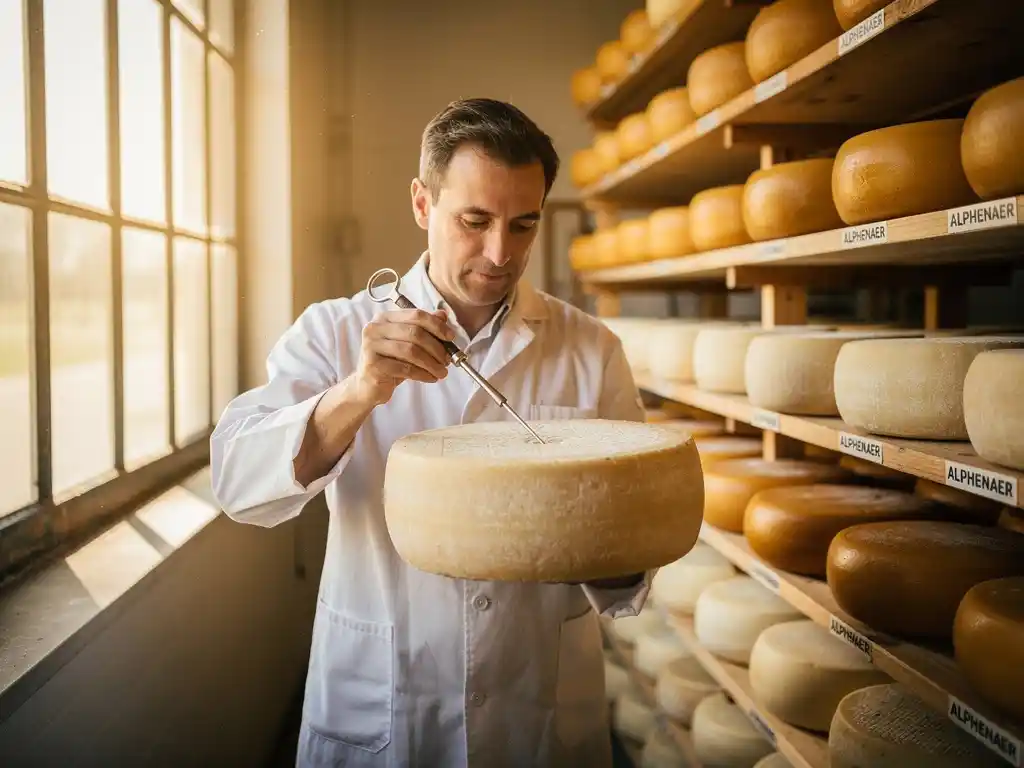
In the Dutch cheese industry, quality assurance is the foundation for safe and consistent products. For producers like us at DeJong Cheese, this means a daily focus on every detail of the production process. From selecting local milk suppliers to final inspection of our Alphenaer goat cheese specialties – quality is central to everything we do. For buyers in the food industry looking for reliable suppliers, understanding these quality systems is essential for making the right choices.
What exactly is quality assurance in cheese production?
Quality assurance in cheese production is a systematic approach where all processes, from milk receipt to final product, are controlled and documented to guarantee consistent quality and food safety. It includes preventive measures, continuous monitoring and corrective actions to prevent deviations.
In practice, quality assurance means that every step in the production process is recorded and monitored. This starts with the selection of milk suppliers and continues through to storage and distribution of the final product. For us as traditional cheesemakers since 1995, this means we combine modern control systems with artisanal knowledge.
The system consists of various components:
- Raw material inspection and supplier control
- Process control during production
- Final product control and laboratory testing
- Traceability of all production batches
- Continuous employee training
- Documentation of all procedures and deviations
For industrial customers, effective quality assurance means certainty about specifications, melting behavior and microbiological safety. This is especially important for products like our goat cheese crumbles for pizza applications, where consistent properties are crucial for the end result.
Which quality systems do Dutch cheese producers use?
Dutch cheese producers work primarily with internationally recognized systems such as IFS Food, BRC Global Standards and HACCP, supplemented with specific Dutch certifications such as the DGZK quality mark for goat cheese. These systems guarantee food safety, traceability and consistent product quality according to global standards.
IFS Food certification is one of the most common standards in the Dutch cheese industry. This system focuses on:
- Management responsibility
- Quality and food safety management system
- Resource management
- Production processes
- Measurements, analyses and improvements
- Food Defense and product inspection
HACCP (Hazard Analysis and Critical Control Points) forms the basis of all food safety systems. This preventive system identifies possible hazards in the production process and establishes critical control points where these hazards can be controlled. For cheese production, typical critical control points are milk pasteurization, pH control during acidification and temperature control during ripening.
The DGZK quality mark is specific to the Dutch goat dairy sector and sets additional requirements for animal welfare, sustainability and product quality. This quality mark guarantees that the goat milk comes from Dutch goat farmers who meet strict welfare and quality requirements.
In addition to these certifications, many producers work with supplementary systems for specific markets, such as Halal certification for export or organic certification for the organic segment. The combination of these systems ensures a robust quality assurance program that meets international requirements.
How is the quality of milk and raw materials controlled?
Quality control of milk begins with daily tests on temperature, acidity, antibiotics and bacteriological parameters upon receipt. Each tanker truck is sampled and tested before the milk is unloaded, with deviations leading to direct rejection of the entire load.
The control process for milk includes various phases. Upon arrival, the temperature is first checked – this must be below 6°C. Subsequently, samples are taken for:
- Antibiotic tests with rapid test methods
- Determination of fat and protein content
- Bacterial count and cell count analysis
- Freezing point determination to exclude water adulteration
- Sensory evaluation for smell and appearance
Specific parameters apply to goat milk that differ from cow milk. The natural fat content is around 3.5-4%, the protein content around 3.2-3.4%. These values are important for the final cheese yield and texture of products like our fresh goat cheese spreads.
Other raw materials such as rennet, starter cultures and additives are also strictly controlled. Suppliers must provide certificates that guarantee quality and food safety. For special ingredients like truffle for our Alphenaer Specials, additional requirements apply for authenticity and microbiological safety.
The traceability of all raw materials is meticulously maintained. Each ingredient receives a unique code with which it can be tracked through the entire production process. This makes it possible to quickly identify the source in case of problems and take targeted measures.
What are the main control points during the cheese production process?
The critical control points during cheese production are pasteurization (72°C for 15 seconds), pH development during acidification (drop to pH 4.6-4.8), temperature control during coagulation and curd processing, salt content after brining or dry salting, and ripening conditions for aged cheeses.
The pasteurization process is the first critical control point where pathogenic bacteria are eliminated. The temperature-time combination is continuously monitored and recorded. For our fresh goat cheese products, this is essential because they are consumed without further ripening.
During acidification, the pH is measured every half hour. Proper acidification is crucial for:
- Texture development of the cheese
- Moisture content in the final product
- Microbiological stability
- Shelf life of the product
Curd processing determines the structure of the cheese. For soft goat cheese like our spreads, the curd is minimally processed to maintain a creamy texture. For harder cheeses, the curd is cut finer and stirred more intensively. Temperature and time are precisely controlled to guarantee consistent results.
Salt content is checked after brining or dry salting. For fresh goat cheese, this is typically around 1.2-1.5%, for aged varieties this can rise to 2%. This affects not only the taste but also shelf life and melting behavior – important for industrial applications.
For aged cheeses like our Goat Brie, ripening rooms are continuously monitored for temperature (10-14°C) and humidity (85-95%). The development of the white mold rind is assessed daily. After 7-10 weeks, the cheese reaches the optimal ripening stage with the characteristic creamy-piquant taste.
How do cheese producers guarantee consistent quality at large volumes?
Consistent quality at large volumes is guaranteed through standardized recipes, automated process control, statistical quality control of each production batch, continuous monitoring of process parameters and regular calibration of all measuring equipment. This is supported by extensive documentation and traceability systems.
Standardization begins with milk treatment. By standardizing fat and protein content, variation in the raw material is minimized. For our industrial goat cheese products like the 5 kg crumbles for pizza applications, this is essential to guarantee consistent melting behavior.
Modern production systems use automated process control where:
- Temperatures are automatically regulated and recorded
- Ingredient dosages are electronically controlled
- pH measurements are continuously performed
- Deviations directly generate alarms
- All data is centrally stored for analysis
Statistical process control (SPC) is applied to identify trends before they lead to deviations. From each production batch, samples are taken for analysis of moisture content, salt content, pH, texture and microbiology. This data is compared with specification limits and historical data.
For products with specific functional properties like our High-melt goat cheese for pizza applications, additional tests are performed. Melting behavior is tested in ovens that simulate conditions in pizza ovens. This guarantees that the product performs consistently in practice.
Personnel training is an often underestimated but crucial aspect. Operators are regularly trained in recognizing deviations and correctly performing controls. An experienced cheesemaker can perceive subtle changes in curd structure or ripening that instruments might miss.
How DeJong Cheese helps with quality assurance for industrial customers
As specialists in goat cheese products since 1995, we at DeJong Cheese understand the critical role of quality assurance for industrial processors. Our systematic approach guarantees the consistent quality that is essential for your production processes.
Our quality guarantee for industrial partners includes:
- IFS Food certification for all production locations
- Detailed product specifications with narrow tolerances
- Batch-wise certificates of analysis
- Consistent functional properties such as melting behavior and pH stability
- Flexible packaging options from 5 kg to 15 kg for efficient processing
- Shelf life up to 2 years for frozen products
For pizza producers, we offer specialized goat cheese forms such as crumbles, pearls and slices with guaranteed melting behavior. Our High-melt varieties are specifically developed for applications where the cheese must maintain its shape when heated. Each batch is tested for melting characteristics to ensure consistent results in your final product.
Our dedicated industrial team understands the challenges of large-scale food production. We offer technical support in product development, share our expertise on optimal processing conditions and can adapt products to your specific requirements. With delivery options of 60 boxes per pallet and guaranteed stock, we support your continuous production.
Are you looking for a reliable partner for high-quality goat cheese products with guaranteed quality? Contact our team through our contact page for a no-obligation conversation about your specific quality requirements. Discover our complete range of industrial cheese solutions on our foodservice page or visit our homepage for more information about our tradition and expertise. For direct product testing, you can request samples through one of our sales points.
Veelgestelde vragen
How can I as a buyer request DeJong Cheese quality certificates for my administration?
You can directly request current IFS Food certificates, product specifications and batch-wise analysis reports from our industrial team via the contact page. We deliver these documents digitally as standard in PDF format and can link them to your supplier management system if desired. For recurring orders, we can set up automatic certificate delivery with each shipment.
What are the main differences in quality control between fresh and aged goat cheese?
For fresh goat cheese, the focus is on microbiological safety directly after production, with strict controls for E. coli, Listeria and yeasts/molds within 48 hours. Aged cheeses are evaluated for ripening progress, mold development and texture evolution over 4-10 weeks. Fresh products require continuous cold chain monitoring (2-4°C), while aged cheeses need specific ripening conditions with controlled temperature and humidity cycles.
How do I prevent quality loss when freezing and thawing industrial goat cheese products?
Freeze goat cheese quickly at -18°C or lower to minimize ice crystal formation. Thaw slowly in refrigeration (24-48 hours at 2-4°C) to prevent texture changes. For crumbles and pearls, direct processing from frozen state is possible in pizza applications. Avoid repeated freezing and use thawed products within 5 days for optimal quality.
What measurement methods can I use in my own production to monitor goat cheese quality?
Implement at least pH measurements (target value 4.6-5.2 depending on type), moisture content determination via drying oven or NIR technology, and visual inspection for color and texture. For melting cheese applications, a simple melting test in oven at 220°C for 5 minutes is effective. Invest in a good pH meter with temperature compensation and calibrate it daily for reliable results.
How long can I store goat cheese products without quality loss and what are the optimal storage conditions?
Fresh goat cheese keeps 3-4 weeks at 2-4°C in unopened packaging, 5-7 days after opening. Aged varieties like Goat Brie are shelf-stable for 8-10 weeks at 4-6°C. Frozen products maintain optimal quality up to 12 months at -18°C, with guaranteed specifications up to 2 years. Always store in original packaging to prevent moisture loss and cross-contamination.
What should I do if I notice a deviation in a delivered batch of goat cheese?
Document the deviation immediately with photos, batch number and specific complaint. Isolate the relevant product to prevent cross-contamination. Contact your supplier within 24 hours for a complaint procedure. Keep samples at the correct temperature for possible re-analysis. A professional supplier like DeJong Cheese has a track-and-trace system that can quickly identify the cause and take corrective measures.
What innovations in quality assurance can we expect in the cheese industry in the coming years?
The cheese industry is investing in real-time monitoring via IoT sensors for continuous temperature and pH tracking, blockchain technology for improved traceability from farm to fork, and AI-driven quality prediction based on process data. Additionally, inline NIR spectroscopy is becoming increasingly accessible for direct composition analysis during production, enabling faster adjustments and reducing waste.
Gerelateerde artikelen
- Hoe ontwikkel je een geitenkaasconcept rond rode ui en honing?
- Hoe organiseer je een leveranciersaudit bij een geitenkaasproducent?
- Wat zegt bedrijfsgrootte van een producent over leverzekerheid op lange termijn?
- Wat zijn de voordelen van geitenkaas spread in een emmer van 10 kg voor snackvullingen?
- Welke allergeneninformatie is verplicht bij industriële geitenkaasproducten?