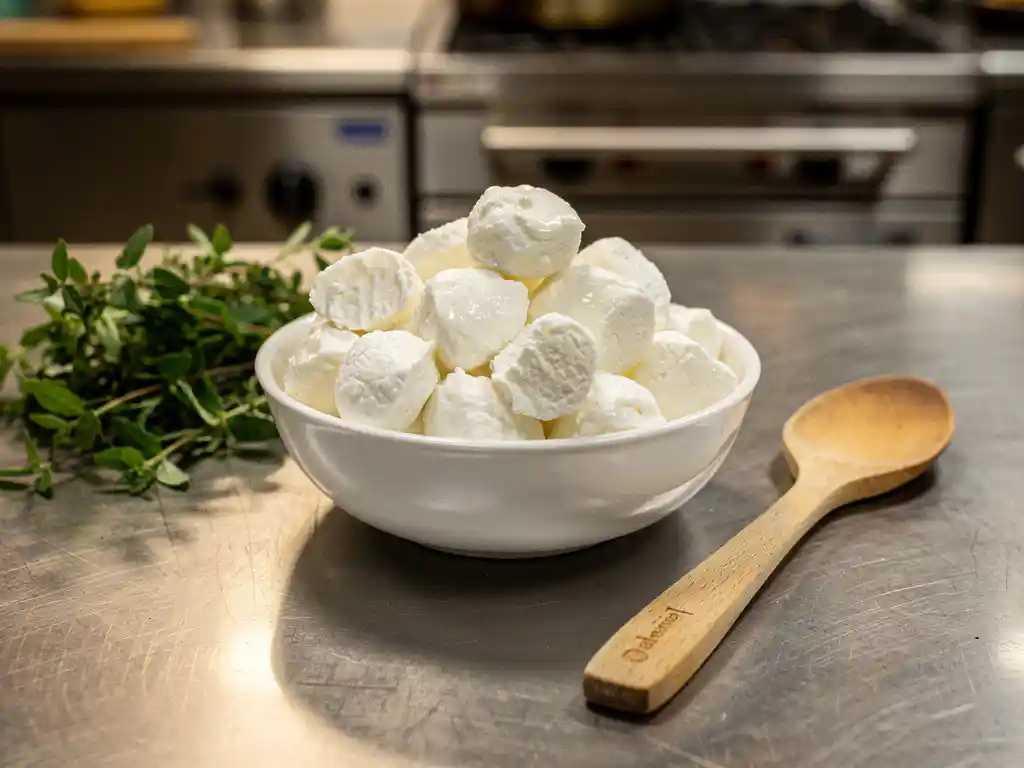
In the food industry, consistent quality is crucial for the success of ready-to-eat meals. For manufacturers working with goat cheese curd, this presents an additional challenge: this delicate raw material requires specific knowledge and attention to prevent quality problems. From the moment of receipt to final processing in your production line, every step counts for the end result.
What is goat cheese curd and why is quality so important?
Goat cheese curd is the basis of fresh goat cheese: coagulated and drained goat milk that has not yet been pressed or salted. This raw material has a granular, moist structure and a neutral pH value, making it ideal for further processing in ready-to-eat meals.
The quality of curd directly determines the success of your end product. High-quality curd ensures consistent texture, predictable melting behavior and stable shelf life in your meals. Poor curd quality, on the other hand, leads to production problems such as uneven distribution in the product, unwanted texture changes during heating and shortened shelf life.
For industrial applications, curd is particularly valuable due to its versatility. You can process it in lasagnas, quiches, stuffed pasta and various casseroles. The neutral taste makes it possible to develop your own flavor profiles, while the natural creaminess of goat milk adds a premium character to your products.
What quality problems occur most frequently with goat cheese curd?
The five most common quality problems with goat cheese curd are: moisture content too high, microbiological contamination, deviating pH value, irregular grain size and oxidation. These problems often arise during transport, storage or due to inconsistent production processes at the supplier.
Moisture content too high is the most critical problem for processors. Curd with more than 82% moisture leads to water separation in your end product, especially after heating. This results in unattractive pooling in packaging and a watery texture that repels consumers. Moreover, excess moisture disrupts your recipe balance, requiring you to add more binding agents.
Microbiological problems often only manifest during the shelf life period of your product. Elevated bacterial counts in curd accelerate spoilage, even after pasteurization of the end product. Yeasts and molds are particularly problematic because they can form heat-resistant spores.
pH deviations affect both texture and taste. Curd with a pH below 4.5 becomes too acidic and crumbly, while a pH above 5.0 leads to a soapy taste and reduced microbiological stability. Irregular grain size causes uneven distribution in your product, which becomes especially visible in clear sauces or thin fillings.
How do you recognize quality problems in goat cheese curd during receipt?
Upon receipt, check curd visually for color (bright white), odor (fresh acidic), texture (uniform grains) and moisture (no free moisture in packaging). Measure core temperature (maximum 4°C) and pH value (4.6-4.8) directly. These quick checks reveal 90% of quality problems within five minutes.
Start your inspection with packaging integrity. Damaged bags or containers indicate temperature fluctuations or rough handling during transport. Check vacuum packages for air inclusion and MAP packages for correct gas composition. Pay specific attention to ice crystal formation in frozen curd, which indicates temperature fluctuations.
Sensory control provides direct information about freshness. Fresh curd smells slightly acidic without sharp or musty odors. The color should be evenly white without yellow or gray discoloration. Taste a small sample: the flavor should be clean and slightly acidic, similar to fresh yogurt. Bitter, soapy or sharp tastes indicate quality problems.
Document every deviation systematically. Photograph problematic batches, note lot numbers and temperature data. This documentation is essential for claims with suppliers and helps identify patterns in quality problems. Establish a standard rejection protocol that clearly defines when a batch is refused.
What are the ideal specifications for goat cheese curd in ready-to-eat meals?
Ideal curd specifications for ready-to-eat meals are: moisture content 78-80%, pH 4.6-4.8, grain size 2-4mm, fat content in dry matter minimum 45%, and microbiological values under strict limits. These parameters guarantee optimal processability and product stability in your production line.
Moisture content is crucial for texture and shelf life. At 78-80% moisture, curd retains its creaminess without water separation during heating. This percentage also ensures good binding with other ingredients without excess moisture disrupting your recipe. For frozen meals, you can reduce moisture content to 76-78% to minimize ice crystal formation.
Microbiological specifications should be stricter than legal standards:
- Total bacterial count: max. 10,000 cfu/g
- Yeasts and molds: max. 100 cfu/g
- Enterobacteriaceae: max. 100 cfu/g
- Listeria monocytogenes: absent in 25g
- Salmonella: absent in 25g
Functional properties determine behavior during processing. Melting behavior should be consistent between 65-85°C without oil separation. The curd should remain stable during mixing and dosing without structural loss. For specific applications like gratins, you need curd that browns slightly without burning, which requires a slightly higher protein content.
How do you prevent quality problems during storage and processing of goat cheese curd?
Prevent quality problems by storing curd at 0-2°C, processing within 48 hours, strictly applying FIFO and preventing cross-contamination. During processing, monitor temperature continuously, prevent long standstill times and keep pH values stable through rapid throughput.
Temperature management starts at receipt. Install continuous temperature recording in all cold storage areas with alarming for deviations. Never place curd near cooling doors or fans where temperature fluctuations occur. During temporary storage during production, temperature may be above 7°C for a maximum of 30 minutes. Use insulated containers for transport within your facility.
Hygiene during handling prevents cross-contamination. Train employees in correct hand hygiene and the use of dedicated equipment for curd. Clean and disinfect all contact surfaces between batches. Pay special attention to dosing equipment where product residues can accumulate. Implement a swab program to verify cleaning effectiveness.
Process optimization minimizes quality loss:
- Thaw frozen curd in a controlled manner in refrigeration (24-36 hours at 2-4°C)
- Mix curd with other ingredients only just before use
- Avoid mechanical stress through gentle mixers and low speeds
- Dose curd as the last ingredient to minimize heating time
- Cool end products quickly to a core temperature below 5°C within 90 minutes
When should you change suppliers due to recurring quality problems?
Change suppliers when quality problems affect more than 5% of deliveries, improvement plans show no results after three months, or critical food safety incidents occur. Document all problems systematically as a basis for this decision and start evaluating alternative suppliers in time.
First establish objective criteria for supplier evaluation. Measure rejection percentage, complaint frequency, response time to problems and effectiveness of corrective measures. A rejection percentage above 5% indicates structural problems in your supplier’s production process. At 10% rejection, the costs of quality control and production loss are no longer acceptable.
Communication with your current supplier often determines the success of improvement trajectories. Organize monthly reviews where you present specific data about quality problems. Demand concrete action plans with measurable objectives and timelines. If a supplier reacts defensively or trivializes problems, this is a clear signal to look for alternatives.
Start evaluating new suppliers in parallel before terminating the relationship. Test at least three batches from different production dates. Perform extensive specification tests and process test batches in your regular production. Evaluate not only product quality but also delivery reliability, communication and willingness to cooperate. A good supplier invests with you in solving your specific challenges.
How DeJong Cheese helps prevent quality problems
As a specialist in goat cheese products since 1995, we understand the challenges of industrial processors. Our goat curd (Goat Curd, product code 1024 VFQ) is produced according to strict quality standards specifically tailored to ready-to-eat meals. With our traditional production method and modern quality control, we deliver consistent curd that meets your highest requirements.
Our curd offers concrete advantages for your production:
- Guaranteed specifications: pH 4.6-4.8, moisture content 78-80%
- Flexible packaging: 15kg bags for efficient processing
- Available fresh (4 weeks shelf life) or frozen (2 years shelf life)
- Consistent grain size for even distribution
- Excellent melting behavior without oil separation
- Complete traceability from milk to end product
We support you with more than just product delivery. Our technical team helps optimize your recipes and processes. We offer test samples for testing in your production line and adapt specifications to your unique needs if necessary. For quality questions, our team is directly available with practical solutions.
Discover how our curd can improve your production quality. Contact us through our contact page for a non-binding conversation about your specific requirements. Visit our foodservice page for more information about our complete industrial range. For direct product testing, you can visit one of our sales points. More information about our family business and our working method can be found on our homepage.
Veelgestelde vragen
How long can I store goat cheese curd after thawing and what are the best practices?
Thawed goat cheese curd must be processed within 48-72 hours when stored between 0-2°C. Always thaw in refrigeration (never at room temperature), use within one production day for optimal quality, and never refreeze. Mark thawed batches clearly with date and time of thawing.
Which binding agents work best with goat cheese curd in ready-to-eat meals?
For optimal binding with goat cheese curd, modified corn starch and locust bean gum work excellently, especially in combination (2:1 ratio). These stabilize texture during heating without masking the delicate goat flavor. Avoid xanthan gum at pH values below 4.7, as this can lead to unwanted gel formation.
How do I prevent goat cheese curd from separating in acidic sauces or when combined with tomato products?
Stabilize the pH of your sauce first to 5.5-6.0 with sodium citrate before adding curd. Always add curd as the last ingredient at temperatures below 65°C and stir gently. For tomato sauces, adding 0.5% sodium carbonate works effectively to neutralize acidity without significantly affecting flavor.
What are typical dosing amounts of goat cheese curd for different applications?
For quiches use 15-20% curd on total weight, for lasagnas 10-12% per layer, and for stuffed pasta 25-30% in the filling. In gratins, 8-10% is sufficient for a creamy texture. These percentages ensure noticeable goat cheese experience without dominating other ingredients and account for moisture loss during preparation.
How can I extend the shelf life of products with goat cheese curd without quality loss?
Extend shelf life through MAP packaging with 30% CO2/70% N2, rapid cooling after production (within 90 minutes to <5°C), and addition of natural preservatives like cultured dextrose (0.5-1%). Pasteurize end products for at least 15 minutes at 75°C core temperature. These measures can extend shelf life from 7 to 21 days refrigerated.
What production errors do I see most when working with goat cheese curd and how do I solve them?
The three most common errors are: processing temperature too high (solution: never above 85°C), mixing too intensively (use paddle mixers at low speed), and wait times too long between process steps (implement continuous flow). Train operators specifically to recognize overheating (grain formation) and overmixing (structural loss) to be able to adjust in time.
Gerelateerde artikelen
- Welke vragen stel je een producent om flexibiliteit in maatwerk te testen?
- Hoe leg je volumegaranties vast bij de inkoop van geitenkaas crumbles op palletschaal?
- Wat zijn de logistieke voordelen van een kaasleverancier die lokaal melk inkoopt?
- Wat zijn de voordelen van een leverancier die zowel verse als ingevroren geitenkaas levert?
- Wat zijn de beste geitenkaasmerken om mee te koken?