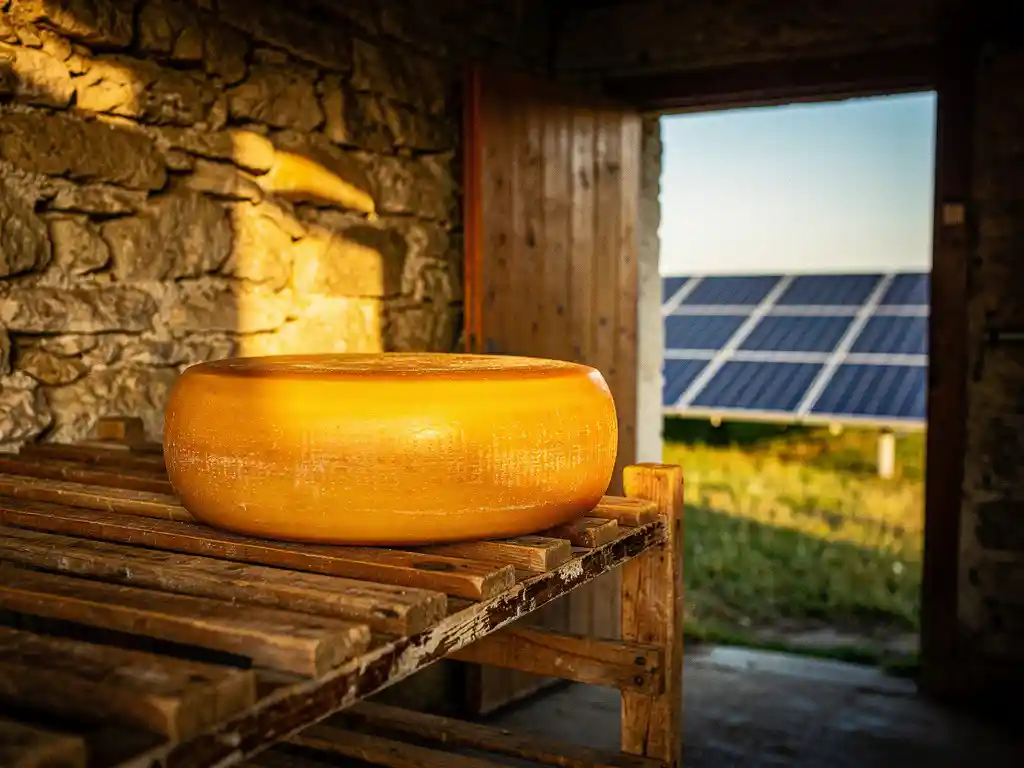
The production of goat cheese is an artisanal process where sustainability is becoming increasingly important. As a traditional cheese dairy since 1995, we see daily how energy needs and environmental awareness come together in our production processes. A crucial component of cheese production is curd, the basis of all cheese varieties. With growing attention to CO₂ reduction in the food industry, more and more cheese producers are exploring how solar energy can reduce their ecological footprint.
What is curd and why is its CO₂ footprint important?
Curd is the solid mass that forms when milk coagulates through the addition of starter culture and rennet, causing milk proteins to clump together and release moisture (whey). This curd forms the basis for all cheese varieties and largely determines the structure and flavor of the final product.
The CO₂ footprint of curd production is significant because this process is energy-intensive. Heating milk to the correct temperature, constant stirring during coagulation, and separating curd and whey all require electricity or gas. In an average cheese dairy, curd production accounts for approximately 35% of total energy consumption.
For the food industry, the CO₂ footprint is becoming increasingly important due to stricter climate targets and growing consumer demand for sustainable products. Buyers like Marco Visser look not only at quality and price, but also at the environmental impact of their suppliers. A lower CO₂ footprint of curd directly means a more sustainable end product, which is essential for companies wanting to achieve their own climate goals.
With goat curd specifically, this plays an extra important role because goat milk is often positioned as a premium and natural product. Consumers expect these products to be produced sustainably as well, increasing pressure on producers to make their processes more sustainable.
How much energy does traditional curd production actually consume?
Traditional curd production consumes an average of 150 to 250 kWh per 1000 liters of processed milk, depending on the type of cheese and specific production method. This amounts to approximately 0.15 to 0.25 kWh per kilogram of produced curd.
The largest portion of this energy consumption comes from three main processes. First, heating the milk to the optimal coagulation temperature, usually between 30 and 35 degrees Celsius for goat cheese. This process alone requires about 40% of the total energy. Second, mechanical stirring during coagulation and cutting of the curd, which accounts for about 25% of energy consumption. Third, pump installations for transporting milk, curd, and whey through the production line.
In a medium-sized cheese dairy that processes 10,000 liters of milk daily, this means an annual electricity consumption of approximately 550,000 to 900,000 kWh for curd production alone. Using conventional energy, this results in CO₂ emissions of approximately 220 to 360 tons per year, based on the Dutch electricity mix.
Besides direct energy for the production process, supporting systems such as cooling, ventilation, and lighting in the production area consume an additional 20 to 30% extra energy. These figures underscore why energy savings and the transition to sustainable energy sources are so important for the cheese industry.
How does solar energy work in a cheese dairy exactly?
Solar energy in a cheese dairy works through photovoltaic panels on roofs and grounds that convert sunlight directly into electricity for production processes. This green power directly feeds the curd vats, stirring installations, pumps, and heating elements that are essential for cheese production.
A typical installation for a medium-sized cheese dairy consists of 800 to 1200 solar panels with a total capacity of 300 to 450 kWp. These panels are usually placed on flat production roofs with an optimal tilt angle for maximum yield. The generated electricity goes through inverters to the factory’s electrical grid, where it is used directly for ongoing processes.
What’s interesting about cheese production is that peak production often coincides with the highest solar power yield. Curd production mainly takes place during daylight hours when the sun shines. This means that a large portion of the required energy can be used directly without intermediate storage. Modern systems are equipped with smart energy management software that can control production processes based on available solar energy.
For processes that take place at night or during cloudy days, the cheese dairy can fall back on the regular electrical grid. Excess energy during sunny periods is fed back to the grid, which further reduces energy costs through net metering. Some companies also invest in battery storage to be even less dependent on the grid.
What is the difference in CO₂ footprint between curd with and without solar energy?
Curd production with solar energy reduces the CO₂ footprint by 70 to 85% compared to production with conventional energy, amounting to a saving of approximately 0.3 to 0.4 kg CO₂ per kilogram of produced curd.
With traditional energy sources, the production of one kilogram of curd emits approximately 0.4 to 0.5 kg CO₂. This is based on the Dutch electricity mix that still partly consists of fossil sources. With solar energy, this emission drops to only 0.06 to 0.1 kg CO₂ per kilogram of curd, where the remaining emissions mainly come from indirect factors such as equipment maintenance and transport.
For a cheese dairy that annually produces 2000 tons of curd, this concretely means a CO₂ reduction of 600 to 800 tons per year. This equals the CO₂ that 30,000 to 40,000 trees absorb in a year, or the equivalent of 3 million car kilometers. This substantial reduction makes curd produced with solar energy attractive for industrial customers who want to reduce their scope 3 emissions.
The impact goes beyond just direct CO₂ reduction. Cheese made from curd produced with solar energy has a 15 to 20% lower environmental burden over its entire lifecycle. This difference is becoming increasingly important now that large food producers have concrete sustainability targets and select suppliers based on their environmental performance.
What challenges exist when switching to solar energy for curd production?
The biggest challenges when switching to solar energy for curd production are the high initial investment of 300,000 to 600,000 euros, the required roof surface of at least 3000 m², and ensuring constant energy supply during production peaks.
The financial threshold forms the first obstacle for many cheese dairies. Although the payback time is usually 6 to 8 years, the investment requires substantial capital or external financing. Especially smaller family businesses may have difficulty freeing up these resources without endangering their operational cash flow. Subsidies such as the SDE++ can help, but the application process is complex and success is not guaranteed.
Technical challenges mainly concern integration with existing production systems. Curd production requires very stable temperatures and continuous energy supply. Fluctuations in solar power yield can disrupt production processes if there are no adequate backup systems. Installing buffer systems or battery storage adds extra costs and complexity.
Spatial limitations also play a role. Not all cheese dairies have sufficient suitable roof surface for a profitable installation. Older buildings may require structural reinforcement to bear the weight of solar panels. Additionally, local zoning plans or monumental status of buildings may impose restrictions on panel placement.
How can cheese producers further reduce their curd CO₂ footprint?
Cheese producers can further reduce their curd CO₂ footprint through process optimization such as heat recovery, more efficient stirring systems, and using green energy for cooling, which together can deliver another 20 to 30% additional reduction.
Heat recovery offers great savings opportunities. The whey released during curd production has a temperature of approximately 30 degrees. This heat can be used through heat exchangers to preheat fresh milk, reducing energy consumption for heating by 15 to 20%. Modern plate heat exchangers have an efficiency of more than 90%.
Process optimization goes beyond just energy. Optimizing curd cutting moments and stirring profiles can shorten production time without quality loss. Variable frequency drive pumps and agitators adjust their energy consumption based on actual need instead of constantly running at full capacity. This can save 10 to 15% energy.
Other measures include:
- Insulation of curd tanks and pipes to minimize heat loss
- LED lighting in production areas for 60% less electricity consumption
- Smart sensors that monitor and optimize production processes in real-time
- Use of biogas from own wastewater treatment for heating
- Cooperation with dairy farmers for shorter transport distances
How De Jong Cheese helps with sustainable curd production
As a traditional cheese dairy with modern sustainability ambitions, De Jong Cheese offers concrete solutions for industrial customers who want to reduce their CO₂ footprint. Our curd and goat cheese products are produced with attention to energy savings and environmental impact.
Our approach to sustainable curd production includes:
- Energy-efficient production processes that minimize consumption per kilogram of curd
- Transparent reporting on the CO₂ footprint of our Goat Curd products
- Flexible delivery options in fresh or frozen form to reduce transport movements
- Cooperation with local goat milk suppliers for short supply chains
- Continuous investments in process optimization and sustainable technologies
For industrial processors such as ready-meal producers, we offer Goat Curd in practical 15 kg packages, available both fresh and frozen. This product forms the ideal basis for further processed goat cheese products with a lower environmental burden. Through our scale and expertise, we can consistently deliver high-quality curd that meets strict sustainability requirements.
Are you interested in how our sustainably produced goat curd can make your production process more sustainable? Contact us through our contact page for a non-binding conversation about the possibilities. Also visit our foodservice page for more information about our complete range of sustainable cheese products. For direct purchase, you can visit our sales points, or visit our homepage for the latest news about our sustainability initiatives.
Veelgestelde vragen
Can I as a small cheese dairy also profitably switch to solar energy for curd production?
Yes, small cheese dairies can also profitably switch to solar energy. Start with a smaller installation of 50-100 kWp that covers approximately 20-30% of your energy needs. This requires an investment from 50,000 euros with a payback time of 5-7 years. Also research collective purchasing trajectories with other local businesses and make use of provincial subsidies specifically for SME companies.
How can I compare the CO₂ footprint of my purchased curd between suppliers?
Ask suppliers for their CO₂ footprint per kilogram of curd, expressed in kg CO₂ equivalent. Reliable suppliers can provide this data based on an LCA (Life Cycle Assessment) or energy monitoring. Pay attention to whether the figures only concern production or also include transport and packaging. Consider suppliers that are certified according to ISO 14064 for CO₂ reporting or that participate in industry initiatives for sustainability.
What quick wins can I implement to immediately improve the sustainability of my curd processing?
Start by optimizing your cooling cycle by cooling curd only when necessary and use night cooling when electricity is cheaper and cleaner. Implement a strict FIFO system to minimize waste and consider bulk packaging instead of small portions to reduce packaging waste by 40-60%. Train employees in energy-conscious work, such as closing cooling doors and turning off equipment during breaks.
Is curd produced with solar energy more expensive than conventionally produced curd?
The price of curd produced with solar energy is initially 2-5% higher due to investment costs, but this difference usually disappears within 3-5 years. In the long term, sustainable curd can even become cheaper due to lower energy costs and more stable prices. Many customers are willing to pay this premium for demonstrably more sustainable products, especially when this helps achieve their own climate goals.
How does the seasonal yield of solar energy affect the continuity of curd production?
Modern cheese dairies compensate for seasonal fluctuations by adjusting production planning to solar power yield, where energy-intensive processes such as pasteurization are scheduled during peak hours. In winter, they fall back on green power from the grid via energy contracts with wind or hydropower certificates. Battery storage of 100-200 kWh can absorb daily fluctuations and ensures stable production even during cloudy periods.
What certifications are relevant for demonstrating sustainably produced curd?
For sustainably produced curd, especially the On the way to PlanetProof quality mark, ISO 14001 environmental management system, and the Science Based Targets initiative (SBTi) are relevant. The new European Product Environmental Footprint (PEF) label is also becoming increasingly important for transparent environmental information. Specifically for energy, Guarantees of Origin (GOs) are essential to demonstrate the use of green power. Also consider B Corp certification for integral sustainability.
Gerelateerde artikelen
- Hoe behoud je onderhandelingspositie bij afhankelijkheid van één kaasleverancier?
- Welke criteria gebruik je om snel kaasleveranciers te shortlisten?
- Wat zijn de voordelen van een kaasproducent die 70% windenergie gebruikt?
- Wat zijn de logistieke voordelen van een kaasleverancier die lokaal melk inkoopt?
- Waarom is een houdbaarheid van 23 weken bij geitenkaas crumbles een voordeel voor inkopers?