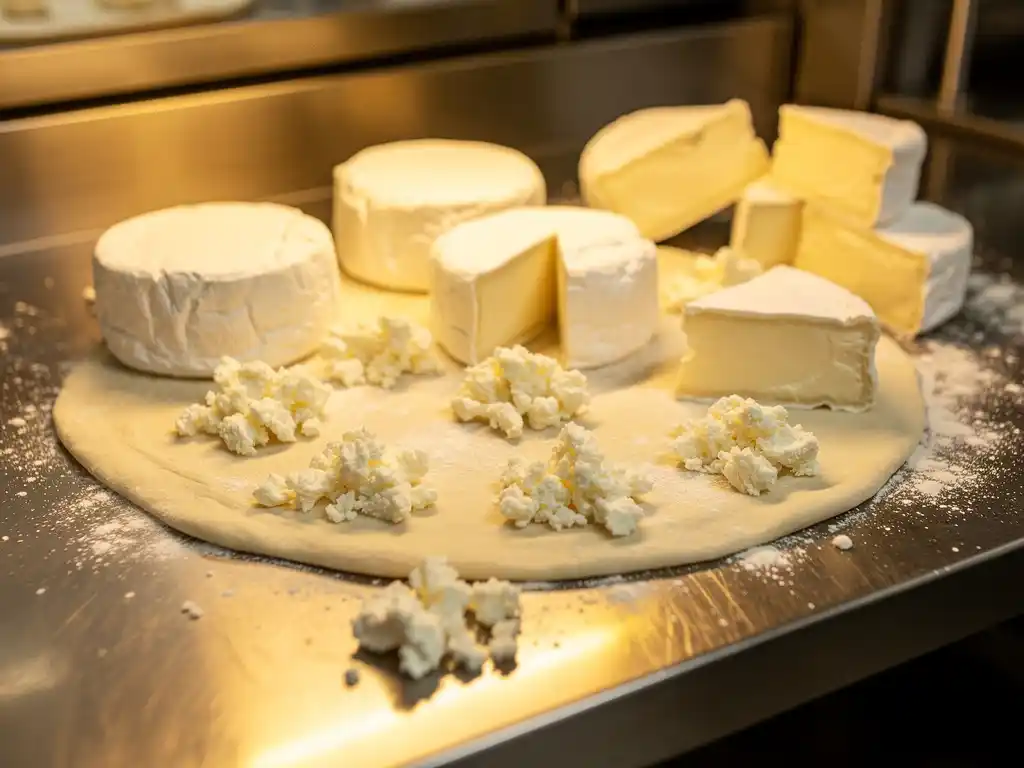
For pizza producers seeking innovative toppings, goat cheese offers unique possibilities that go beyond traditional mozzarella or cheddar. With our years of expertise in industrial cheese supply, we understand the specific requirements that pizza production places on ingredients. From melting behavior to processability in production lines – every property must be perfectly tailored to your production process.
What are the key properties of goat cheese for pizza toppings?
Goat cheese for pizza toppings must have a lower melting temperature than cow’s milk cheese, maintain a creamy texture during baking, and contain sufficient moisture to prevent drying out. The fat content should ideally be between 16-25% for optimal melting properties without releasing excessive moisture.
The pH value of goat cheese plays a crucial role in melting behavior. With a naturally lower pH than cow’s milk cheese (approximately 4.5-5.0), goat cheese melts earlier and more evenly, ensuring beautiful distribution across the pizza without clumping. The protein content in goat cheese is composed differently than in cow’s milk cheese, with smaller fat globules that contribute to a softer, creamier texture after baking.
For industrial processing, product consistency is essential. Goat cheese must:
- Have uniform particle size for automatic dosing
- Remain stable during transport and storage
- Show no separation during temperature fluctuations
- Have predictable melting patterns in tunnel ovens
Shelf life is another important aspect. Fresh goat cheese typically has a shorter shelf life than aged variants, but through special packaging techniques like Modified Atmosphere Packaging (MAP), this can be extended to several weeks, which is essential for industrial applications.
Which types of goat cheese from the range are most suitable for pizza?
For pizza applications, fresh goat cheese balls, spreadable goat cheese with 16% fat content, and specially developed goat cheese slices are most suitable. These variants offer optimal melting behavior, good dosing capability in production lines, and retain their characteristic flavor during the baking process.
Fresh goat cheese in balls or crumbled form is ideal for artisanal pizzas where the cheese is used as an accent topping. This form partially retains its structure during baking, creating textural contrast. The balls can be automatically dosed with precision equipment, guaranteeing consistent production results.
Spreadable goat cheese offers unique possibilities for pizza producers. With only 16% fat content, this variant is:
- Easy to process in spray equipment
- Suitable as a base layer under other toppings
- Stable in flavor at higher temperatures
- Cost-effective due to lower fat content
Goat cheese slices are specially developed for uniform coverage. These pre-portioned slices melt evenly and are ideal for production lines where speed and consistency are crucial. The slices can be stacked without sticking together, which increases processability.
For premium pizza lines, aged goat cheese variants like mini brie are interesting. These offer a more complex flavor that pairs well with gourmet pizzas with figs, honey, or nuts as complementary ingredients.
How does goat cheese behave during the baking process on pizza?
Goat cheese begins to melt at 55-60°C, significantly lower than mozzarella, and forms no long strings but rather a creamy layer. At oven temperatures of 250-300°C, the outside caramelizes lightly while the core remains creamy, resulting in a characteristic flavor and texture combination.
The melting process of goat cheese occurs in phases. First, the cheese becomes soft and loses its original shape. Then it gradually spreads without the typical string formation of cow’s milk cheese. This makes goat cheese ideal for pizzas where even cheese coverage is desired without the traditional “cheese pull”.
During baking, goat cheese undergoes the Maillard reaction, where natural sugars and proteins react to form golden-brown spots. This caramelization contributes to:
- Development of nutty flavor notes
- Visually appealing golden-brown color
- Light crispy texture at the edges
- Retention of creaminess in the center
The moisture content in goat cheese plays an important role during baking. Unlike hard cheeses, goat cheese gradually releases moisture, preventing the pizza from becoming too wet. This makes it possible to apply goat cheese directly to the dough without an intermediate layer, simplifying the production process.
For tunnel ovens in industrial settings, it’s important to know that goat cheese reaches the desired texture faster than traditional pizza cheese. This can lead to shorter baking times or adjusted oven temperatures for optimal results.
What is the difference between goat cheese and traditional pizza cheese in application?
Goat cheese melts without string formation, has a lower melting temperature, offers a pronounced flavor profile, and requires 20-30% less quantity for the same flavor intensity. Traditional pizza cheese like mozzarella focuses on texture and mild flavor, while goat cheese adds flavor and creaminess.
The application technique differs significantly between both cheese types. Where mozzarella is typically sprinkled over the entire pizza for complete coverage, goat cheese is often strategically placed in smaller portions. This is due to the more intense flavor profile and different visual presentation that goat cheese offers.
Cost-wise, there are important differences:
- Goat cheese has a higher purchase price per kilo
- Due to the more intense flavor, less volume is needed
- Total cheese costs per pizza can be comparable
- Premium positioning justifies a higher selling price
In production lines, goat cheese requires different handling than mozzarella. The softer texture means dosing equipment may need to be adjusted. Fresh goat cheese cannot be grated like block cheese, requiring alternative processing methods such as crumbling or using pre-portioned pieces.
Combining goat cheese with traditional pizza cheese offers interesting possibilities. A base layer of mozzarella for texture with accents of goat cheese for flavor creates a balanced product that combines the best of both worlds. This hybrid approach is becoming increasingly popular in premium pizza lines.
What technical specifications should industrial goat cheese for pizza have?
Industrial goat cheese for pizza must have a fat content between 16-25%, a pH of 4.5-5.0, be shelf-stable for at least 4 weeks at 2-4°C, and have uniform particle size for automatic dosing. The moisture content should be between 55-65% for optimal melting behavior without excessive moisture loss.
Microbiological parameters are strictly defined for food safety in industrial applications. Goat cheese must comply with:
- Listeria monocytogenes: absent in 25g
- Salmonella: absent in 25g
- E. coli: <100 cfu/g
- Staphylococcus aureus: <100 cfu/g
For automated production, physical properties are crucial. The cheese must flow freely without clumping, withstand temperature fluctuations during transport within the factory, and show no separation under mechanical stress. This requires specific production processes and possibly the use of natural stabilizers.
Packaging specifications play an important role in shelf life and processability. Modified Atmosphere Packaging (MAP) with a specific gas mix significantly extends shelf life. Bulk packages of 5-10 kg are standard for industrial processing, with vacuum packaging for maximum freshness.
Traceability is essential in modern food production. Each batch of goat cheese must be provided with a unique code that refers back to production date, milk origin, and all relevant quality controls. This is supported by certifications such as IFS Food and specific EC numbers for export within Europe.
How can goat cheese best be processed in pizza production lines?
You process goat cheese optimally at 8-12°C to maintain the right consistency, use dosing equipment with larger openings than for grated cheese, and place the cheese as one of the last toppings to prevent excessive melting. Automatic crumblers or portioning units are ideal for consistent distribution.
Temperature control during processing is critical. Goat cheese becomes softer and stickier at room temperature, which can lead to blockages in dosing equipment. A refrigerated conveyor belt and a climate-controlled processing room are therefore essential for smooth production.
For different pizza types, specific processing methods have been developed:
- Frozen pizzas: apply cheese after the first freezing stage for better adhesion
- Fresh pizzas: directly before packaging for maximum freshness
- Par-baked pizzas: after par-baking for optimal flavor retention
- Ready-to-eat pizzas: in combination with protective atmosphere
Quality control during production requires adapted procedures. Visual inspection must check for even distribution, correct portion size, and absence of discoloration. Random taste tests after baking ensure consistent product quality.
Integration into existing production lines can usually be done without major investments. Adjustments are often limited to adjusting dosing equipment and possibly adding a cooling unit. Training of production staff focuses on the different handling properties of goat cheese compared to traditional cheese types.
How DeJong Cheese helps with industrial goat cheese for pizza
As a specialist in goat cheese products since 1995, we understand the unique challenges of industrial pizza production. Our technical expertise and flexible production processes enable us to work with you to develop the perfect goat cheese solution for your pizza line.
What we offer for pizza producers:
- Custom goat cheese products tailored to your specifications
- Consistent quality thanks to IFS Food certification
- Technical support in product development
- Flexible delivery options from small test batches to bulk volumes
- Private label possibilities for your own brand
Our industrial goat cheese solutions are specifically developed for seamless use in automated production lines. With shelf life up to 28 weeks for certain products and various packaging options from portion packages to bulk, we adapt to your production needs.
Are you curious how goat cheese can enrich your pizza range? Contact us for a no-obligation conversation about the possibilities. Visit our foodservice page for more information about our complete range, or visit one of our sales points to taste our products. Discover more about our tradition and methods on our homepage.
Veelgestelde vragen
How do I prevent goat cheese from burning too quickly on my pizzas in a tunnel oven?
Place goat cheese in the last 40-50% of the baking time or lower the top temperature by 10-15°C. Also consider placing the goat cheese under other toppings or mixing it with a neutral cheese like mozzarella that acts as a protective layer. For tunnel ovens with multiple zones, you can lower the temperature in the last zone.
What goat cheese-mozzarella ratio works best for a balanced premium pizza?
A ratio of 30% goat cheese to 70% mozzarella offers the ideal balance between flavor and texture. This mix provides sufficient ‘cheese pull’ from the mozzarella while the goat cheese provides flavor depth and creaminess. For more pronounced goat cheese flavor, you can go up to 40%, but above this percentage you lose the characteristic pizza cheese properties.
How can I best store goat cheese in my production facility to minimize quality loss?
Store goat cheese strictly between 2-4°C with constant humidity of 80-85%. Use the FIFO principle and only open packages in the cold room to prevent condensation. Once opened, fresh goat cheese must be processed within 48-72 hours. Invest in a separate cold room for dairy products to prevent cross-contamination with other ingredients.
What are typical cost differences between goat cheese pizzas and regular pizzas in production?
Ingredient costs are 15-25% higher due to the more expensive goat cheese, but this is compensated by 20-30% less cheese usage and a 30-50% higher selling price for premium pizzas. The total profit margin can therefore be 10-15% higher. Additional costs may arise from adapted handling and possibly slower production speed in the startup phase.
What allergens and labeling requirements apply specifically to pizzas with goat cheese?
Goat cheese contains milk protein and must be labeled as ‘milk (goat)’ according to EU legislation. Although some people with cow’s milk allergy can tolerate goat’s milk, you must legally always warn for milk allergy. Also clearly mention ‘goat cheese’ in the product name to avoid confusion, especially since many consumers expect a different taste than with regular cheese.
How do I test if my current pizza oven is suitable for goat cheese products?
Perform a test run with different oven temperatures between 230-280°C and baking times of 4-8 minutes. Document the melting behavior, color development and moisture loss. Goat cheese usually requires 10-15% shorter baking time or lower temperature than mozzarella pizzas. Also test different positions on the pizza and combinations with other ingredients to determine the optimal baking profile for your specific oven.
Gerelateerde artikelen
- Wat zijn de mogelijkheden van private label geitenkaasconcepten voor retailpartners?
- Wat zijn de logistieke voordelen van een kaasleverancier die lokaal melk inkoopt?
- Wat zijn de kwaliteitsnormen voor geitenkaas in de voedingsindustrie?
- Wat betekent EC-accreditatie voor een producent van industriële geitenkaas?
- Wat zijn de beste geitenkaasmerken om mee te koken?