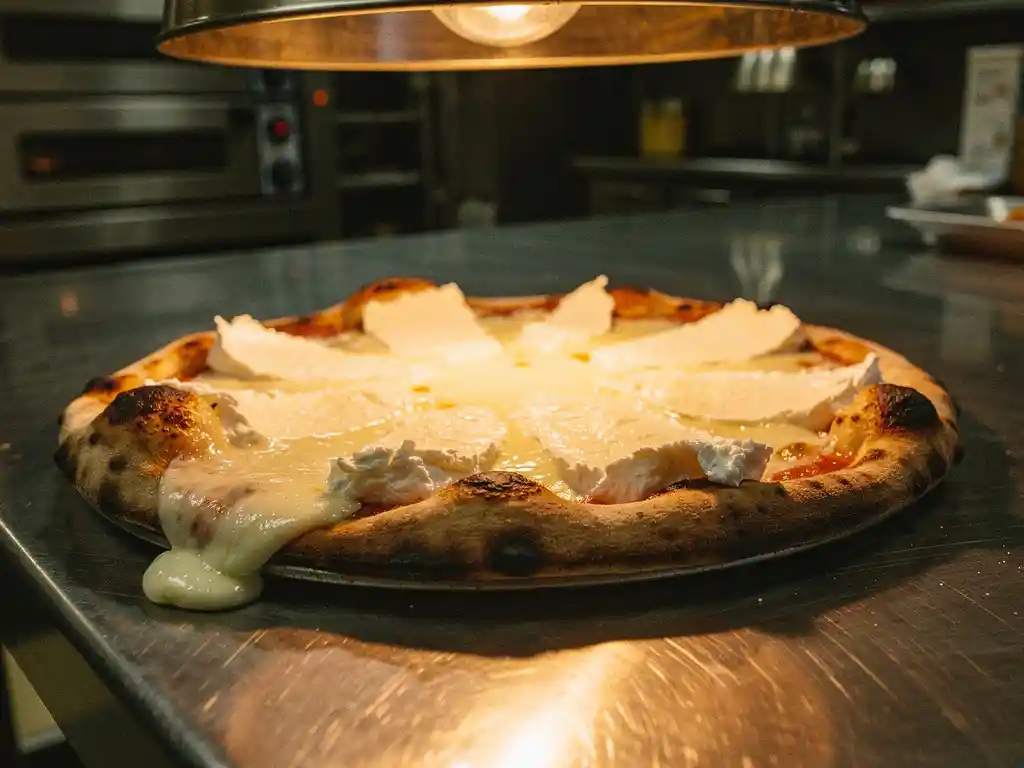
In the world of industrial pizza production, cheese choices are crucial for both product quality and cost efficiency. While cow’s cheese has traditionally been the standard, more and more producers are discovering the unique advantages of goat cheese for their pizza applications. At DeJong Cheese, we have been observing this shift for years, where our goat cheese specialties offer new possibilities for pizza producers seeking differentiation, quality, and reliable delivery.
What are the key differences between goat cheese and cow’s cheese for pizza applications?
Goat cheese distinguishes itself from cow’s cheese through a lower melting point, finer protein structure, and naturally lower lactose content, resulting in better processability and creamier melting behavior on pizzas. These fundamental differences make goat cheese particularly suitable for industrial pizza production.
The protein structure of goat cheese contains smaller fat globules than cow’s cheese, causing the cheese to melt more evenly and release less oil during the baking process. This means that pizzas with goat cheese maintain a more consistent appearance, even after extended storage in heated display cases. For producers working with pre-baked pizzas or frozen pizzas, this is a significant advantage.
The natural lactose content in goat cheese is considerably lower than in cow’s cheese, often less than 0.1% in aged varieties. This makes the product accessible to a growing group of consumers with lactose intolerance. Additionally, goat cheese has a characteristic flavor profile that is milder and less salty than many traditional pizza cheeses, providing more room for other flavor components on the pizza.
The pH value of goat cheese is typically slightly higher than that of cow’s cheese, which affects the shelf life and stability of the final product. This property, combined with the lower moisture content in many goat cheese varieties, contributes to longer shelf life of pizzas without quality loss.
How does goat cheese perform when heated compared to traditional pizza cheese?
Goat cheese melts at lower temperatures (approximately 140-150°C) than traditional pizza cheese, reaches the desired consistency faster, and better maintains its structure without excessive oil separation or burning at the edges. These properties make it ideal for modern pizza ovens with shorter baking times.
In industrial tunnel ovens, goat cheese performs excellently due to the uniform heat distribution it achieves. The finer protein structure ensures that the cheese doesn’t string like mozzarella, but rather forms a creamy layer that adheres well to the pizza base and toppings. This reduces the risk of shifting during transport and handling.
An important advantage for producers is the reduced browning of goat cheese. Where traditional pizza cheese can quickly develop dark spots at higher temperatures, goat cheese maintains its light color longer. This provides a more consistent end product, especially important for chains that maintain strict visual standards.
Tests in production environments show that goat cheese also performs better during repeated reheating. For foodservice applications where pizzas are kept warm, goat cheese maintains its texture and flavor longer without becoming tough or rubbery as often happens with cow’s cheese.
What cost advantages does goat cheese offer for large-scale pizza production?
Goat cheese offers cost advantages through more efficient use (15-20% less needed per pizza), longer shelf life, less product loss due to better melting properties, and the ability to charge premium prices for differentiated products. These factors more than compensate for the higher purchase price per kilogram.
The efficiency of goat cheese in use stems from its more intense flavor profile and better coverage. Where traditional pizza cheese is often applied in thick layers, goat cheese requires only a thinner layer for the same flavor experience. This means that more pizzas can be produced from each kilogram of cheese.
Production losses are significantly reduced because goat cheese is less sensitive to temperature fluctuations during storage and processing. The cheese remains processable longer and needs to be rejected less often due to quality loss. For companies with multiple production shifts, this means less waste at the end of each shift.
Market positioning of pizzas with goat cheese as premium products opens new pricing strategies. Consumers are willing to pay more for products with goat cheese, enabling higher margins. Especially in the segment of artisanal or gourmet pizzas, this price difference can reach 15-25% without market resistance.
What are the technical specifications of goat cheese relevant to pizza producers?
For pizza production, the most important technical specifications of goat cheese are: fat content 45-55% in dry matter, moisture content 35-45%, pH value 5.2-5.8, melting point 140-150°C, and protein content of 18-22%. These values guarantee optimal processability and end results.
Fat content largely determines the melting behavior and creaminess of the cheese on pizza. Goat cheese with a fat content around 50% offers the ideal balance between melting quality and structure retention. In industrial processing, consistency in this specification is crucial for predictable results.
The shelf life of fresh goat cheese for pizza applications varies from 8-12 weeks under refrigerated conditions, considerably longer than many fresh cow’s cheese products. Aged goat cheese can even be shelf-stable for up to 23 weeks, simplifying inventory management and reducing the risk of spoilage.
- Freeze resistance: Specific goat cheese varieties are suitable for freezing without quality loss
- Grating properties: Goat cheese grates excellently at temperatures between 2-4°C
- Blendability: Combines well with other cheese varieties for custom blends
- Allergens: Naturally gluten-free and often low-lactose (<0.1%)
For automated production lines, the consistent grain size of grated goat cheese is an important advantage. The cheese clogs dosing equipment less frequently and distributes more evenly over the pizza surface.
How does goat cheese influence the flavor profile and differentiation of industrial pizzas?
Goat cheese adds a distinctive, mild-creamy flavor profile with subtle citrus notes that transform traditional pizzas into premium products, where the cheese complements other ingredients without dominating. This unique taste creates immediately recognizable differentiation in a competitive market.
The milder salt content of goat cheese offers producers more control over the total flavor profile of their pizzas. Where traditional pizza cheese often dominates the salt content, goat cheese leaves room for more complex flavor combinations with herbs, vegetables, and meat products.
Consumer tests show that pizzas with goat cheese are experienced as lighter and more digestible. This perception, combined with the actually better digestibility due to smaller fat molecules, makes goat cheese pizzas attractive to health-conscious consumers.
For producers working with seasonal or regional specialties, goat cheese offers excellent combination possibilities. The cheese harmonizes particularly well with Mediterranean ingredients like sun-dried tomatoes, olives, and fresh herbs, but also with sweeter toppings like figs or honey for gourmet variants.
What practical considerations are there when switching to goat cheese in existing production lines?
The switch to goat cheese requires minimal adjustments: lower oven temperatures (10-15°C lower), adjusted dosing amounts (15-20% less), and possibly different storage conditions. Most existing equipment can be used without modification, simplifying the transition.
Storage management requires attention during the transition. Goat cheese requires stable cooling between 2-4°C and is more sensitive to temperature changes than some cow’s cheese varieties. Setting up separate storage zones or adjusting existing cooling protocols may be necessary.
Training production personnel focuses mainly on the different handling properties of goat cheese. The cheese is often softer and more fragile in block form, requiring adapted techniques when cutting or grating. The melting behavior also differs, requiring adjustment of baking times and visual quality controls.
Supplier relationships play a crucial role in a successful transition. Selecting a reliable goat cheese supplier with consistent quality and delivery reliability is essential. Ask for certifications like IFS Food and traceability of the milk source for quality assurance.
Phased implementation is recommended: start with one pizza variant as a pilot, evaluate consumer reaction and production processes, adjust recipes based on feedback, and then roll out to other products. This approach minimizes risks and maximizes learning opportunities.
How DeJong Cheese helps with industrial pizza applications
As specialists in goat cheese since 1995, we at DeJong Cheese understand the unique challenges of industrial pizza producers. Our Alphenaer goat cheese products are specifically developed for consistent performance in large-scale production environments.
Our solutions for pizza producers include:
- Guaranteed consistent quality: IFS Food-certified production with strict quality controls
- Flexible delivery options: From small test batches to large-scale volumes with reliable delivery times
- Technical support: Advice on optimal applications and recipe adjustments
- Customization possibilities: Private label and customized specifications for unique product requirements
- Sustainable production: 100% DGZK-certified milk suppliers and active ESG policy
Our fresh and aged goat cheeses are available in various formats, from blocks for grating to pre-grated variants for direct application. With shelf life up to 23 weeks, our products offer the flexibility that modern pizza production requires.
Are you ready to discover the advantages of goat cheese in your pizza production? Contact us for samples and technical advice. Visit our foodservice page for more information about our complete range, or find one of our sales points in your region. Discover how DeJong Cheese can be your partner in creating distinctive pizza products with authentic goat cheese.
Veelgestelde vragen
How can I best start testing goat cheese on my current pizza recipes?
Start by replacing 30-50% of your current cheese with goat cheese in one test recipe, adjust the baking time (reduce by 1-2 minutes) and evaluate the result. Then test with different ratios until you find the ideal balance between taste, texture and costs. Request test samples from suppliers like DeJong Cheese for small batches before switching to large scale.
Which goat cheese varieties are most suitable for frozen pizzas?
For frozen pizzas, semi-hard to hard goat cheeses with a moisture content below 40% work best, as these show less moisture loss during freezing and thawing. Avoid fresh goat cheese for frozen applications. Choose pre-grated variants with anti-caking agent or block form that you grate yourself after thawing for optimal results.
How do I prevent goat cheese from browning too quickly in my conveyor oven?
Lower the top temperature by 10-15°C compared to your standard settings for cow’s cheese, place the cheese under other toppings where possible, or mix goat cheese with 20-30% mozzarella for a balance between browning and flavor. Also consider applying a thinner cheese layer, which not only reduces browning but is also more cost-efficient.
What are the most common mistakes when working with goat cheese in pizza production?
The three biggest mistakes are: using too much cheese (goat cheese has a more intense flavor, so less is needed), leaving the cheese out of refrigeration too long (becomes soft and difficult to process quickly), and maintaining the same baking times as for cow’s cheese (goat cheese needs shorter baking times). Train your personnel specifically on these differences for consistent results.
Can I combine goat cheese with other cheese varieties for a custom blend?
Yes, goat cheese blends excellently with mozzarella (for stretchiness), cheddar (for color and sharpness) or Parmesan (for umami). A popular blend is 60% goat cheese, 30% mozzarella and 10% Parmesan. Test different ratios to develop your signature blend that fits your brand identity and price point.
How do I communicate the added value of goat cheese to my customers without it seeming too 'niche'?
Focus on concrete benefits like ‘easier to digest’, ‘creamier in taste’ and ‘artisanal character’ instead of technical details. Use terms like ‘premium cheese selection’ or ‘artisanal cheese’ on the menu. Test with A/B marketing where you offer the same pizza with different descriptions to see what resonates best with your target audience.
Gerelateerde artikelen
- Hoe test je geitenkaas crumbles in een nieuw product voordat je overgaat tot grootschalige inkoop?
- Hoe voorkom je kwaliteitsproblemen bij geitenkaas wrongel in kant-en-klaarmaaltijden?
- How do you streamline the internal approval process for a new cheese variety?
- Welke geitenkaassoorten zijn het beste voor gerechten met een milde smaak?
- Hoe wordt geitenkaas genoemd?