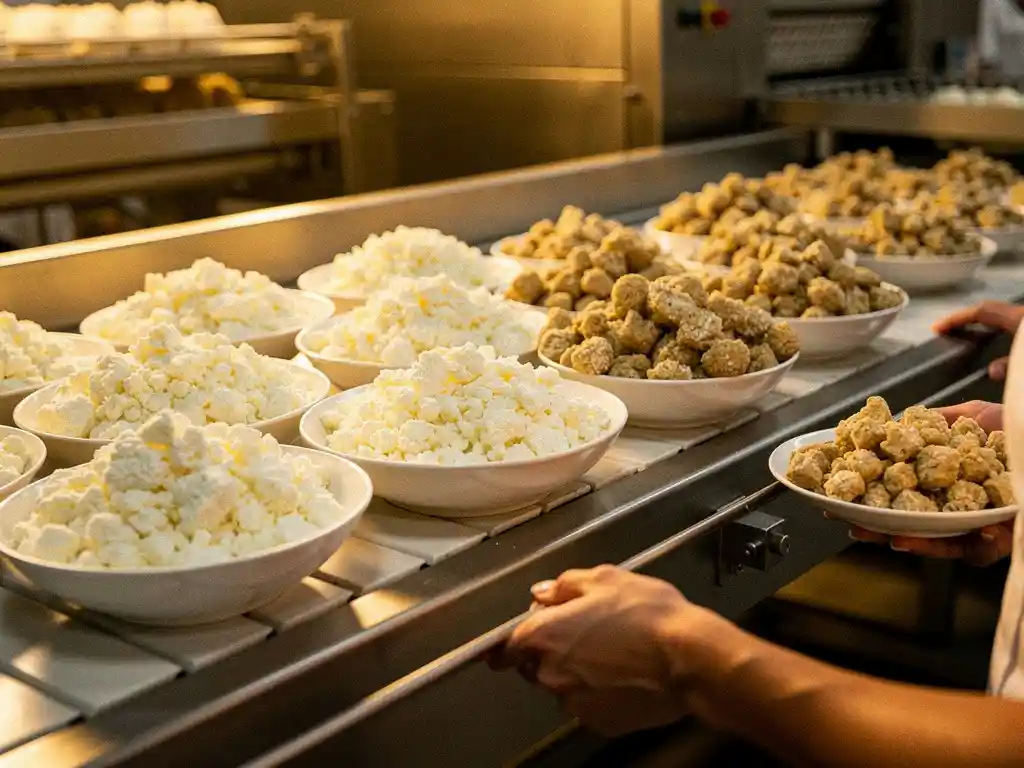
In the food industry, goat cheese crumbles form an essential ingredient for countless products, from ready-made pizzas to salads and casseroles. For buyers like Marco Visser, who daily struggle with supplier choices and quality assurance, inconsistent crumbles can however lead to significant hidden costs. These costs go much further than just the purchase price and can seriously undermine the profitability of product lines. In this article, we examine the real impact of varying quality in goat cheese crumbles and how you can identify and minimize these hidden costs.
What are goat cheese crumbles and why is consistent quality crucial?
Goat cheese crumbles are small, loose pieces of fresh or aged goat cheese with a crumbly texture, usually between 5 and 15 grams per piece. They are obtained by crumbling fresh goat cheese into uniform chunks that are easily sprinkled over products.
Consistent quality is crucial because crumbles in industrial applications must exactly meet predetermined specifications. The fat content, moisture percentage, melting behavior and size of the crumbles directly determine how they behave during production, packaging and preparation. When these properties vary between deliveries, problems arise in automated production lines where machines are calibrated to specific parameters.
For producers of pizzas, ready meals and salads, inconsistent quality means that recipes must be adjusted, machines recalibrated and possibly entire production batches rejected. A difference of only 2% in moisture content can for example lead to incorrect melting behavior on pizzas, causing the end product to not meet quality requirements. Furthermore, varying quality affects the shelf life of the end product, which can result in higher return percentages and problems with customer satisfaction.
How much does production waste due to varying crumble quality actually cost?
Production waste due to varying crumble quality costs on average between 15,000 and 50,000 euros per incident, depending on the scale of the production line and the complexity of the product. These costs include downtime, wasted raw materials, labor hours and missed delivery deadlines.
The actual costs go much further than just the direct production costs. When a batch of goat cheese crumbles does not have the right specifications, the entire production line must be shut down for adjustments. This means that operators must recalibrate machines, which takes an average of 2 to 4 hours. During this downtime, personnel costs continue while no production takes place.
Additionally, costs arise from waste of other ingredients. If for example a pizza production line stops after dough, sauce and other toppings have already been applied, these products often have to be discarded. For a production line that produces 5,000 pizzas per hour, a 3-hour downtime can lead to the loss of thousands of euros worth of raw materials.
The indirect costs are often even higher. Missed delivery deadlines can result in contractual penalties, especially with just-in-time deliveries to supermarket chains. Reputation damage with customers can lead to loss of future orders. Furthermore, quality employees must spend extra time investigating the cause and implementing corrective measures.
What hidden costs arise from inconsistent melting and processing properties?
Inconsistent melting and processing properties of goat cheese crumbles lead to hidden costs of on average 8-12% of total production costs. These costs manifest in increased energy consumption, longer process times, higher failure rates and additional quality controls.
The melting behavior of goat cheese crumbles is determined by factors such as fat content, moisture percentage, pH value and protein structure. When these properties vary, ovens and processing equipment must be continuously adjusted. A batch of crumbles with higher moisture content for example needs longer processing time, leading to higher energy costs and reduced production capacity.
In practice, this means that operators must constantly monitor and adjust. In pizza production, inconsistent melting behavior can lead to uneven distribution of cheese, burn spots or undermelted pieces. This results in products that do not pass quality control and must be discarded or reworked.
The costs for additional quality controls are significant. Companies must take more samples, perform laboratory tests more frequently and deploy additional personnel for visual inspections. Costs also arise from the need to build a safety margin into recipes, where more crumbles are used than strictly necessary to compensate for variations. This can increase raw material costs by 5-10% without adding value to the end product.
How does variable crumble quality affect your supply chain and inventory costs?
Variable crumble quality increases supply chain and inventory costs by 20-35% due to the need for safety stocks, more frequent deliveries, additional storage space and more complex inventory management. Companies must maintain buffers to absorb quality variations.
The impact on the supply chain begins with planning. When the quality of goat cheese crumbles is unpredictable, buyers cannot rely on just-in-time deliveries. They must maintain larger safety stocks to prevent production from stopping due to unusable batches. This means more capital tied up in inventory and higher storage costs for refrigerated spaces.
Variable quality also significantly complicates inventory management. Different batches with different specifications must be stored and registered separately. First-in-first-out principles are disrupted when older batches do not have the right quality for certain production lines. This leads to increased handling costs and a greater risk of waste due to exceeding expiration dates.
Transport costs also rise. Instead of efficient, large deliveries, companies must order smaller quantities more frequently to spread the risk. This results in higher transport costs per kilogram of product. Furthermore, suppliers must be changed more frequently when quality problems persist, leading to additional administrative burdens and loss of volume discounts.
What are the risks and costs of non-compliance due to quality problems?
Non-compliance due to quality problems with goat cheese crumbles can lead to fines of 10,000 to 500,000 euros, product recalls, temporary production stops and in extreme cases loss of certifications or permits. The reputation damage can take years to repair.
Food safety regulations impose strict requirements on the consistency and traceability of ingredients. When goat cheese crumbles do not meet declared specifications, such as allergen information, microbiological standards or nutritional values, serious compliance risks arise. Inspection services can impose immediate fines and in serious cases shut down production lines.
The costs of a product recall are enormous. In addition to the direct costs of recalling, destroying and compensating products, there are legal costs, crisis management and communication costs. A medium-sized recall easily costs several hundred thousand euros. On top of this comes the loss of consumer confidence, which can result in years of revenue decline.
Certifications such as IFS, BRC or specific customer audits can be endangered by repeated quality problems. Losing a certification means direct exclusion from certain markets or customers. Regaining certifications takes time, money and often requires substantial investments in process improvements. Meanwhile, contracts with large retailers or foodservice chains can be terminated, with long-term financial consequences.
How can you calculate and reduce the total costs of inconsistent goat cheese crumbles?
You calculate the total costs of inconsistent goat cheese crumbles by adding up direct production costs, quality control costs, inventory costs, compliance risks and opportunity costs. This typically amounts to 25-40% on top of the purchase price. Reduction starts with supplier selection based on consistency.
For an accurate calculation, you must first map all cost items. Start by documenting production waste: how many hours of downtime, how much product rejected, how much rework needed? Multiply these by your hourly rates and raw material prices. Add the extra costs for quality control: laboratory tests, additional personnel, administration.
You calculate inventory costs by multiplying the extra safety stock by your capital costs and storage costs. Don’t forget to include the costs of product loss due to shelf life. You quantify compliance risks by multiplying the chance of incidents by the potential impact, including fines and revenue loss.
To reduce these costs, start with a thorough evaluation of your suppliers. Choose suppliers who can demonstrate that they deliver consistent quality, preferably with certifications and track records. Implement incoming inspections and work with specifications that are measurable and realistic. Consider long-term contracts with quality guarantees and bonus-penalty arrangements.
Invest in real-time quality monitoring during production to detect deviations quickly. Train your operators in recognizing quality variations and give them the tools to adjust quickly. Finally, work with your supplier on continuous improvement by sharing feedback and jointly developing solutions.
How DeJong Cheese helps with consistent quality of goat cheese crumbles
As a traditional family business since 1995, we at DeJong Cheese understand the crucial role of consistent quality in industrial applications. Our goat cheese crumbles are produced according to strictly controlled processes, where each batch meets exactly the same specifications. This means for you as a buyer certainty about melting behavior, processing properties and end result.
Our solution for consistent quality consists of:
- Standardized production: Our crumbles (13g) are available in fresh and high-melt variants, both with identical specifications per batch
- Flexible packaging options: Available in bags of 5 kg or 10 kg, tailored to your production volumes
- Extended shelf life: Frozen products up to 2 years shelf life, fresh product with guaranteed consistency throughout the entire shelf life period
- IFS Food certification: Complete traceability and quality assurance according to the highest industry standards
- Technical support: Our team is ready to think along about the optimal application in your production process
We invite you to experience the benefits of consistent quality yourself. Contact our team via our contact page for a no-obligation conversation about your specific requirements. Visit our foodservice page for more information about our complete range of industrial cheese products. For direct products you can also visit one of our sales points. Discover how 30 years of experience in goat cheese production can make the difference for your production line at dejongcheese.nl.
Veelgestelde vragen
How can I as a buyer objectively compare the quality consistency of different suppliers?
Ask suppliers for test samples from at least 5 different production batches over a period of 3 months. Test these samples on core parameters such as moisture content, fat percentage, pH value and melting behavior under identical conditions. Document the variations between batches – a standard deviation of more than 5% on critical parameters indicates inconsistent quality. Also ask for certification reports and complaint statistics from other industrial customers.
What contractual agreements should I make to protect myself against quality variations?
Include specific quality parameters with tolerances in your delivery contract, for example moisture content 45% (±2%). Stipulate a right to compensation for deviations that cause production disruptions. Agree on a bonus-penalty system where consistent quality is rewarded and variations lead to discounts. Ensure a clause that gives you the right to refuse batches that do not meet specifications, including compensation for costs incurred.
What is the best way to switch to a new supplier without production risks?
Start with a parallel test phase of 2-3 months where you process small volumes from the new supplier alongside your current supplier. Test first on one production line before scaling up. Document all process adjustments needed and train operators thoroughly. Maintain sufficient safety stock from your current supplier during the transition. Only communicate the switch to customers after the new supplier has delivered stable quality for at least 6 weeks.
How do I calculate whether it is financially more advantageous to purchase more expensive but consistent crumbles?
Add up all hidden costs: production waste (average €30,000 per incident), extra quality controls (€50-100 per batch), increased inventory costs (20-35% extra), and risk of compliance fines. Compare this with the price difference between suppliers. For example: if consistent crumbles are €0.50 per kg more expensive but you save €100,000 per year in hidden costs with a consumption of 150,000 kg, then the more expensive option is €25,000 more advantageous per year.
What real-time measurement methods can I implement to detect quality variations immediately?
Install inline moisture meters and temperature sensors at the entrance of your production line to signal deviations immediately. Use image recognition software to monitor the size distribution and color of crumbles. Implement melting tests every hour where a small sample is tested under standardized conditions. Link these measurements to your production system so that when deviations occur, an automatic warning is given and the line possibly stops before large losses occur.
What are the key KPIs I should track to monitor the impact of crumble quality?
Monitor these five core KPIs: failure percentage per supplier/batch, number of hours production downtime due to quality problems, percentage rework needed, inventory rotation and shelf life losses, and complaints related to cheese quality. Set target values (for example max 2% failure) and review monthly. Link these KPIs directly to supplier performance and use them as a basis for supplier discussions and contract negotiations.
Gerelateerde artikelen
- Hoe onderhandel je een vaste prijs af met een geitenkaasproducent?
- Hoe controleer je of een leverancier voldoet aan HACCP-richtlijnen?
- Welke KPI's gebruik je om een geitenkaasproducent te beoordelen op leverbetrouwbaarheid?
- How do you establish volume guarantees when purchasing goat cheese crumbles on a pallet scale?
- How do you create an efficient shortlist of goat cheese producers for the food industry?