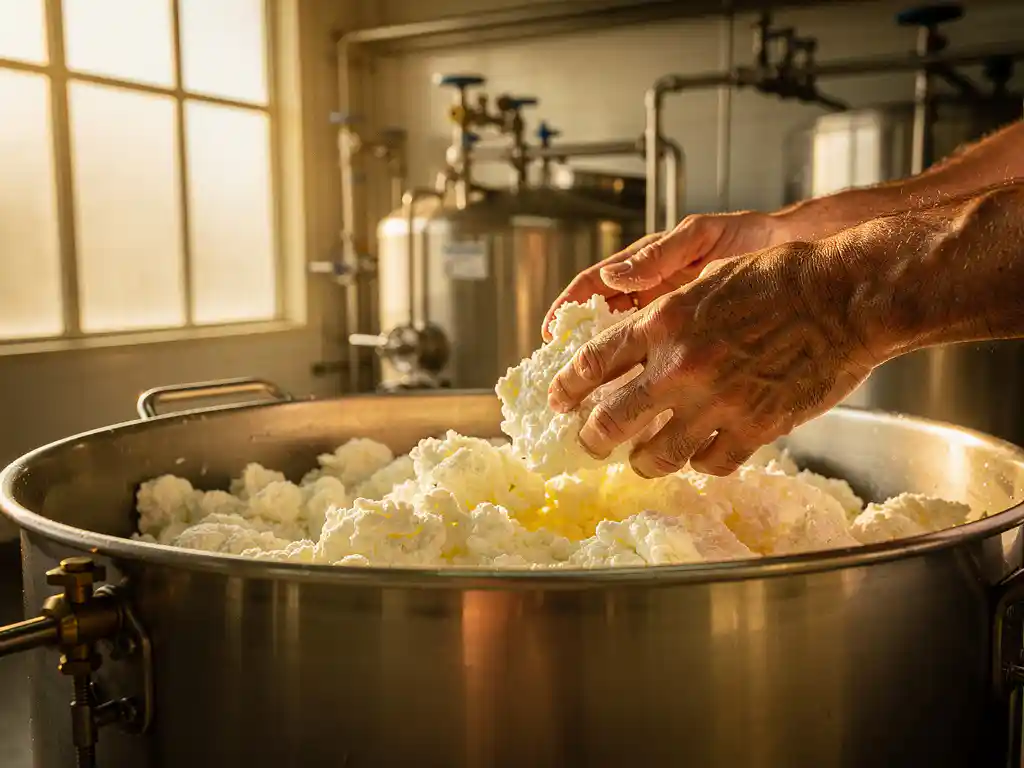
When selecting a supplier for industrial quark, speed is crucial. Production processes don’t stop, and a reliable partner for your quark needs must be quickly evaluated. Whether you’re looking for fresh goat quark, cow quark, or specific variants for your production line, an efficient qualification process saves valuable time and prevents production problems. This article provides practical guidelines for quickly and effectively assessing quark suppliers.
What are the key quality criteria for industrial quark?
The key quality criteria for industrial quark are dry matter content (35-45%), consistency, microbiological safety, functional properties like pumpability and freeze stability, and the absence of whey loss during processing. These parameters determine whether the quark is suitable for large-scale industrial applications.
Dry matter content is fundamental for the processing properties of quark. A consistent percentage between 35% and 45% ensures predictable results in production processes. Too low dry matter content leads to structural loss, while too high content complicates processability.
Microbiological parameters form a critical safety factor. Industrial quark must meet strict standards for total viable count, yeasts, molds, and pathogens. These values must remain consistent throughout the entire shelf life, both fresh and frozen.
Functional properties determine usability in specific applications. Pumpability is essential for automated production processes. Freeze stability without whey loss guarantees quality retention during long-term storage. The quark must remain stirrable without structural loss, even after multiple processing steps.
Sensory properties such as color, odor, and taste must be neutral and consistent. Deviations indicate quality problems or unwanted fermentation. For applications in bakery, tapas fillings, or semi-finished products, a neutral base is essential for the final result.
How do you test the consistency of quark deliveries?
Test the consistency of quark deliveries by systematically analyzing samples from at least five consecutive batches for dry matter content, pH value, texture, and microbiological parameters. Document all measurements and calculate standard deviation to objectively establish supplier reliability.
Start by establishing a test protocol where each delivery is sampled according to the same method. Take samples at different points in the packaging to get a representative picture. For 15 kg buckets, this means at least three sampling points: top, middle, and bottom.
Perform standard laboratory tests on each sample:
- Dry matter determination via oven drying method at 105°C
- pH measurement with calibrated electrode
- Texture analysis with penetrometer for hardness and cohesion
- Microbiological count according to ISO standards
- Visual inspection for color deviations or foreign particles
Record all measurements in a database and calculate the average value and standard deviation per parameter over the test period. A standard deviation below 5% for dry matter content and below 0.2 for pH value indicates good consistency. Higher variations point to process control problems at the supplier.
Also evaluate the documentation per delivery. Consistent suppliers provide detailed specification sheets with current analysis results. Compare the stated values with your own measurements to verify the reliability of supplier information.
What certifications should a quark supplier have?
A quark supplier must have at least IFS Food or BRC certification, EC accreditation for dairy processing, HACCP implementation, and traceability systems. For specific markets, additional certificates such as Halal, Kosher, or VLOG are necessary, depending on your end product and target market.
IFS Food certification guarantees that the supplier meets international standards for food safety and quality management. This standard covers production processes, hygiene, traceability, and risk management. A current IFS certificate with high score (minimum Higher Level) indicates professional operations.
EC accreditation is legally required for dairy processors in the European Union. The EC number on product packaging confirms that the producer complies with all EU regulations for dairy production. Check if the company is regularly inspected by national authorities such as COKZ in the Netherlands.
Industry-specific certifications show commitment to sustainability and quality:
- DGZK (Sustainable Goat Dairy Chain) for goat quark guarantees animal welfare and transparency
- GMP+ Feed Safety Assurance for quark intended for animal feed
- Kwaligeit certification for milk suppliers ensures quality from the source
For international trade or specific product lines, religious certifications are often required. Halal and Kosher certificates must be current and issued by recognized authorities. VLOG certification is essential for the German market when GMO-free raw materials are required.
What is the difference between fresh and frozen industrial quark?
The difference between fresh and frozen industrial quark lies in shelf life (4 weeks fresh versus 2 years frozen), processing properties after thawing, and logistical flexibility. Frozen quark retains all functional properties, provided it is correctly frozen and thawed, while fresh quark requires immediate processing.
Fresh quark has a limited shelf life of typically 4 weeks from production. This requires precise planning and just-in-time delivery. The quark maintains optimal processing properties during this period, particularly for applications where texture is critical, such as fresh fillings or direct consumption.
Frozen quark offers significant advantages for production planning. With a shelf life of 2 years, larger inventories can be maintained, reducing price fluctuations and delivery risks. After correct thawing at 4°C for 24-48 hours, the quark fully recovers its original properties.
Quality differences between fresh and frozen are minimal with professional freezing methods:
- Modified Atmosphere Packaging (MAP) prevents freezer burn
- Quick freezing at -40°C preserves cell structure
- Stable frozen storage at -18°C guarantees consistent quality
- No whey loss during thawing through proper process control
The choice between fresh and frozen depends on production volume, storage capacity, and processing frequency. Large-scale producers often prefer frozen quark for inventory security, while artisanal processors prefer fresh quark for optimal flavor experience.
How do you conduct a quick supplier audit?
Conduct a quick supplier audit for quark via a structured checklist in maximum one day: document review (2 hours), production site inspection (3 hours), sampling and analysis (1 hour), and final reporting (2 hours). Focus on critical control points such as hygiene, process control, and traceability.
Start with document review prior to the site visit. Request certificates, specification sheets, complaint registration, and recall procedures. Verify the validity of certifications online and check if specifications match your requirements. This saves time during the physical visit.
During the location inspection, focus on five main areas:
- Raw material reception: milk supply control, temperature registration, sampling
- Production process: production room hygiene, process parameters, personnel competence
- Packaging and storage: packaging materials, temperature control, FIFO system
- Laboratory: analysis capacity, equipment calibration, records
- Dispatch: transport conditions, documentation, traceability
Take representative samples from different production batches for your own analysis. Test at least dry matter content, pH, and microbiology. Compare results with supplier specifications to verify reliability. Also request reference samples from deviant batches to assess problem-solving capability.
Conclude with a brief evaluation discussion where findings are discussed. Ask critical questions about capacity, flexibility, and contingencies. A professional supplier has clear answers on delivery security, quality deviations, and emergency procedures. Document all findings in a standardized report for objective comparison between suppliers.
How De Jong Cheese helps with qualifying industrial quark
We understand that time is precious in your selection process. Therefore, we make qualifying our industrial quark as efficient as possible. With our transparent approach and comprehensive documentation, you can determine within one working day whether our quark meets your requirements.
Our support for quick qualification includes:
- Directly available certifications: IFS Food, EC accreditation (NL Z1977 EU), Halal and Kosher certificates
- Detailed product specifications with guaranteed values for dry matter content (35-45%)
- Free test samples of both fresh goat quark and cow quark
- Technical support for processing tests in your production line
- References from industrial customers worldwide
- Possibility for site visit and audit within 48 hours
Our quark is characterized by freeze stability without whey loss, pumpability for automated processes, and consistent quality thanks to our traditional production since 1995. With a shelf life of 4 weeks fresh or 2 years frozen, we offer the flexibility that modern production requires.
Start testing our industrial quark today. Contact us for free samples and technical documentation. Visit our product page for the complete range or visit our Alphen store for a personal introduction. Discover more about our family business at dejongcheese.nl.
Veelgestelde vragen
How long does it take on average to fully qualify a new quark supplier?
A complete qualification of a quark supplier typically takes 2-4 weeks, including document review, site audit, laboratory testing of multiple batches, and contract negotiations. For urgent situations, preliminary approval can be given within 48-72 hours based on certifications, test samples, and references, followed by extensive validation during the first deliveries.
What are the most common pitfalls when switching quark suppliers?
The biggest pitfalls are underestimating recipe adjustments (different quarks often require different proportions), ignoring seasonal influences on quark quality, and insufficient communication about specific processing requirements. Prevent problems by testing in parallel with your current supplier, evaluating seasonal samples, and discussing technical specifications in detail including your exact production processes.
What costs should I include when comparing quark suppliers besides the product price?
Calculate in addition to the per-kilo price also transport costs, minimum order size, storage costs (fresh versus frozen), quality controls, possible production losses due to inconsistent quality, and administrative burdens. A supplier with 5% higher price but better consistency and service can be more advantageous overall due to lower processing costs and less production downtime.
How do I test if frozen quark remains suitable for my production process after thawing?
Perform a complete cycle test: freeze fresh quark samples according to supplier specifications, store for at least 1 month at -18°C, thaw according to protocol (24-48 hours at 4°C), and then test pumpability, whey separation, pH stability, and processability in your specific application. Compare results with fresh quark and repeat the test with samples from different production dates for seasonal variation.
When is it worthwhile to contract multiple quark suppliers?
Dual sourcing is advisable for annual volumes above 100,000 kg, critical product lines without substitution possibilities, or when your production has seasonal peaks that one supplier cannot handle. Distribute orders 70/30 or 60/40 between main supplier and backup to keep both relationships active, strategically distributing different quark types (goat/cow) or fresh/frozen across suppliers.
What technical support can I expect from a professional quark supplier?
A professional supplier offers application testing in their laboratory, on-site troubleshooting for processing problems, recipe advice for new product development, training for your production personnel on optimal processing, and proactive communication about quality variations or availability issues. Ask explicitly during qualification about these services and whether they are included or at additional cost.
Gerelateerde artikelen
- Hoe borg je traceerbaarheid van melk tot eindproduct bij geitenkaasinkoop?
- Hoe gebruik je een keurmerk als onderscheidend element in productontwikkeling?
- Wat zijn de kosten van een leverancierswissel bij industriële geitenkaas wrongel?
- Hoe verkort je het selectieproces bij het zoeken naar een nieuwe kaasleverancier?
- Wat zijn de signalen dat een leverancier van geitenkaas crumbles onbetrouwbaar is?