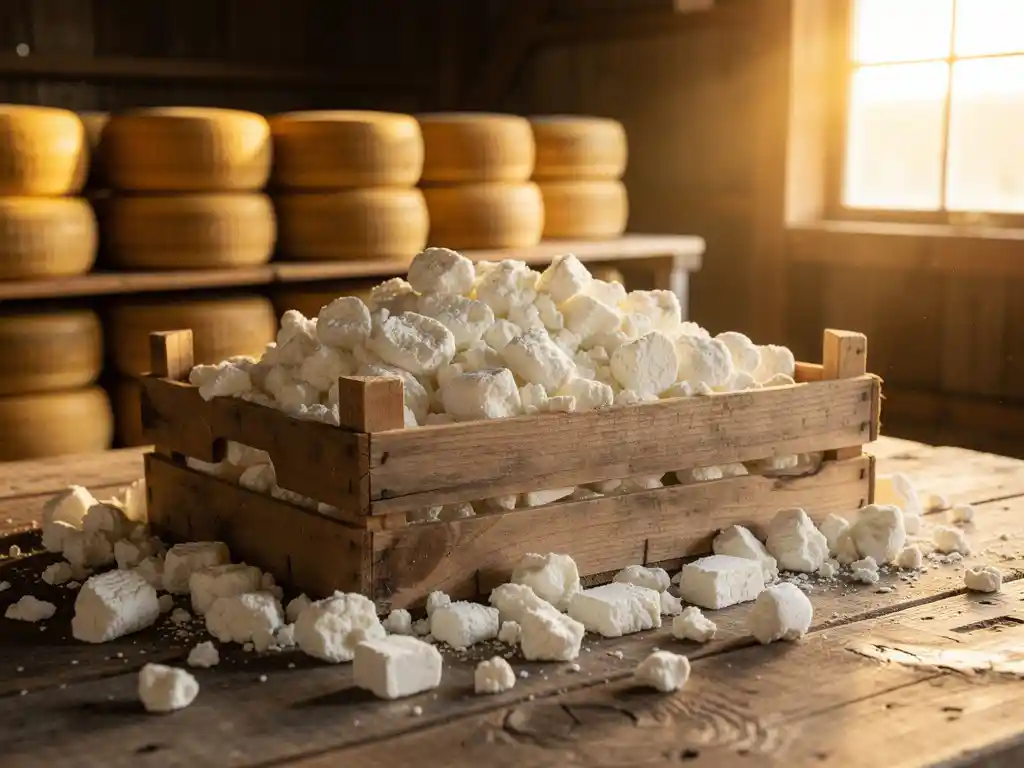
As a purchaser in the food industry, you know how crucial reliable suppliers are for your production line. Goat cheese crumbles are increasingly used in ready-made meals, pizzas, and salads. The demand for consistent quality and large volumes is growing, but can you trust that a Dutch producer meets these requirements? In this article, we answer the key questions about industrial supply of goat cheese crumbles.
What are goat cheese crumbles and why are they popular in the food industry?
Goat cheese crumbles are crumbled pieces of fresh or aged goat cheese with a grain size of 5-15 millimeters, specifically developed for industrial applications. This pre-crumbled cheese saves processing time, offers consistent portioning, and melts evenly in hot dishes like pizzas, quiches, and casseroles.
The popularity of goat cheese crumbles in the food industry stems from multiple practical advantages. First, they offer a distinctive flavor that is milder than traditional goat cheese, making them widely applicable. The crumbles have a longer shelf life than fresh goat cheese in blocks, often up to 23 weeks under proper conditions. This reduces waste and simplifies inventory management.
For production lines, crumbles are ideal because they can be used directly from the packaging without additional processing steps. The uniform format ensures consistent dosing in automated systems. Moreover, goat cheese crumbles are naturally lactose-free, which meets the growing demand for lactose-free products in the market.
What volume of goat cheese crumbles can a Dutch producer supply?
Dutch goat cheese producers can typically supply between 500 and 5,000 kilograms of goat cheese crumbles per week, depending on production capacity and seasonal demand. Established family businesses with modern facilities can flexibly scale up to 20,000 kilograms per month for large industrial customers.
Supply capacity depends on various factors. Traditional cheese makers that have been active since the 1990s have often built extensive networks of milk suppliers. This enables them to guarantee consistent volumes, even during seasonal peaks. A typical production line for goat cheese crumbles can process 200-300 kilograms per hour, with modern equipment ensuring uniform crumbling.
For industrial customers, minimum order quantities (MOQ) are important. Dutch producers usually maintain an MOQ of 1,200 units for packaged units, which amounts to approximately 144-288 kilograms per order, depending on packaging size. Lead times vary from 2-4 weeks for standard orders, with possibilities for rush deliveries for urgent needs. Many producers also offer inventory contracts where weekly or monthly deliveries are guaranteed according to fixed schedules.
What determines the consistency of goat cheese crumbles in large volumes?
The consistency of goat cheese crumbles is primarily determined by standardized production processes, constant milk quality, and controlled aging conditions. Dutch producers use traditional recipes with modern quality controls to minimize batch-to-batch variations to less than 5% in texture and flavor.
The production process begins with milk selection. Experienced cheese makers work with fixed groups of goat farmers who use the same feeding methods. The milk is tested daily for fat content, protein values, and bacteriological quality. These parameters are carefully tracked to compensate for seasonal influences.
During cheese production, temperature control and starter management are crucial. The milk is acidified and coagulated according to exact time schedules, with each batch receiving the same treatment. Cutting, stirring, and draining are done with programmed equipment that eliminates human variations. For crumbling, modern facilities use precision equipment that keeps grain size within strict tolerances.
Aging conditions play an essential role in aged goat cheese crumbles. Climate-controlled aging chambers keep temperature and humidity constant, regardless of external weather conditions. This results in predictable texture development and a consistent flavor profile across all batches.
How do you test if goat cheese crumbles are suitable for your production line?
Test goat cheese crumbles by first processing small trial batches in your production line, paying attention to melting behavior, texture after heating, and flavor retention. Ask suppliers for technical specifications and test samples of at least 5 kilograms to simulate realistic production scenarios.
Start with a laboratory test where you subject the crumbles to your specific processing temperatures. Note the melting point, oil separation, and color change at different temperatures between 180-220 degrees Celsius. For pizza applications, it’s important that the crumbles melt evenly without forming brown spots. For ready-made meals, the cheese must maintain its structure during freezing and reheating.
Then perform a machine test on your production line. Check if the crumbles flow smoothly through dosing systems without clumping. Measure portioning accuracy over at least 100 products to ensure consistency. Watch for possible blockages in hoppers or conveyor belts. Also test the shelf life of your end product with the new goat cheese crumbles under different storage conditions.
Finally, organize a taste panel with your quality team. Compare products with different percentages of goat cheese crumbles to determine the optimal recipe. Document all test results systematically for future reference and communication with your supplier.
What are the key certifications for industrial goat cheese supply?
The essential certifications for industrial goat cheese supply are IFS Food, BRC Global Standards, and FSSC 22000, supplemented with specific Dutch quality marks such as the DGZK certificate. These certifications guarantee food safety, traceability, and consistent quality according to international standards.
IFS Food (International Featured Standards) is the most requested certification in the European food industry. This standard sets strict requirements for production processes, hygiene, HACCP implementation, and quality management. For goat cheese producers, this means detailed documentation of every production step, from milk receipt to end product. Audits take place annually where all aspects of production are checked.
The DGZK quality mark (De Groene Koe Zuivelketen) is specific to Dutch dairy products and guarantees sustainable production. This includes animal welfare, environmental management, and transparent business operations. For industrial customers, this provides assurance about ethical production and corporate social responsibility.
Additional important certifications are:
- Halal certification for export to specific markets
- ISO 22000 for food safety management systems
- SKAL certification for organic goat cheese crumbles
- GMP+ for animal feed applications of by-products
How do you prevent supply chain disruptions with goat cheese crumbles?
Prevent supply chain disruptions by signing long-term contracts with established Dutch producers, maintaining buffer stocks of 4-6 weeks, and identifying backup suppliers. Implement an early warning system where suppliers proactively communicate about potential disruptions.
Risk management begins with supplier selection. Choose producers with proven track records of at least 10 years of consistent delivery. Dutch family businesses that have been active since the 1990s often have robust networks that absorb seasonal fluctuations. Ask about their continuity plans for situations like milk shortages, power outages, or transport problems.
Develop a diversified approach with multiple supply options. Combine fixed monthly contracts for base volumes with flexible call-off orders for peaks. Consider Modified Atmosphere Packaging (MAP) for longer shelf life, allowing you to maintain larger buffers without quality loss. Also discuss private label possibilities where exclusive production runs guarantee your availability.
Technology plays a crucial role in modern supply chain management. Implement real-time inventory monitoring linked to automatic ordering systems. Many Dutch producers offer EDI connections for seamless integration with your ERP system. This reduces administrative errors and speeds up the ordering process. Also make agreements about emergency deliveries within 48 hours for unforeseen situations.
How DeJong Cheese helps with consistent delivery of goat cheese crumbles
As a family business since 1995, we at DeJong Cheese understand the challenges of industrial processors. Our Alphenaer goat cheese specialties are produced according to traditional recipes, with modern technology ensuring the consistency your production line requires. With our experience in global delivery to retail, foodservice, and industry, we offer reliable solutions for large volumes.
Our approach for industrial partners includes:
- Flexible production capacity up to 20,000 kg per month
- Guaranteed lead times of 2-4 weeks
- Private label possibilities for exclusive recipes
- IFS Food certification for maximum food safety
- Technical support in product development
- 23 weeks shelf life for optimal inventory management
We invite you to discover our foodservice possibilities and experience how traditional craftsmanship and modern efficiency come together. Contact us for a no-obligation conversation about your specific needs. Also visit our sales points to taste our products, or view our complete range on our website.
Veelgestelde vragen
How can I control the quality of goat cheese crumbles before placing a large-scale order?
First ask for reference products from comparable industrial customers and technical datasheets with detailed specifications. Then test at least 3 different batches over a period of 6 weeks to assess seasonal variations. Also perform stability tests where you store the crumbles under your standard warehouse conditions and check weekly for texture, color and flavor retention.
Which packaging options are most suitable for automated production systems?
For automated systems, flowpack bags of 2-5 kg with easy-peel closure are ideal, as these can be opened mechanically without product loss. Bulk packaging in 10-20 kg boxes with PE liner works excellently for high-volume applications. Consider vacuum packaging with perforated film for optimal breathing during longer storage, especially when working with just-in-time deliveries.
What are typical problems when switching from block cheese to crumbles in existing recipes?
The moisture content of crumbles can be 3-5% lower than block cheese, which affects the final texture of your product. Adjust dosages with 10-15% more crumbles to maintain the same cheese intensity. Also watch for faster melting times; reduce oven temperatures by 10-20°C or shorten baking times by 15-20% to prevent burning.
How do I calculate the actual cost savings when switching to goat cheese crumbles?
Calculate not only the kilogram price, but also labor costs (saving 2-3 man hours per 100 kg), reduced waste percentages (typically 5-8% less waste), and longer shelf life that can reduce inventory costs by 20-30%. Also factor in energy savings through shorter processing times and reduced cooling capacity. A realistic ROI calculation usually shows 15-25% total cost savings within 6 months.
What adjustments are needed in my HACCP plan when introducing goat cheese crumbles?
Update your allergen management because goat milk is a separate allergen, add new CCPs for temperature control during storage (max 7°C), and implement specific metal detection settings for crumbles. Document new microbiological limit values (Listeria <10 cfu/g, E.coli <100 cfu/g) and train personnel in correct handling of pre-packaged dairy products according to the new process steps.
How do I prevent clumping of goat cheese crumbles during storage and transport?
Store crumbles at constant temperature between 2-6°C with maximum 75% humidity, use anti-caking agents like cellulose (0.5-1%) if permitted in your product, and avoid temperature fluctuations during transport. Implement first-in-first-out rotation strictly and use within 7 days after opening. For bulk storage, perforated containers are essential to prevent condensation formation.
Gerelateerde artikelen
- Hoe bescherm je je inkoopbudget tegen prijsschommelingen in geitenmelk?
- Wat zijn de mogelijkheden van lokale sourcing als unique selling point?
- Waar let een inkoper op bij het selecteren van een producent van industriële geitenkaas?
- Hoe voorkom je leveringsonderbrekingen bij je vaste kaastoeleverancier?
- Wat zijn de signalen dat een leverancier van geitenkaas crumbles onbetrouwbaar is?