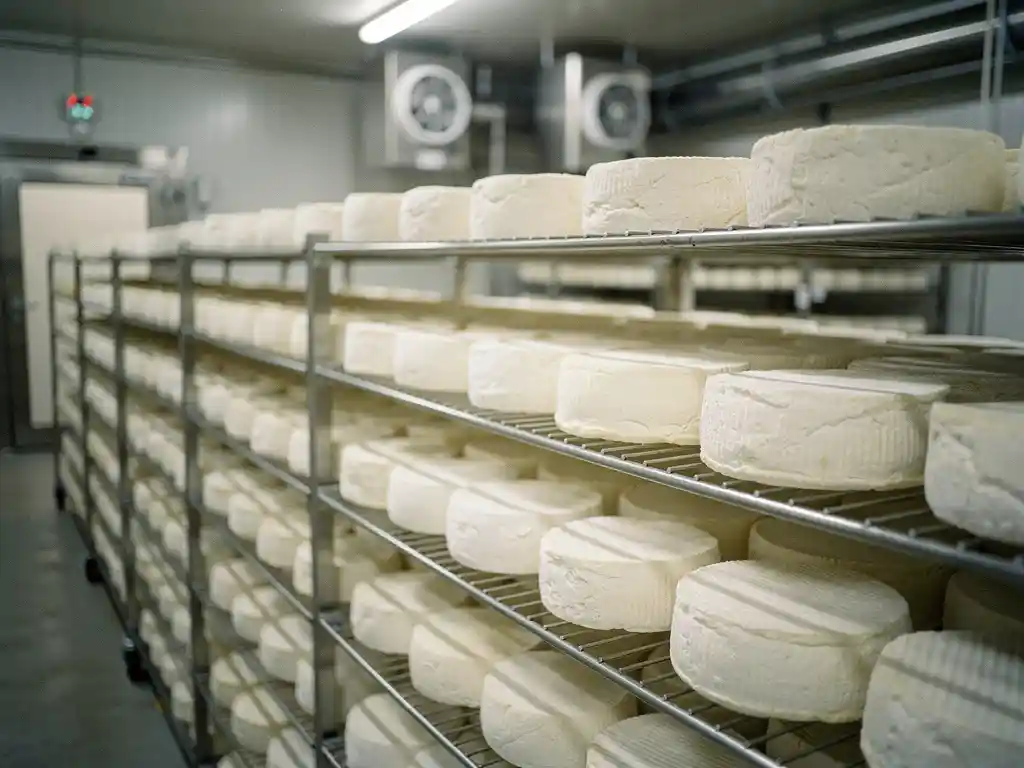
In the food industry, managing the shelf life of fresh goat cheese pucks is a critical factor for product quality and food safety. Whether you’re working with goat cheese slices for ready-to-eat meals or fresh goat cheese for pizzas, effective shelf life management prevents waste and ensures consistent quality. This article answers the key questions about optimizing the shelf life of goat cheese pucks in production environments.
What determines the shelf life of fresh goat cheese pucks?
The shelf life of fresh goat cheese pucks is primarily determined by moisture content, pH value, salt content, and packaging method. Fresh goat cheese typically has a shelf life of 4 to 8 weeks when properly stored, while aged varieties can last up to 23 weeks due to their lower moisture content and protective rind.
The production process plays a fundamental role in shelf life. The quality of the goat milk used forms the foundation – milk from local farms that is processed immediately after milking results in longer shelf life. The acidification process and degree of coagulation influence the microbiological stability of the final product.
The packaging method has a direct impact on shelf life. Modified Atmosphere Packaging (MAP) can significantly extend the shelf life of fresh goat cheese pucks by reducing oxygen content and inhibiting the growth of unwanted microorganisms. Vacuum packaging offers similar benefits for spreadable goat cheese varieties.
Temperature control throughout the entire process – from production to storage – is essential. Every degree of temperature increase can shorten shelf life by days. For industrial applications, this means an integrated cold chain from production to processing is necessary.
How do you calculate the optimal shelf life for goat cheese pucks in production?
Calculating the optimal shelf life begins with microbiological analyses and sensory tests under different storage conditions. Conduct accelerated shelf-life testing at elevated temperatures (10-15°C) and extrapolate the results to normal storage temperatures (2-4°C) to get a reliable estimate within 2-3 weeks.
For an accurate calculation, you must consider the following factors:
- Initial microbiological load of the product
- Growth curves of relevant microorganisms at different temperatures
- Sensory deviations such as flavor changes or texture loss
- Chemical parameters such as pH decline and fatty acid development
- Packaging integrity during storage time
Use the Q10 rule as a starting point: for every 10°C temperature increase, the reaction rate of chemical and microbiological processes doubles. This means products that are shelf-stable for 8 weeks at 4°C are only shelf-stable for 4 weeks at 14°C.
Implement a safety margin of at least 30% on the calculated shelf life. If tests show that goat cheese slices remain acceptable for 10 weeks, set the expiration date at a maximum of 7 weeks. This buffer compensates for variations in distribution and storage conditions.
What storage conditions extend the shelf life of fresh goat cheese pucks?
Optimal storage conditions for fresh goat cheese pucks require a constant temperature between 2-4°C, relative humidity of 80-85%, and protection from light and temperature fluctuations. These conditions slow microbiological growth and enzymatic processes that lead to quality loss.
Temperature stability is crucial – fluctuations of more than 2°C can cause condensation, which promotes mold growth. Invest in cold rooms with precise temperature control and place temperature loggers at critical points to detect deviations immediately.
Humidity must be carefully balanced. Too low humidity (below 75%) leads to dehydration and rind formation in fresh goat cheese, while too high humidity (above 90%) stimulates mold growth. For goat cheese balls in MAP packaging, external humidity is less critical but still relevant for packaging integrity.
Light protection prevents photo-oxidation of fats, which causes rancidity and color changes. Use dark storage rooms or light-tight packaging. UV radiation is particularly harmful and must be completely excluded.
Air circulation in the storage room must be sufficient to prevent temperature gradients, but not so strong that it causes dehydration. An air flow of 0.1-0.3 m/s is usually optimal for refrigerated storage of packaged cheese products.
What are the biggest risks to shelf life in a production environment?
The biggest risks to shelf life are temperature fluctuations during transport and storage, cross-contamination in production areas, inadequate hygiene of equipment, packaging damage, and human errors in product handling. These factors can reduce the shelf life of fresh goat cheese by 50-75%.
Temperature control poses the greatest risk. Any interruption in the cold chain, even for short periods, accelerates microbiological growth exponentially. A temperature rise to 10°C for 4 hours can shorten the remaining shelf life of goat cheese slices by a week.
Cross-contamination occurs when pathogens or spoilage organisms from other products or surfaces reach the cheese. This risk is particularly high in multi-functional production areas where different dairy products are processed. Strict separation of product flows and regular disinfection are essential.
Packaging integrity is critical for aged goat cheese in MAP packaging. Small holes or tears disrupt the protective atmosphere and drastically shorten shelf life. Implement inline packaging controls and train personnel in correct handling of packaged products.
Human factors such as incorrect FIFO management, wrong temperature settings, or unhygienic work often represent underestimated risks. An employee who forgets to change gloves after a break can compromise an entire production batch.
How do you implement an effective FIFO system for goat cheese pucks?
An effective FIFO system (First In, First Out) for goat cheese pucks requires clear product labeling with production date and shelf life, physical separation of batches, digital tracking via WMS or ERP systems, and daily checks by designated employees. This system prevents older products from being left behind while newer ones are shipped.
Start with a visual management system where each batch of goat cheese slices gets a unique color code per production week. For example:
- Week 1: Red labels
- Week 2: Yellow labels
- Week 3: Green labels
- Week 4: Blue labels
Set up the warehouse with clearly marked FIFO lanes where new products can only be added at the back and picking only happens from the front. Install physical barriers or roller tracks that enforce this flow.
Implement a digital tracking system that provides real-time insight into product age and location. Modern WMS systems can automatically generate warnings when products approach their shelf life limit. For spreadable goat cheese with shorter shelf life, set warnings at 50% and 75% of total shelf life.
Train all warehouse employees in FIFO principles and make one person per shift responsible for FIFO compliance. Conduct weekly audits where products are randomly checked for proper rotation. Document deviations and implement corrective measures immediately.
What quality controls are essential for shelf life management?
Essential quality controls include daily temperature measurements, weekly microbiological tests on finished products, sensory evaluations at 25%, 50% and 75% of shelf life, pH measurements, and packaging integrity controls. These controls detect deviations before they compromise product quality.
Microbiological monitoring must include at least the following parameters:
- Total plate count (aerobic mesophilic)
- Lactic acid bacteria
- Yeasts and molds
- Enterobacteriaceae as hygiene indicator
- Pathogens such as Listeria monocytogenes (monthly)
Sensory evaluation is crucial for fresh goat cheese because flavor and texture changes often occur before microbiological limits are exceeded. Train a panel of at least 5 employees to recognize deviations such as acidification, bitterness, rancidity, or texture loss.
pH monitoring provides early indication of unwanted fermentation. Fresh goat cheese balls should maintain a stable pH between 4.2-4.6. A drop below 4.0 indicates excessive acidification, while a rise above 5.0 may indicate proteolytic activity.
Packaging controls must include both visual inspection and instrumental tests. Check MAP packages for gas composition with a headspace analyzer. For vacuum-packed products, measure the residual oxygen content which should remain below 2% for optimal shelf life.
How DeJong Cheese helps with shelf life management of fresh goat cheese pucks
At DeJong Cheese, we offer complete support for optimizing shelf life management in production environments. With our years of expertise since 1995 and high-quality Alphenaer goat cheese products, we help industrial customers like you minimize waste and maximize quality.
Our shelf life management solutions include:
- Technical specifications and shelf life data for all product variants
- Advice on optimal storage and processing conditions
- Consistent product quality through traditional production methods
- Flexible packaging options adapted to your production process
- Support in setting up quality control systems
Our fresh goat cheese pucks and aged varieties are specifically developed for industrial processing, with guaranteed shelf life and consistent properties. From spreadable goat cheese for ready-to-eat meals to goat cheese slices for pizza applications – we deliver products that perfectly match your production needs.
Contact us today for a personal consultation about shelf life optimization in your production environment. Visit our foodservice page for more information about our complete range, or directly contact our specialists. Also discover where you can find our products through our sales points page, or visit our homepage for the latest news about our goat cheese specialties.
Veelgestelde vragen
How can I extend the shelf life of goat cheese pucks without affecting the flavor?
Use Modified Atmosphere Packaging (MAP) with an optimal gas mix of 30% CO2 and 70% N2, combine this with natural preservatives such as lactic acid cultures, and consider High Pressure Processing (HPP) treatment that eliminates pathogens without affecting sensory properties. These methods can extend shelf life by 30-50% while maintaining the authentic goat cheese flavor.
What are the first signs that goat cheese pucks are approaching their optimal shelf life?
Watch for subtle changes such as slight discoloration at the edges, minimal moisture development in the packaging, a slightly softer texture in hard cheeses or becoming firmer in soft variants, and a slightly more intense odor. These early warning signals usually appear 7-10 days before the official expiration date and indicate that you should accelerate inventory rotation.
What software or tools are most effective for monitoring shelf life data in large production volumes?
Implement an integrated system such as SAP Extended Warehouse Management or Infor CloudSuite Food & Beverage with real-time dashboards for shelf life monitoring. Combine this with IoT sensors for temperature recording and RFID tags for automatic batch tracking. For smaller operations, tools like FoodLogiQ or Parsley Software are cost-effective alternatives specifically designed for shelf life management in the food industry.
How do I effectively train production employees in shelf life management without reducing productivity?
Develop micro-learning modules of 5-10 minutes that employees can follow during quiet moments, implement visual work instructions directly on the shop floor with QR codes to instructional videos, and organize monthly ‘quality walks’ where experienced operators coach new employees. Gamification with a point system for correct FIFO management and temperature controls increases engagement without requiring additional training time.
What is the difference in shelf life management between organic and regular goat cheese pucks?
Organic goat cheese pucks often have 15-20% shorter shelf life due to the absence of synthetic preservatives and higher initial microbiological load of organic milk. Compensate for this with stricter temperature control (maximum 3°C), more frequent microbiological monitoring (2x per week), and shorter distribution chains. Consider natural biopreservation methods such as protective lactic acid cultures for organic products.
What equipment investments deliver the greatest ROI for shelf life improvement?
Prioritize investments in continuous temperature monitoring systems (ROI within 6 months through reduced waste), automatic MAP packaging machines with inline gas analysis (30-40% longer shelf life), and rapid microbiological testing systems such as TEMPO® or BactiFlow® that provide results within 24 hours instead of 3-5 days. These technologies together can reduce product loss by 60-70%.
How do I deal with seasonal fluctuations in the shelf life of goat cheese products?
Adjust your shelf life calculations seasonally: reduce shelf life by 10-15% during warm summer months when the cold chain is more vulnerable, increase microbiological controls in spring when milk composition changes due to fresh grass, and implement stricter receiving controls for raw materials during autumn. Work with buffer stocks of 20% extra during peak periods and communicate seasonal variations proactively to customers.
Gerelateerde artikelen
- Wat is de invloed van vetgehalte op het smeltgedrag van geitenkaas in pizzaproductie?
- Wat zijn de voordelen van een exclusief partnerschap met een gespecialiseerde geitenkaasproducent?
- Hoe beoordeel je een productcatalogus van een geitenkaasproducent als inkoper?
- Waarom is leveranciersconcentratie een risico bij de inkoop van geitenkaas pucks?
- Wat zijn de signalen dat een leverancier van geitenkaas crumbles onbetrouwbaar is?