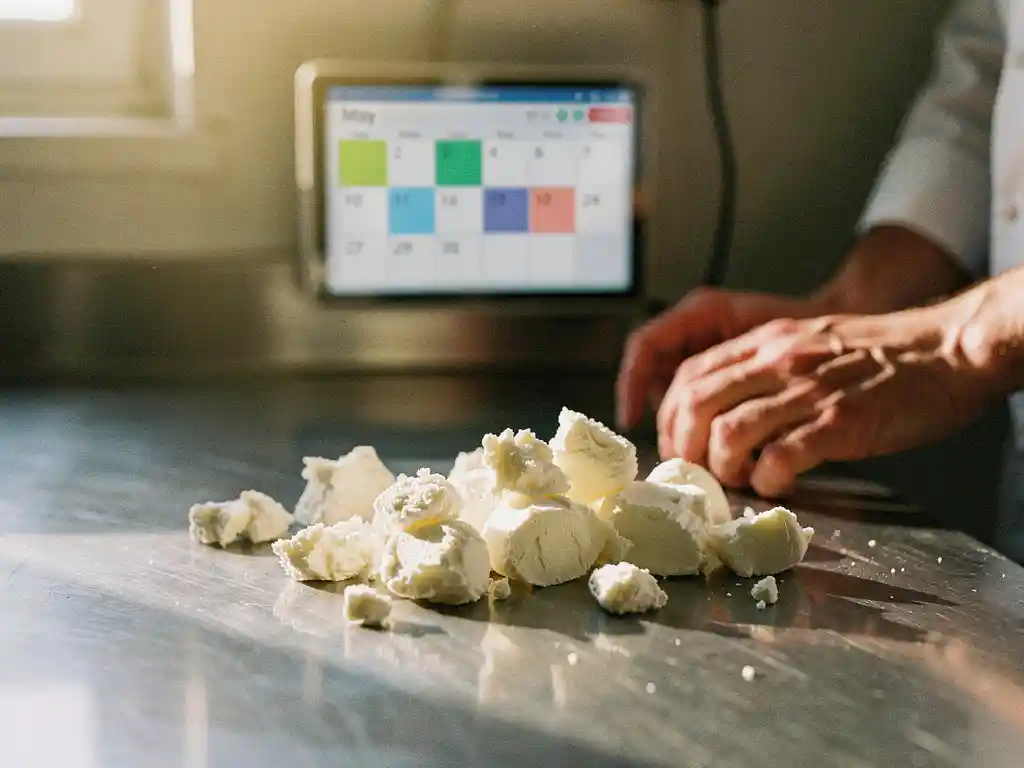
In the food industry, shelf life is a crucial factor for buyers when selecting ingredients. For goat cheese crumbles, an extended shelf life of 23 weeks can make the difference between efficient production and costly waste. This extended shelf life offers buyers like Marco Visser, who are responsible for purchasing cheese products for industrial processing, significant advantages in inventory management, production planning, and risk management.
What does a 23-week shelf life mean for goat cheese crumbles?
A 23-week shelf life for goat cheese crumbles means that the product retains its quality, flavor, and food safety for over five months from the production date under proper storage conditions. This is significantly longer than fresh cheese products that are often only shelf-stable for a few weeks, giving buyers much more flexibility in their planning and inventory management.
The extended shelf life is made possible through specific production techniques and packaging methods such as Modified Atmosphere Packaging (MAP). This technology replaces the air in the packaging with a protective gas mixture that slows the growth of microorganisms without using artificial preservatives. For goat cheese crumbles, this means that the characteristic flavor and texture are preserved throughout the entire shelf life period.
For industrial processors who use goat cheese in ready meals, pizzas, or salads, this long shelf life offers the opportunity to purchase larger volumes without the risk of spoilage. This is especially valuable for seasonal productions or when launching new product lines where sales velocity is still uncertain.
How does a long shelf life affect inventory costs for buyers?
A 23-week shelf life significantly reduces inventory costs because buyers can benefit from volume discounts on larger orders, need to order less frequently, and achieve lower transportation costs per unit. These financial benefits can amount to 15-20% cost savings annually for companies with consistent consumption of goat cheese crumbles.
The extended shelf life also reduces the need for just-in-time deliveries, which is especially important during supply chain disruptions. Buyers can build strategic inventory when prices are favorable or when delivery security is a factor. This provides negotiating power in price negotiations and protects against sudden price increases in the commodity market.
Additionally, longer shelf life dates reduce costs for inventory rotation and decrease administrative burden. Less frequent deliveries mean fewer incoming goods inspections, less invoice processing, and less time spent on supplier communication. For a medium-sized production company, this can translate to several hours of time savings per week for the purchasing department.
What production advantages does a 23-week shelf life offer in the food industry?
In the food industry, a 23-week shelf life translates directly to more flexible production planning, fewer production stops due to ingredient shortages, and the ability to better handle seasonal peaks. Production lines can run more efficiently when ingredients like goat cheese crumbles are consistently available without frequent quality checks or expiration date verifications.
The extended shelf life makes it possible to plan larger production batches without concerns about ingredient freshness. This is especially valuable for companies that work with campaign production or export to distant markets. A pizza producer can, for example, develop a special goat cheese variant for the Christmas period and purchase the required crumbles months in advance without quality loss.
For quality managers, the stable shelf life also means predictable product properties throughout the entire usage period. Melting behavior, texture, and flavor intensity remain consistent, resulting in end products with constant quality. This reduces complaints, increases customer satisfaction, and strengthens the producer’s brand.
What is the difference between fresh goat cheese and crumbles in terms of shelf life?
Fresh goat cheese typically has a shelf life of 4-8 weeks, while goat cheese crumbles can be shelf-stable for up to 23 weeks. This difference stems from the lower moisture content of crumbles, specific production processes, and optimized packaging methods that protect the product from spoilage without affecting the authentic flavor.
The production process of crumbles includes additional steps that extend shelf life. After traditional cheese making, the crumbles are dried to a specific moisture percentage, which limits the growth of microorganisms. The crumbly structure also has a smaller contact surface between particles, which slows oxidation. Fresh goat cheese, on the other hand, retains more moisture and has a homogeneous structure that is more sensitive to microbial growth.
For industrial applications, this difference means that crumbles are more suitable for products with longer distribution chains or more complex production processes. A frozen pizza producer can use crumbles without worrying about the time between production and consumption, while fresh goat cheese is better suited for products with shorter turnaround times like fresh salads or delicatessen preparation.
How does a long shelf life reduce supply chain risks for buyers?
A 23-week shelf life offers buyers a substantial buffer against supply chain disruptions by making it possible to maintain safety stock, handle supplier changes, and bridge seasonal fluctuations. This extended period gives companies the flexibility to purchase proactively rather than reactively, which is crucial in a market with increasing unpredictability.
During transportation disruptions, such as port strikes or road blockades, companies with longer shelf-life products can continue their production without immediate impact. A stock of several weeks of goat cheese crumbles can make the difference between production continuity and costly downtime. This is especially relevant for companies that depend on international suppliers or work with just-in-time production systems.
The extended shelf life also makes it possible to work with multiple suppliers without complex inventory rotation. Buyers can spread orders across different suppliers for risk distribution, with the long shelf life ensuring that all products can be used within their quality period. This reduces dependence on one supplier and strengthens the negotiating position.
How DeJong Cheese helps with long-lasting goat cheese solutions
We at DeJong Cheese understand the challenges that buyers in the food industry face. Our Alphenaer goat cheese crumbles with a 23-week shelf life offer the perfect solution for companies looking for reliable, high-quality ingredients with maximum flexibility in planning and inventory management.
Our advantages for industrial buyers:
- Guaranteed 23-week shelf life for optimal inventory flexibility
- Consistent quality thanks to our traditional production processes since 1995
- IFS Food certification for complete food safety guarantee
- Flexible delivery options with minimum order quantities adapted to your needs
- Private label possibilities for your own brand positioning
With our years of experience in the foodservice and industrial sector, we can think along about the best solution for your specific application. Whether it concerns pizza toppings, ready meals, or salads, our technical specialists are ready to advise you on melting behavior, texture, and application possibilities.
Are you curious how our long-lasting goat cheese crumbles can optimize your production process? Contact us for a no-obligation conversation about your specific needs. Also visit our website for more information about our complete range or visit one of our sales points to experience our products yourself.
Veelgestelde vragen
How should I best store goat cheese crumbles with 23 weeks shelf life in my warehouse?
Store goat cheese crumbles at a constant temperature between 2-6°C in the original packaging, preferably in a separate cold room without strong odors. Ensure stable humidity (70-80%) and avoid temperature fluctuations by not placing products directly near the door. Register batch numbers and expiration dates in your inventory system for optimal FIFO rotation.
Can I freeze goat cheese crumbles to extend shelf life even further?
Although technically possible, freezing goat cheese crumbles is not recommended because it can affect texture and functionality. Melting behavior may change and the crumbly structure may be lost after thawing. With 23 weeks shelf life, freezing is usually unnecessary; rather plan your purchasing strategically to stay within regular shelf life.
What are the key quality indicators I should check upon receipt of a goat cheese crumbles delivery?
Check upon receipt the packaging integrity (no damage or bloated packages), product temperature (should be between 2-6°C), expiration dates and batch numbers. Perform random visual and odor checks: crumbles should have a uniform white to light yellow color without discoloration or mold formation, and a fresh, characteristic goat cheese smell without sour or ammonia-like odors.
How do I calculate the optimal order quantity for goat cheese crumbles with this long shelf life?
First calculate your average monthly consumption and multiply by 3-4 months for basic inventory. Account for seasonal peaks, planned promotions and a 20% safety margin. With 23 weeks shelf life you can safely maintain 4-5 months inventory, benefiting from volume discounts without spoilage risk. Use the formula: Optimal order quantity = (Average monthly consumption × 4) + (Seasonal peak × 1.2).
What documentation should I request from my supplier to guarantee the 23-week shelf life?
Request a technical product specification with microbiological parameters, a shelf life study supporting the 23 weeks, and regular analysis reports per batch. Also ensure a supplier declaration about preservation methods used (such as MAP), allergen information and traceability data. IFS or BRC certificates from the producer provide additional assurance about quality processes.
How can I monitor remaining shelf life of goat cheese crumbles in my ERP system?
Implement a batch tracking system where each incoming delivery is registered with production date and expiration dates. Set automatic alerts at 60, 30 and 14 days before expiration. Link this data to your production planning so older batches are automatically scheduled first. Many modern ERP systems like SAP or Microsoft Dynamics have standard modules for shelf life management that you can configure for your specific FIFO requirements.
What are typical mistakes companies make when purchasing long shelf-life cheese products?
The biggest mistake is over-purchasing without proper sales planning, where companies order too much purely because of the long shelf life. Other common errors are not checking storage conditions upon receipt, mixing different batches without registration, and ignoring FIFO principles because the product is ‘shelf-stable anyway’. Companies also often underestimate the impact of temperature fluctuations during internal transport between warehouse and production.
Gerelateerde artikelen
- Hoe ontwikkel je een fenugreek- of kruidenvariant binnen het Alphenaer-assortiment?
- Wat zijn de mogelijkheden van private label geitenkaasconcepten voor retailpartners?
- Hoe organiseer je een proeflevering van geitenkaas crumbles bij een nieuwe producent?
- Waarom is een leverancier met eigen melkbronnen binnen 100 km betrouwbaarder voor de industrie?
- Waar let een inkoper op bij het selecteren van een producent van industriële geitenkaas?