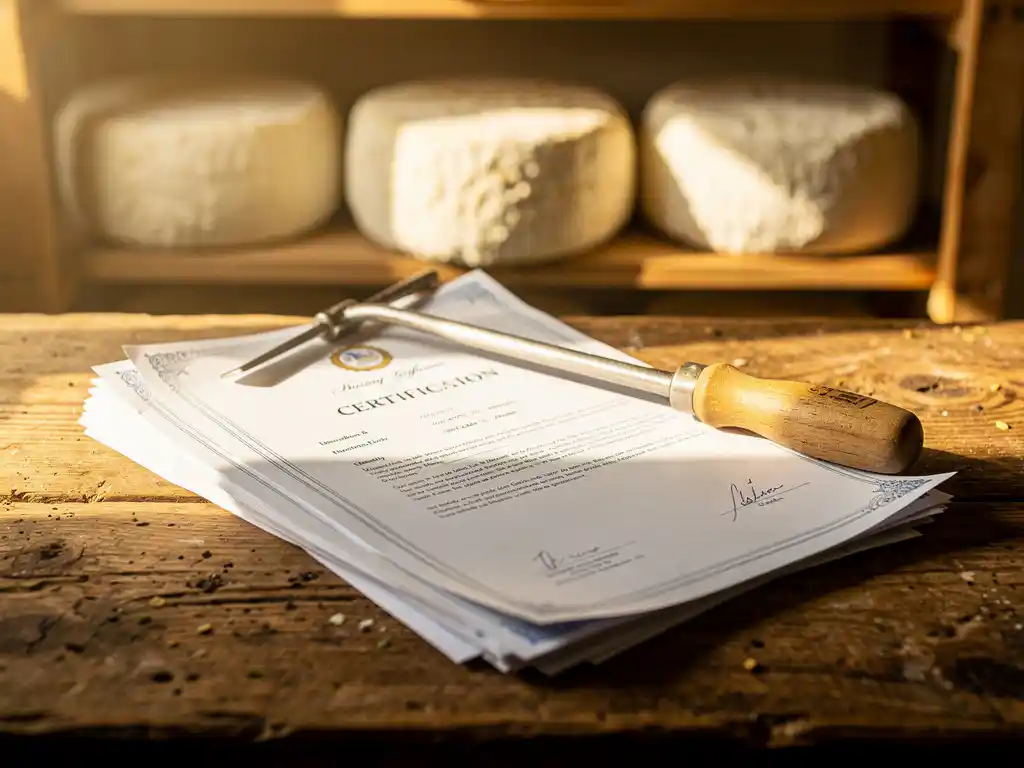
In the food industry, documentation is more than administration – it is the backbone of safe and reliable deliveries. As a buyer in the cheese industry, you know that the right paperwork makes the difference between smooth production and costly delays. From legal requirements to technical specifications: every supplier must be able to provide the correct documents immediately. This article covers exactly which documentation is essential and how you as a buyer can maintain control over the paperwork.
What are the legally required documents for cheese suppliers?
Cheese suppliers must be able to provide at minimum an EC accreditation, IFS Food certification, and an oval EU identification label with company number. These documents are legally required for trade within the European Union and guarantee that the supplier meets all hygiene and food safety requirements.
The EC accreditation proves that the company has been approved by the competent authorities and may export within Europe. The oval label with the unique company number (such as NL Z1977 EU) must be on every dairy product and enables direct traceability. In the Netherlands, the COKZ (Control Body for Dairy Quality) monitors whether companies meet all legal requirements.
In addition to these basic documents, there are additional certifications that are often mandatory for specific markets. Think of Halal and Kosher certificates for religious markets, GMP+ Feed Safety Assurance for animal feed ingredients, and VLOG certification for non-GMO products. For suppliers who source milk from farms, certification through the Kwaligeit chain quality system is standard.
Note that these documents must be current and regularly renewed. An expired certificate can lead to suspension of deliveries and fines. Therefore, always ask about the validity period and set reminders in your system for timely renewal.
What technical specifications should a cheese supplier be able to provide?
A professional cheese supplier provides standard specification sheets with fat content, dry matter percentage, pH value, salt content, microbiological parameters, and allergen information. This technical data is crucial for production processes and must be available per product batch.
For industrial applications, additional specifications are essential. Think of melting behavior at different temperatures, stability during freezing and thawing, and functional properties such as stirrability or pumpability. For cheese for pizza applications, for example, the supplier must be able to indicate whether the product is suitable for high-melt applications and what the behavior is during heating.
Shelf life data forms a separate chapter within the specifications. A supplier must be able to indicate exactly what the shelf life is from production and from delivery, both for fresh and frozen products. For products with Modified Atmosphere Packaging (MAP), different shelf lives often apply than for standard packaging.
Packaging specifications are equally important: weight per unit, number per box, pallet configuration (block or EU pallet), and whether the packaging is recyclable. With the increasing focus on sustainability, many customers want to know what percentage of the packaging is recyclable and whether there are plans for further sustainability improvements.
How quickly should a supplier be able to provide certificates?
Professional suppliers have all standard certificates available digitally immediately and can deliver them within 24 hours. For specific batch-related documents such as analysis certificates, a maximum delivery time of 48 hours after production or delivery applies.
The speed with which documentation is delivered says a lot about the professionalism of a supplier. Companies with a good document management system always have certificates such as IFS Food, BRC, or ISO 22000 current in a digital database. They can share these directly via email or through a supplier portal.
For urgent deliveries or audits, it is crucial that documents are available even faster. Therefore, when establishing a supplier relationship, ask about the procedure for urgent situations. Some suppliers offer 24/7 access to an online portal where you can download certificates yourself.
Note: speed should never come at the expense of completeness. A quick but incomplete certificate is worthless. Always check whether all pages are present, whether signatures and stamps are visible, and whether the validity date is correct.
What is the difference between an analysis certificate and a declaration of conformity?
An analysis certificate contains measurable test results from a specific batch, while a declaration of conformity confirms that a product meets pre-agreed specifications or standards. The analysis certificate is factual evidence, the declaration of conformity is a promise.
Analysis certificates are prepared after laboratory tests and contain concrete values: exact percentages of fat, protein, moisture, and microbiological counts. These documents are batch-specific and have a unique number linked to the production date. They are often used in complaint handling or quality controls.
Declarations of conformity are more general in nature and declare that products meet certain standards, legislation, or customer specifications. They may relate to allergens, GMO status, or food safety. These declarations are usually renewed annually and apply to an entire product range.
In practice, you need both documents. The declaration of conformity provides assurance about general product properties and compliance with legislation. The analysis certificate provides specific evidence for individual deliveries. In case of deviations or complaints, the analysis certificate is leading because it contains factual measured values.
What traceability documents are essential for cheese delivery?
Essential traceability documents include the EU oval with company number, batch numbers on product and packaging, delivery notes with best-before dates, and complete tracking from milk suppliers to end product. These documents must cover the entire chain from farm to delivery.
The traceability system begins with the milk suppliers. Professional cheese suppliers can demonstrate which farms the milk comes from, including certifications such as DGZK (Sustainable Goat Dairy Chain) for goat milk. This information must be linked to production data so that the source can be quickly traced in case of incidents.
During production, batch numbers are assigned that register all process steps: pasteurization temperatures, added ingredients, ripening times, and packaging moments. This data must be kept for at least two years after the best-before date according to EU legislation.
During delivery, CMR documents or digital waybills are essential for traceability during transport. These must contain temperature recordings for refrigerated products, exact delivery times, and signatures for receipt. Modern systems offer real-time tracking via GPS and temperature sensors, providing additional assurance about the cold chain.
How do you check whether supplier documentation is current and valid?
Check documentation by comparing validity dates with your delivery dates, verifying certificate numbers with issuing authorities, and scheduling an annual document audit. Set automatic reminders for expiration dates of critical certificates.
Start by setting up a supplier database where you digitally store all certificates with their expiration dates. Many companies use special software for this that automatically warns when documents expire. Ask suppliers to proactively send new versions as soon as certificates are renewed.
Regularly verify the authenticity of certificates by checking the numbers on the websites of certifying bodies. For IFS Food, you can consult the IFS Database, for example. Pay attention to details such as signatures, logos, and the scope of the certificate – does it cover all production locations and products you purchase?
Organize an annual formal supplier evaluation in which documentation is a fixed component. Ask not only about extensions of existing certificates, but also inquire about new certifications or changes in production processes that may affect documentation. Make this part of your supplier agreement so that updates are automatically shared.
How De Jong Cheese helps with documentation management
As a family business with more than 30 years of experience, we at De Jong Cheese understand how important fast and complete documentation is for your production process. Our approach ensures that you never have to wait for essential documents:
- All certificates available digitally immediately: IFS Food certification, EC accreditation, Halal/Kosher certificates
- Technical specifications per product delivered in advance, including melting behavior and freezing possibilities
- Complete traceability from DGZK-certified milk suppliers to end product
- Analysis certificates available within 48 hours after production
- Proactive updates when certificates are renewed
- Dedicated account manager who knows and anticipates your documentation requirements
Would you like to experience how smooth documentation management can be? Contact us for a non-committal conversation about your specific documentation requirements. Visit our foodservice page for more information about our complete range and services. For direct product testing, you can visit one of our sales points, or visit our website for the complete overview of our capabilities.
Veelgestelde vragen
How do I deal with suppliers who refuse to share certain certificates due to 'trade secrets'?
This is a red flag. Legally required certificates such as IFS Food or EC accreditation are never trade secrets. Give the supplier a deadline of maximum 5 working days to deliver anyway, otherwise switch to a more transparent supplier. Also include this in your supplier terms: no documents means no contract.
What software or systems are most suitable for managing supplier documentation?
For smaller companies, a well-organized SharePoint or Google Drive with automatic expiration notifications often suffices. Larger organizations choose specific Supplier Management Systems such as SAP Ariba, Coupa, or FoodDocs. The most important thing is that your system sends automatic reminders for expiring certificates and maintains an audit trail of all document changes.
What do I do if during production it turns out that an analysis certificate doesn't match the actual product properties?
Stop production immediately and isolate the relevant batch. Contact the supplier within 2 hours for clarification and ask for re-analysis by an independent lab. Document everything for your complaint file. If this happens more often, consider performing random counter-analyses upon receipt of raw materials.
How much time should I reserve for a complete documentation audit of all my cheese suppliers?
Plan approximately 2-3 hours per supplier for a thorough audit, including verification of certificates and follow-up. For 10 suppliers, you’ll need at least a work week. Spread this over the year by checking 2-3 suppliers each month. Critical suppliers (large volumes or high risk) you check quarterly, others annually.
Are there industry-specific databases where I can check the documentation status of Dutch cheese suppliers?
Yes, the COKZ publishes a public list of recognized dairy companies with their EU numbers. For IFS certificates, you can consult the IFS Database (paid). The Dutch Dairy Organization (NZO) offers members access to supplier information. For Halal certification, check with Halal Quality Control, for Kosher with the Chief Rabbinate.
What are the financial risks if I work with incomplete supplier documentation?
The risks are significant: NVWA fines can reach up to €1,350,000 for large companies with serious violations. Additionally, you risk product recalls (average €500,000 damage), reputation damage, and liability claims. Insurers may refuse payouts for negligence in document control. Therefore, invest €10,000 per year in good document management rather than risk millions.
How do I train new buyers in assessing technical cheese documentation?
Start with basic training on dairy legislation via COKZ or NZO (1-2 days). Pair new buyers with an experienced colleague for 3 months for practical learning. Have them start with standard products before assessing complex specifications. Develop a checklist with red flags (missing signatures, unrealistic values) and organize monthly case discussions to learn from mistakes.
Gerelateerde artikelen
- Welke vragen ontbreken vaak in een eerste gesprek met een kaasproducent?
- Hoe beoordeel je of een leverancier voldoende R&D-capaciteit heeft?
- Wat is de CO₂-voetafdruk van geitenkaas die lokaal binnen 100 km wordt geproduceerd?
- Hoe verschilt de houdbaarheid van geitenkaas per verpakkingsformaat in de industrie?
- Hoe kies je tussen geitenkaas crumbles, parels en plakjes voor een geautomatiseerde pizzalijn?