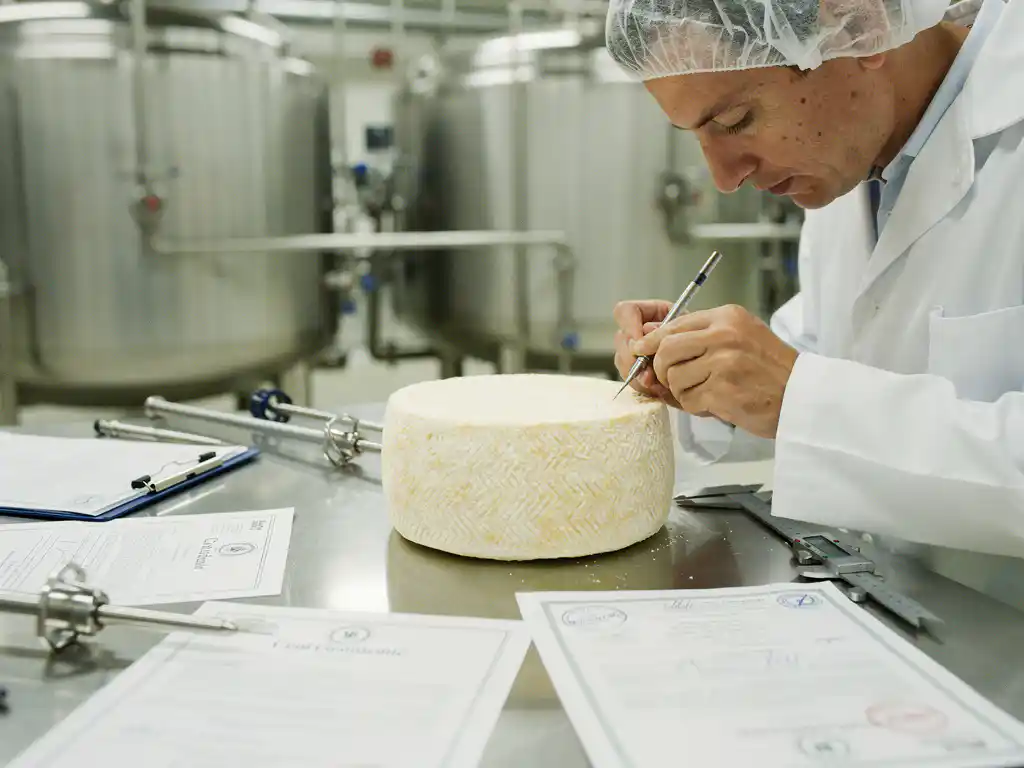
As a purchaser in the food industry, you know that choosing your cheese supplier directly impacts your production quality and food safety. When selecting a supplier for industrial applications, certifications are not a luxury, but an absolute necessity. They form the foundation for reliable cooperation, consistent quality, and risk management in your supply chain.
In this guide, we discuss which certifications are essential for cheese suppliers serving the industry. From basic certifications to market-specific requirements – we provide you with concrete tools to ask the right questions and make well-informed decisions.
Why are certifications important for industrial cheese suppliers?
Certifications guarantee that a cheese supplier meets international standards for food safety, quality, and traceability. They protect your production against risks such as microbiological contamination, allergen contamination, and quality fluctuations, while simultaneously ensuring compliance with laws and regulations.
For you as a purchaser, certifications offer concrete advantages. They reduce the risk of product recalls, which are costly and can damage your reputation. Certified suppliers have structured processes for quality control, resulting in consistent product specifications that are crucial for your production line.
Additionally, certifications simplify your own audit processes. Instead of conducting extensive supplier audits, you can rely on independent verification by recognized certification bodies. This saves time and resources, while still ensuring high standards.
Certifications are also essential for market access. Many retailers and end customers require their suppliers to work with certified ingredient suppliers. Without the right certifications, your end product may be excluded from certain markets or customers.
Which basic certifications should every cheese supplier have at minimum?
Every professional cheese supplier must have at minimum HACCP certification, a recognized GFSI standard such as BRC or IFS, and comply with EU hygiene regulations. These basic certifications form the foundation for food-safe production and are often contractual requirements.
HACCP (Hazard Analysis and Critical Control Points) is the absolute foundation. This system identifies and controls critical points in the production process where food safety risks can occur. A supplier without HACCP certification should not even be considered for industrial supply.
Besides HACCP, a GFSI-recognized standard is indispensable. The Global Food Safety Initiative has approved various standards, of which BRC (British Retail Consortium) and IFS (International Featured Standards) are the most common in the cheese sector. These certifications go beyond HACCP and also cover quality management, product integrity, and process control.
For suppliers within the EU, hygiene regulations (EC) 852/2004 and 853/2004 are legally mandatory. This legislation sets specific requirements for the production of dairy products, including temperature control, microbiological criteria, and traceability. Always ask for the EU approval number of the production location.
Finally, ISO 9001 for quality management is a valuable addition. Although not specifically developed for food, this certification demonstrates that the supplier works systematically on continuous improvement and customer focus.
What is the difference between BRC, IFS, and ISO 22000 certifications?
BRC focuses strongly on product integrity and consumer protection with British retail standards, IFS focuses on process optimization according to German and French retail requirements, while ISO 22000 is a global management system standard that offers flexibility in implementation, but is less prescriptive in specific requirements.
BRC (British Retail Consortium) sets very detailed requirements for production environment, personnel hygiene, and product control. This standard has a strong focus on preventing fraud and ensuring product authenticity. BRC uses a graduated scoring system (AA, A, B, C, D) where higher scores allow longer audit intervals. For cheese suppliers, BRC often means investments in metal detection, allergen control, and extensive documentation of recipes.
IFS (International Featured Standards) was developed by German, French, and Italian retail organizations. This standard places more emphasis on process control and continuous improvement. IFS works with a percentage score where suppliers can achieve “Higher Level” status with scores above 95%. The standard is particularly strong in evaluating management commitment and the effectiveness of corrective measures.
ISO 22000 combines ISO 9001 (quality management) with HACCP principles in an internationally recognized framework. This standard is less prescriptive than BRC or IFS, giving organizations more freedom in implementation. ISO 22000 is popular with multinationals because it is recognized worldwide and integrates well with other ISO management systems. The disadvantage is that some retailers only accept ISO 22000 in combination with additional certification.
For you as a purchaser, the practical impact is important: BRC-certified suppliers often have the most rigid processes, but also the highest compliance costs. IFS suppliers usually excel in process efficiency. ISO 22000 suppliers offer flexibility, but may require additional verification of specific food safety practices.
How do you verify that a cheese supplier’s certifications are valid?
Check certificate validity through official databases of certification bodies such as the BRC Directory, IFS Database, or websites of accreditation organizations. Always ask for the complete certificate including annexes, check the scope, validity date, and whether the production location matches your delivery address.
Start by verifying the certificate number in the official database of the relevant standard. For BRC use directory.brcgs.com, for IFS go to database.ifs-certification.com. These databases are publicly accessible and show real-time certificate status. Pay special attention to the certificate scope – is cheese production explicitly mentioned? A general food safety certificate is not specific enough.
Always ask for the complete certificate including all annexes. The annexes contain crucial information about exclusions, conditional approvals, or specific product categories. Check whether the certified location matches the production address where your products come from. Multi-site certificates require extra attention: is the specific production location for your products included?
Verify the accreditation of the certification body itself. Legitimate certifiers are accredited by national accreditation organizations such as RvA (Netherlands), UKAS (UK), or DAkkS (Germany). The accreditation logo and number must be on the certificate. Be alert to certificates from non-accredited bodies – these have no value for compliance.
Set up a system for periodic re-verification. Certificates typically have a validity of one to three years, with annual surveillance audits. Ask your supplier to proactively send new certificates before the current ones expire. Consider including certificate validity as a contractual obligation, with automatic notification for approaching expiry dates.
Which additional certifications are important for specific markets?
For organic products, SKAL or EU-Organic certification is required, halal and kosher certification opens doors to religious markets, while sustainability certifications such as B-Corp or specific animal welfare labels are becoming increasingly important for premium retailers and conscious consumers.
Organic certification is legally required for any product sold as “organic.” In the Netherlands, SKAL Biocontrole monitors compliance with EU regulation 2018/848. For cheese producers, this means strict requirements for milk origin, use of additives, and separation of organic and conventional production streams. Note: organic certification of the supplier is necessary, even if you only use the ingredient in an organic end product.
Halal certification is carried out by various bodies such as HQC, HFFIA, or Halal Feed and Food. For cheese, the main points of attention are rennet (must come from halal-slaughtered animals or be microbial) and cross-contamination with non-halal products. Kosher certification (such as OK Kosher or Kof-K) sets similar, but often stricter requirements, especially around the separation of dairy and meat products.
Sustainability certifications are rapidly gaining importance. B-Corp certification evaluates the total societal impact of a company. For dairy, specific programs such as “On the way to PlanetProof” or “Better Life quality mark” are relevant. These certifications address animal welfare, environmental impact, and fair trade practices – aspects increasingly considered in tenders.
Retailer-specific standards may also be relevant. Large supermarket chains often have their own requirements on top of standard certifications. Tesco, for example, requires additional ethical audits, while Walmart applies specific sustainability targets. Ask your supplier about experience with your end customers – do they already have certifications that align with specific retail requirements?
What are the risks of working with non-certified cheese suppliers?
Non-certified suppliers bring risks of product recalls, legal liability, loss of customers, and reputation damage. You miss guarantees on food safety, traceability, and consistent quality, which can lead to production shutdowns, fines, and exclusion from important sales markets.
The biggest direct risk is food safety. Without certified processes, there is no independent verification of hygiene practices, temperature control, or allergen management. A single contamination with pathogens such as Listeria can lead to a costly recall action, where not only the direct costs but also the long-term damage to your brand can be disastrous. Legal claims from consumers ultimately end up with you, even if the contamination originated at your supplier.
Operational risks are at least as important. Non-certified suppliers often lack process control for consistent quality. Variations in fat content, moisture percentage, or pH can disrupt your production process. Without documented specifications and measurement procedures, troubleshooting becomes guesswork. This leads to production losses, recipe adjustments, and delays.
Commercial consequences can be far-reaching. Many retailers and foodservice chains require certification throughout the supply chain. One non-certified supplier can mean you are excluded from lucrative contracts. Audits by end customers will directly identify this weak link. Certifying a supplier afterwards takes at least 6-12 months – time during which you may lose important customers.
Finally, there are compliance risks. Food authorities such as the NVWA expect you to perform due diligence on suppliers. In case of incidents, the absence of supplier certification will be seen as negligence. This can lead to fines, increased supervision, or in extreme cases withdrawal of your own permits. The costs of one incident far exceed the possibly lower purchase prices from non-certified suppliers.
How De Jong Cheese helps with certifications for industrial applications
As a family business with more than 30 years of experience, we at De Jong Cheese understand the complexity of certification requirements in the food industry. Our production location in Alphen has all essential certifications needed for reliable delivery to industrial customers like you.
Our certifications and quality guarantees include:
- HACCP-certified production processes for all fresh and aged cheese products
- EU approval number for export within and outside Europe
- Full traceability from milk supplier to end product
- Detailed product specifications for all our industrial cheese products
- Flexibility for additional certifications based on customer needs
For you as a purchaser, this means concrete advantages. Our curd and cream cheese products are delivered with consistent specifications between 35% and 45% dry matter. The freeze-stable variants maintain their quality without whey loss, essential for your production processes. With a shelf life up to 2 years frozen, you can minimize inventory risks.
We provide transparent documentation with every delivery, including analysis certificates and traceability information. Our team understands industrial requirements and thinks proactively about certification issues for new markets or product applications.
Would you like to know more about our certifications and how we can meet your specific requirements? Contact us for a personal conversation about the possibilities. Visit our foodservice page for more information about our complete industrial range, or find one of our sales points to experience our products yourself. On our website you will find all details about our family business and our passion for artisanal cheese production.
Veelgestelde vragen
How often should supplier certificates be checked and updated?
Check certificates at least quarterly and set up an automatic alert system for expiry dates. Ask suppliers to send new certificates at least 3 months before expiration and include this as a contractual obligation. For critical suppliers, monthly verification via online databases is recommended.
What are the first steps if my current cheese supplier doesn't have all required certifications?
Start an immediate dialogue about certification trajectory and timeline, where 6-12 months is realistic for new certification. Meanwhile evaluate alternative suppliers as backup and consider temporary solutions such as additional incoming inspections. Document all agreements in writing and set clear deadlines with consequences for non-compliance.
What specific questions should I ask during a supplier audit about certifications?
Ask for the latest audit report including non-conformities, status of corrective actions, and plans for recertification. Verify that all production locations are covered, inquire about experience with unannounced audits, and ask specifically about exclusions in the certificate scope that may be relevant for your products.
How can I pass through certification costs in my product prices without competitive disadvantage?
Communicate the added value of certifications to your customers in terms of risk reduction and market access. Calculate the total costs of non-compliance including potential recalls and reputation damage. Consider long-term contracts with certified suppliers for better price agreements and position certified ingredients as a quality feature in your marketing.
What are the biggest pitfalls when interpreting certificates from international suppliers?
Watch for cultural differences in interpretation of standards, verify that translations of certificates are accurate, and check whether local certifications are equivalent to European norms. Be extra alert to scope limitations that may be ‘hidden’ in annexes and always ask for English or Dutch versions of critical documents.
How do I build an effective supplier certification management system?
Implement a digital system with automatic expiry date alerts, create a risk matrix categorizing suppliers by criticality, and establish clear procedures for certificate verification. Train your purchasing team in reading certificates, create standard checklists per product category, and plan annual reviews of your certification requirements.
What new certification trends should I watch for in the coming years?
Blockchain-based traceability certification is gaining importance, as are CO2 footprint verifications and regenerative agriculture standards. Expect stricter requirements around plastic use and packaging sustainability, and prepare for possible mandatory digital product passports that bundle all certifications for supply chain transparency.
Gerelateerde artikelen
- Wat zijn de voordelen van een leverancier met eigen productiefaciliteiten?
- Waarom kan geitenkaas spread met een houdbaarheid van 10 weken goedkoper uitpakken dan vers?
- Hoe beoordeel je een productcatalogus van een geitenkaasproducent als inkoper?
- Hoe bewaak je de leveranciersprestaties van een producent van industriële geitenkaas?
- Wat zijn de MOQ-vereisten voor geitenkaas pizza-assortiment in de voedingsindustrie?