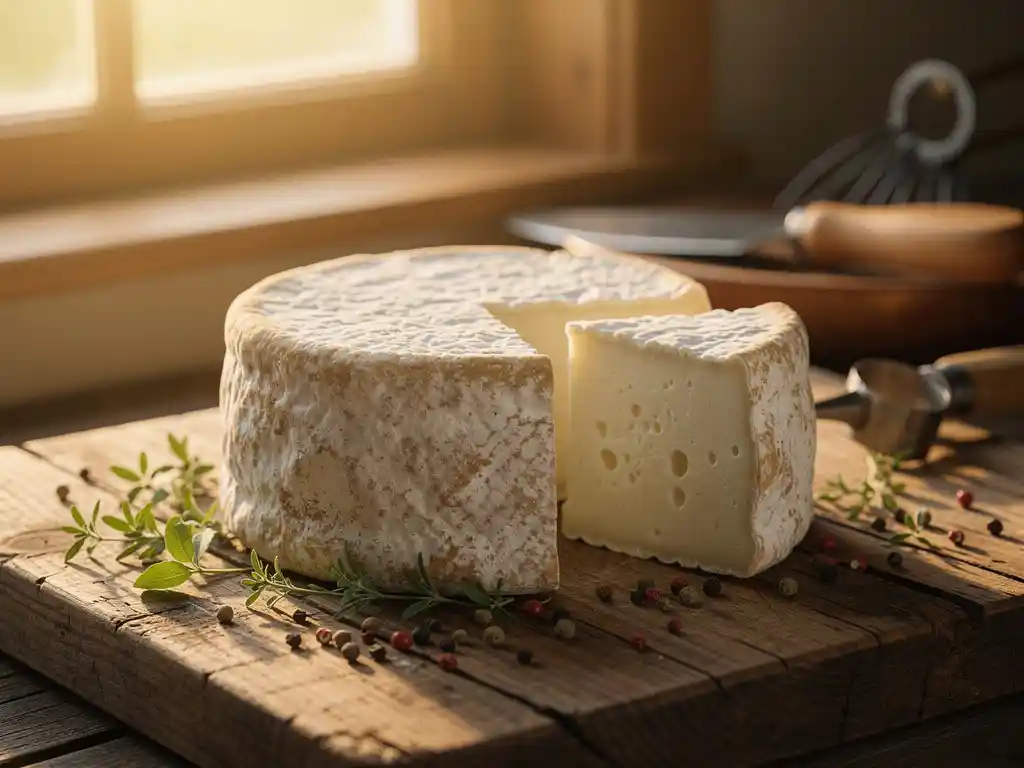
In the modern food industry, goat cheese plays an increasingly important role as an ingredient for various products. From pizzas to ready meals, the demand for high-quality goat cheese continues to grow. For buyers and production managers, it is essential to know what quality standards these cheeses must meet. This article covers the key aspects of quality assurance, certification, and technical specifications that are crucial when working with industrial goat cheese.
What are the key quality standards for goat cheese in the industry?
The key quality standards for industrial goat cheese include microbiological safety, consistent composition, physical properties, and sensory characteristics. These standards ensure that the cheese is safe for consumption and suitable for processing in production processes.
Microbiological standards form the foundation of food safety. Goat cheese must comply with strict limits for pathogens such as Listeria monocytogenes, Salmonella, and E. coli. Additionally, total viable counts, yeasts, and molds are regularly monitored. Fresh goat cheese has stricter standards than aged varieties because the aging process provides natural protection against certain microorganisms.
The composition of goat cheese must be consistent for reliable processing. This means fixed percentages for:
- Fat content (usually between 20-45% in dry matter)
- Moisture content (40-60% for semi-hard to soft cheeses)
- Salt content (1.5-3% for optimal flavor and shelf life)
- pH value (4.5-5.5 for fresh varieties)
- Protein content (minimum 15% for good functionality)
Physical properties determine how the cheese behaves during processing. Melting behavior, texture, processability at different temperatures, and stability during heating are critical factors. For pizza applications, for example, goat cheese must melt evenly without oil separation, while for salads a crumbly structure is desired.
Sensory quality remains important, even in industrial applications. The characteristic mild flavor of goat cheese should not be too pronounced, especially not the typical “goaty” aftertaste that deters some consumers. The color should be uniformly white to cream white, without discoloration or spots.
What certifications are mandatory for goat cheese suppliers?
Mandatory certifications for goat cheese suppliers include HACCP certification as an absolute foundation, supplemented with recognized food safety standards such as IFS Food, BRC, or FSSC 22000. These certifications ensure that suppliers comply with international standards for food safety and quality management.
HACCP (Hazard Analysis and Critical Control Points) forms the foundation of every food safety approach. This system identifies potential hazards in the production process and implements control points to manage risks. For goat cheese producers, this means strict monitoring of temperature during storage and transport, hygiene protocols during production, and traceability from raw materials to final product.
IFS Food (International Featured Standards) is widely accepted in the European market. This standard goes beyond food safety alone and also includes:
- Quality management and continuous improvement
- Management responsibilities
- Resource management including personnel training
- Production processes and product development
- Measurements, analyses, and improvements
Additional certifications can be valuable depending on the market. Organic certification opens doors to premium segments. Halal and kosher certification expands market reach. Sustainability certificates such as the Dutch DGZK quality mark demonstrate social responsibility. For export outside Europe, specific country certificates may be required, such as FDA registration for the United States.
Suppliers must renew their certifications annually through independent audits. This ensures continuous compliance with standards. When selecting a supplier, it is important to look not only at the possession of certificates but also at audit results and any past non-conformities.
How are quality controls performed on industrial goat cheese?
Quality controls on industrial goat cheese are performed through a combination of incoming inspection on milk, process monitoring during production, final product analyses, and continuous tracking during storage and transport. This systematic approach ensures consistent quality from raw material to final product.
Quality assurance begins at milk reception. Each tanker truck is tested for:
- Antibiotic residues (must be negative)
- Somatic cell count (indicator for udder health)
- Total bacterial count (microbiological quality)
- Fat and protein content
- Freezing point (detection of water adulteration)
- Temperature upon arrival
Continuous measurements take place during the production process. Temperature and time are monitored during pasteurization, with a minimum of 72°C for 15 seconds being the standard. pH development during acidification is measured hourly to determine the right moment for further processing. Salt content in brine baths is checked and adjusted daily.
Laboratory analyses on final products include both microbiological and chemical tests. Microbiologically, pathogens, indicator organisms, and shelf-life parameters are tested. Chemically, composition, pH, water activity, and any allergens are analyzed. Sensory evaluation by trained panels assesses taste, odor, texture, and appearance according to standardized protocols.
Modern technology plays an increasingly important role in quality control. Near-infrared spectroscopy (NIR) enables real-time analysis of fat and moisture content. Inline pH meters monitor acidification continuously. Metal detectors and X-ray equipment screen for foreign objects. Digital systems automatically record all measurement values for traceability and trend analysis.
Statistical process control helps identify deviations before they lead to quality problems. Control charts for critical parameters show when a process threatens to deviate from specifications. This enables preventive intervention, which saves costs and ensures quality.
What are the technical specifications for goat cheese in processing operations?
Technical specifications for goat cheese in processing operations include melting point (65-75°C), pH stability (4.8-5.5), moisture content for optimal processing (45-55%), and specific functionality requirements such as stretchability, browning behavior, and oil separation during heating.
For pizza applications, melting characteristics are crucial. Fresh goat cheese melts at lower temperatures than aged varieties due to higher moisture content. Melting behavior is influenced by:
- Calcium content (lower calcium = better melting behavior)
- pH value (optimal 5.2-5.4 for good melt)
- Fat content (minimum 20% in dry matter for creamy melt)
- Protein structure (intact casein network essential)
For ready meals, different requirements apply. Stability during freezing and thawing is central. Goat cheese must minimize syneresis (moisture loss) during these cycles. The texture must not become grainy after heating in microwave or oven. Flavor retention after prolonged storage at -18°C is essential, where oxidation of fats must be prevented through proper packaging.
Processability on production lines requires specific properties. For automatic dosing, the cheese must be homogeneously crumbled with a particle size of 3-8mm. For slices, exact dimensions and weight tolerances of maximum ±5% apply. The adhesion capacity to other ingredients determines whether pretreatment is necessary.
Modified Atmosphere Packaging (MAP) places its own demands on the cheese. CO2 tolerance without flavor deviation, texture retention at 30-40% CO2 in the packaging atmosphere, and microbiological stability throughout extended shelf life are critical. Water activity (aw) must be between 0.92-0.96 for optimal shelf life without quality loss.
How do suppliers guarantee consistent quality at large volumes?
Suppliers guarantee consistent quality at large volumes through standardized production processes, strict raw material selection, advanced process automation, and comprehensive quality control systems with statistical monitoring. This systematic approach minimizes variation between batches.
Raw material management forms the foundation for consistency. Successful suppliers work with fixed groups of goat farmers who apply controlled feeding and management. Milk is pooled and standardized to exact fat and protein content before processing begins. Seasonal influences are compensated by adjusting process parameters based on historical data.
Process automation eliminates human variation. Modern cheese dairies use:
- Automated dosing systems for rennet and starter cultures
- Computer-controlled temperature regulation with ±0.1°C accuracy
- Robot-controlled cheese handling for uniform pressing
- Inline measuring equipment for real-time adjustment
- Predictive algorithms that anticipate process deviations
Batch management and traceability are essential for volume production. Each production batch receives unique identification linking all process parameters, raw materials, and quality results. When deviations occur, the cause can be quickly identified and corrected. Retention samples from each batch enable retrospective investigation.
Continuous improvement through data analysis optimizes consistency. Suppliers analyze trends in quality data to identify systematic variations. Capability studies demonstrate whether processes remain within specifications during scaling up. Six Sigma methodologies reduce variation to minimal levels, with Cpk values >1.33 being the norm for critical parameters.
Robust supply chain management prevents disruptions. Buffer capacity in cooling, multiple transport options, and contingency plans for unforeseen circumstances guarantee delivery reliability. Inventory management based on FIFO (first in, first out) ensures that products are delivered within optimal quality periods.
How DeJong Cheese helps with quality assurance in the food industry
As a traditional family business since 1995, we at DeJong Cheese understand the challenges of industrial processors. Our combination of artisanal expertise and modern quality systems provides the certainty that buyers like Marco Visser seek for their production processes.
Our approach for consistent industrial quality includes:
- IFS Food certification – We comply with the highest international standards for food safety
- Traditional recipes since 1995 – Proven formulas guarantee predictable results in your processes
- Flexible volumes – From small test batches to large-scale production runs
- Technical support – Our team advises on optimal application in your specific process
- Private label possibilities – Custom solutions according to your exact specifications
For fresh goat cheese, goat cheese slices, or aged specialties, we offer consistent quality that aligns with industrial processing requirements. Our Alphenaer product line is known for controlled melting behavior and neutral flavor profiles that fit perfectly in ready meals and pizza applications.
Would you like to know more about how our goat cheese specialties can improve your production process? Contact our team for technical specifications, samples, or a no-obligation consultation. Visit our foodservice page for more information about our complete range, or schedule an appointment through our contact page. For direct availability, you can also consult our sales points. Discover on our website how 30 years of experience makes the difference in your production.
Veelgestelde vragen
How can I optimize the shelf life of goat cheese in my production process?
Optimize shelf life by strictly maintaining the cold chain (2-4°C), applying Modified Atmosphere Packaging with 30-40% CO2, and keeping water activity between 0.92-0.96. Additionally, implement FIFO inventory rotation and use barrier packaging that minimizes oxygen and moisture transport.
What adjustments are needed when switching from cow's milk cheese to goat cheese in existing recipes?
When switching, you must account for the lower melting point of goat cheese (5-10°C lower), the more intense flavor requiring 20-30% less dosage, and the higher moisture content that may affect drying times. Test small batches first and gradually adjust processing temperatures, dosages, and times based on sensory evaluations.
What are the most common quality problems in industrial processing of goat cheese and how do I prevent them?
Common problems are oil separation during heating (prevent by choosing cheese with optimal pH 5.2-5.4), texture loss after freezing (use stabilizers or choose cheese with lower moisture content), and flavor deviations due to oxidation (apply vacuum packaging or MAP). Work with your supplier to align cheese specifications with your specific process.
How do I determine the right technical specifications for goat cheese in my specific application?
Start with a functionality analysis: determine desired melting behavior, texture after processing, and flavor intensity. Conduct pilot tests with different cheese types and document performance on critical parameters. Consult with technical specialists from your supplier who have experience with similar applications and request customized samples for validation.
What equipment investments are needed for processing goat cheese versus other cheese types?
Usually no major investments are needed, but fine-tuning is essential. Adjust dosing equipment for the softer texture of fresh goat cheese, calibrate temperature controls for the lower melting point, and consider gentle transport systems to ensure structure retention. Invest especially in accurate temperature monitoring (±0.5°C) for consistent results.
How do I integrate sustainability requirements into my goat cheese purchasing without compromising quality?
Choose suppliers with recognized sustainability certificates like DGZK or equivalent, who use local milk for lower CO2 footprint, and who are transparent about animal welfare. Ask about possibilities for bulk packaging to reduce packaging waste and consider seasonal contracts that respect natural production cycles without quality loss.
Gerelateerde artikelen
- Welke garanties kun je vragen aan een leverancier over levertijden?
- Wat zijn de kosten van een leverancierswissel bij industriële geitenkaas wrongel?
- Welke smaakvarianten van geitenkaas zoals cranberry-kaneel zijn populair in de voedingsindustrie?
- Wat zijn de voordelen van een raamcontract met een gespecialiseerde geitenkaasproducent?
- Wat zijn de belangrijkste contractpunten bij een leveranciersovereenkomst voor geitenkaas?