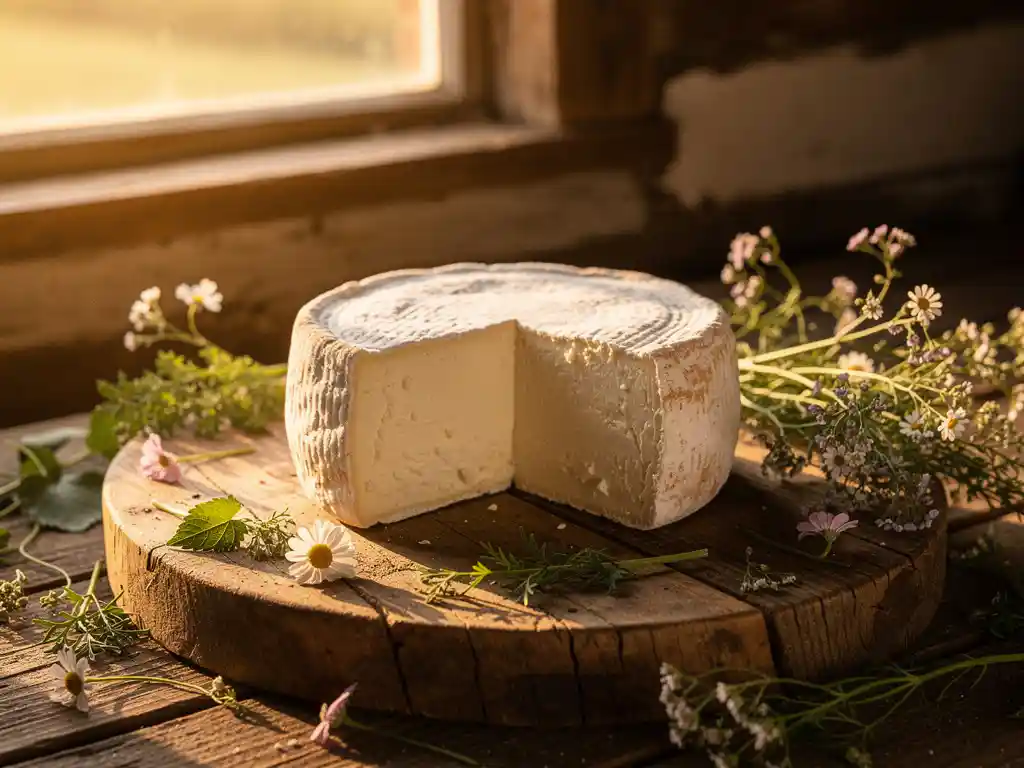
Sustainability in the dairy industry is increasingly high on the agenda of both producers and consumers. At DeJong Cheese, we notice that customers like Marco Visser, a buyer in the food industry, are increasingly asking about the environmental impact of our goat cheese products. The CO₂ footprint of cheese is a complex topic influenced by various factors, from the origin of the milk to the transport distance. In this article, we answer the most important questions about the CO₂ footprint of locally produced goat cheese and show how our approach at DeJong Cheese contributes to more sustainable cheese production.
What exactly is the CO₂ footprint of goat cheese?
The CO₂ footprint of goat cheese is the total amount of greenhouse gases released during the entire production process, from milk production to the final product. For locally produced goat cheese within 100 km, this averages between 5 and 8 kg CO₂ equivalent per kilogram of cheese, significantly lower than the industry average of 10-13 kg.
This footprint encompasses various stages in the production chain. The largest contribution comes from milk production at the goat farm itself, where feed, water, and energy for the animals account for approximately 60-70% of total emissions. The transport of milk to our cheese factory contributes only 3-5% to the total footprint thanks to the short distances within 100 kilometers.
The cheese production process itself, including pasteurization, curd preparation, and ripening, is responsible for approximately 20-25% of CO₂ emissions. Packaging and distribution to the end customer make up the remaining 5-10%. At DeJong Cheese, we see that our local approach with milk suppliers within a 100 km radius makes a measurable difference in the total environmental impact.
It’s important to understand that the CO₂ footprint isn’t just about direct emissions. Indirect factors such as animal feed production, energy consumption for cooling during transport and storage, and even the processing of byproducts also play a role in the overall picture.
How much CO₂ does local production within 100 km actually save?
Local production within 100 km saves an average of 2-3 kg CO₂ per kilogram of goat cheese compared to international production chains. This amounts to a reduction of 20-30% on the total CO₂ footprint, with transport savings being the biggest factor alongside more efficient logistics and fresher milk processing.
The transport savings alone are significant. While international cheese products often travel thousands of kilometers from farm to consumer, we at DeJong Cheese limit milk transport distance to a maximum of 100 kilometers. This not only saves direct fuel emissions but also reduces the need for intensive cooling during long transports.
An additional benefit of local production is the ability to process milk fresher. Fresh goat milk can be processed into cheese within 24 hours of milking, which saves energy on cooling and preservation. This faster processing results in energy savings of approximately 15-20% compared to milk that has been in transit for days.
The local approach also means shorter supply chains for other ingredients and packaging materials. Our suppliers of packaging and auxiliary materials are largely located within the Netherlands, which further reduces the total logistical footprint. For industrial customers like Marco Visser, this means not only a lower environmental impact but also more reliable supply security.
Which factors determine the environmental impact of goat cheese production?
The environmental impact of goat cheese production is mainly determined by five factors: feed production for goats (40-50%), energy consumption in the cheese factory (20-25%), transport and logistics (10-15%), packaging materials (5-10%), and water consumption during production (5-10%). Sustainable business operations in each of these areas can significantly reduce the total impact.
Feed production is the biggest factor because growing feed crops requires energy, water, and often artificial fertilizer. At our DGZK-certified milk suppliers, increasingly more local feed is used, which reduces transport emissions. Additionally, these farms work on optimal feed efficiency, where goats need less feed per liter of milk.
We have drastically reduced energy consumption in our cheese factory by installing 1,000 solar panels that generate 350,000 kWh per year. This covers 30% of our total energy consumption, while the remaining 70% comes from wind energy. This switch to renewable energy has reduced our production-related CO₂ emissions by more than 80%.
We optimize transport and logistics through smart route planning and combining deliveries. For our industrial customers, this means we can efficiently deliver large volumes like our 15 kg Goat Curd bags with minimal transport movements. The short distances to our milk suppliers make it possible to work with smaller, more efficient vehicles.
In the area of packaging, we are actively working on the transition to 100% recyclable materials. For products like our Goat Cheese Crumbles bags, we already use fully recyclable packaging, which reduces the environmental impact of this component by approximately 30%.
How does the CO₂ footprint of goat cheese compare to other cheese types?
Goat cheese has on average a 15-20% lower CO₂ footprint than comparable cow cheese, with 5-8 kg CO₂ per kg for local goat cheese versus 8-10 kg for local cow cheese. This difference comes from goats’ more efficient feed conversion, their lower methane emissions, and the often smaller-scale, local production systems.
Goats are naturally more efficient milk producers than cows. They need less feed per liter of milk and produce significantly less methane during digestion. A dairy goat emits annually about 20-30 kg of methane, while a dairy cow emits 100-120 kg. This lower methane production translates directly into a lower CO₂ equivalent footprint.
Production systems for goat milk are often smaller-scale and more locally organized than those for cow milk. At DeJong Cheese, we work exclusively with Dutch goat farmers within 100 km, while large cow milk processors often mix milk from different countries. This local focus not only reduces transport emissions but also promotes more efficient business operations.
Interestingly, the CO₂ footprint of hard goat cheese like our Alphenaer aged and old varieties is relatively lower per kilogram of final product. Although the ripening process costs energy, less cheese is needed for the same flavor intensity, which reduces the footprint per serving. For sheep cheese, the footprint usually lies between that of goat and cow cheese, around 7-9 kg CO₂ per kg.
What can cheese producers do to reduce their CO₂ footprint?
Cheese producers can most effectively reduce their CO₂ footprint by switching to renewable energy, purchasing milk locally within 100 km, using recyclable packaging, optimizing production efficiency, and collaborating with sustainably certified milk suppliers. These measures can together reduce the footprint by 40-60%.
The switch to renewable energy has had the biggest impact for us. With our combination of solar panels and wind energy, we have drastically reduced the CO₂ emissions of our production process. For every kilogram of fresh goat cheese we produce, we now save approximately 1.5 kg CO₂ compared to fossil energy.
Local milk purchasing is essential for CO₂ reduction. Our collaboration with DGZK-certified goat farmers within 100 km means not only shorter transport distances but also better control over sustainability practices on the farms. These farmers actively work on emission reduction through, for example, precision feeding and manure processing.
We continuously improve production efficiency through smart process optimization. Our Modified Atmosphere Packaging (MAP) system for industrial products extends shelf life without preservatives, which reduces food waste. For products like our Goat Curd, we optimize the dry matter content between 35% and 45%, which makes transport more efficient.
Innovation in product development also plays a role. Our new lactose-free UHT goat milk, for example, has a shelf life of 45 weeks without cooling, which delivers enormous energy savings in the distribution chain. For industrial customers, we develop products that can be delivered both fresh and frozen, which offers flexibility in transport and storage.
How do you recognize truly sustainable local goat cheese as a consumer?
You can recognize truly sustainable local goat cheese by certifications like DGZK for animal welfare, transparent origin information on the packaging, the EC quality mark with company number, information about renewable energy in production, and recyclable packaging. Also pay attention to the distance between producer and point of sale: truly local means a maximum of 100-150 km.
The DGZK mark (Sustainable Goat Dairy Chain) is an important indicator. This mark guarantees not only animal welfare and animal health but also sets requirements for energy, climate, and sector transparency. All our milk suppliers are DGZK-certified, which means the entire chain from milk production to cheese meets strict sustainability requirements.
Transparency about origin is crucial. On our Alphenaer products, you will always find the EC number NL Z1977 EU, which indicates our production location in Alphen. For fresh goat cheese slices and aged goat cheese logs, we clearly state that the milk comes from the immediate region. This traceability provides certainty about the truly local origin.
When shopping, also look for practical sustainability indicators. Recyclable packaging is increasingly the norm among sustainable producers. Our transition to 100% recyclable packaging is visible on the products. The presence of multiple certifications like IFS Food, Halal, and Kosher also indicates a professional organization that invests in quality and transparency.
For the conscious consumer, visiting the producer is an excellent way to verify sustainability. In our Alphenaer store next to the cheese factory, visitors can see with their own eyes how we work, from the solar panels on the roof to the short supply routes for milk.
How DeJong Cheese helps with sustainable goat cheese production
At DeJong Cheese, we make the difference in sustainable goat cheese production through our unique combination of local milk purchasing, renewable energy, and innovative product development. For industrial customers like Marco Visser, we offer not only high-quality goat cheese products but also concrete CO₂ savings in their supply chain.
Our sustainability approach offers measurable benefits:
- 100% renewable energy through 1,000 solar panels and wind energy
- All milk from DGZK-certified suppliers within 100 km
- IFS Food-certified production with full traceability
- Innovative products like freezable Goat Curd with 2-year shelf life
- On track to 100% recyclable packaging
For the food industry, this means reliable delivery of sustainable goat cheese products that align with ESG objectives. Our industrial packaging of 5 kg, 10 kg, and 15 kg is optimized for efficient transport and minimal packaging materials. Products like our Goat Cheese Crumbles and Pizza assortment are available both fresh and frozen, which offers flexibility in production and inventory management.
Would you like to know more about how our sustainable goat cheese products can contribute to your CO₂ reduction goals? Please contact us through our contact page for a personal conversation about your specific needs. View our complete assortment for foodservice and industry or visit one of our points of sale to taste our products. For more information about DeJong Cheese and our sustainability approach, visit our homepage.
Veelgestelde vragen
How can I as a company calculate my CO₂ footprint when using goat cheese in my products?
Start by collecting data about your annual goat cheese consumption and ask your supplier for a CO₂ footprint report per kilogram of product. Multiply this by your consumption and add transport from supplier to your location (approximately 0.1 kg CO₂ per ton-km). Many suppliers like DeJong Cheese can provide specific footprint data for their products, including certification that you can use for your own sustainability reporting.
What practical steps can I take to minimize food waste of goat cheese in my production process?
Choose flexible packaging sizes that match your production volumes, such as the 5, 10, or 15 kg industrial packages. Consider freezable products like Goat Curd that are shelf-stable for up to 2 years, which offers inventory flexibility. Implement a first-in-first-out system and use Modified Atmosphere Packaging (MAP) products that extend shelf life without quality loss.
Are there subsidies or certifications available for companies switching to sustainable local goat cheese?
Various provinces offer SME subsidies for supply chain sustainability, where switching to local suppliers often qualifies. For certification, you can consider B Corp or CO₂ Performance Ladder, where using certified sustainable ingredients counts. Ask your goat cheese supplier for documentation of their sustainability certifications like DGZK, which you can use for your own certification processes.
How do I compare the actual sustainability between different goat cheese suppliers?
Ask potential suppliers for concrete data: CO₂ emissions per kg product, percentage of renewable energy, average transport distance from milk suppliers, and recycling percentage of packaging. Look for certifications like DGZK, IFS Food, and ISO 14001. Visit the production location if possible to verify claims and ask for their sustainability report or annual report for transparent figures.
What are the biggest pitfalls when communicating about sustainable goat cheese to my customers?
Avoid vague claims like ‘environmentally friendly’ without concrete substantiation – this can be seen as greenwashing. Be specific about what ‘local’ means (within how many km?) and use only verified data. Don’t just communicate about CO₂, but also about animal welfare, fair milk prices, and social aspects. Ensure all sustainability claims are traceable to your supplier and supported by certifications.
How can I justify the premium price of sustainable local goat cheese in my cost calculation?
Calculate the Total Cost of Ownership including lower transport costs, more reliable delivery (less waste), longer shelf life, and possible subsidies. The premium of 10-15% is often compensated by 20-30% less food waste and better product quality. Additionally, you can pass on the added value to customers who are willing to pay for sustainability, which market research shows applies to 65% of consumers.
Gerelateerde artikelen
- Hoe plan je de inkoop van harde geitenkaas met een levertijd van drie weken?
- Hoe voorkom je voedselverspilling bij grootschalig gebruik van geitenkaas wrongel?
- How do you establish volume guarantees when purchasing goat cheese crumbles on a pallet scale?
- Hoe kies je tussen geitenkaas crumbles, parels en plakjes voor een geautomatiseerde pizzalijn?
- Wat is de betekenis van EC-nummer NL Z1977 EU op kaasproducten?