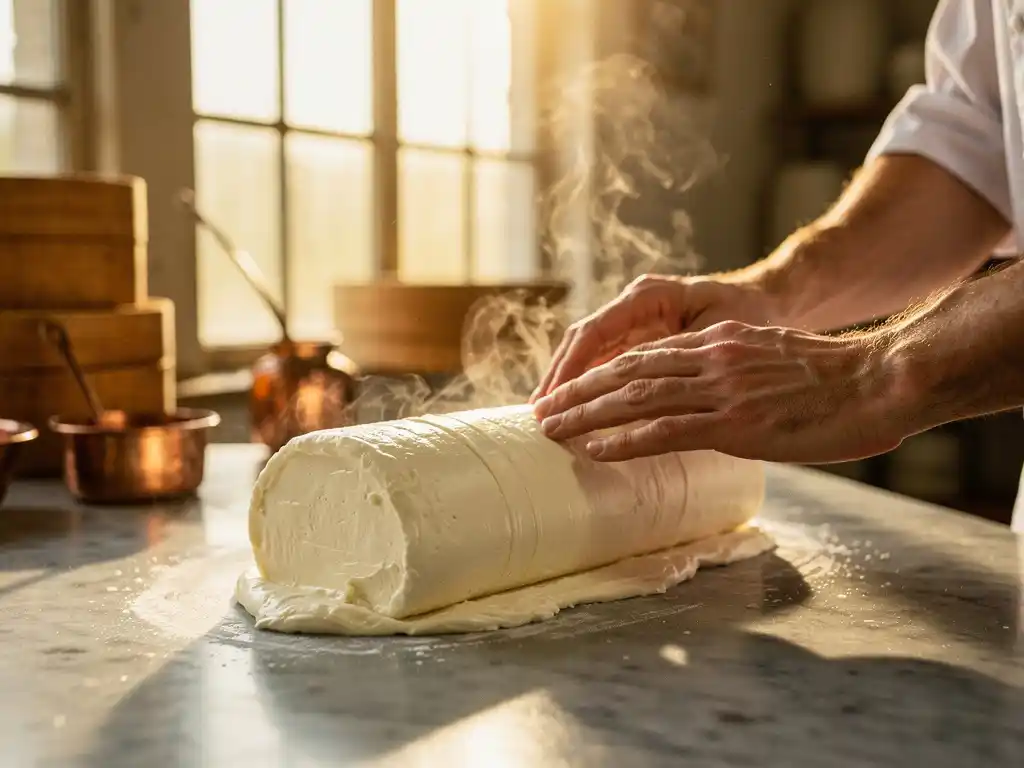
In the world of product development for the food industry, high-melt goat cheese plays an increasingly important role. This specialized cheese variant offers unique properties that create new possibilities for product innovation. From pizza manufacturers to ready-meal producers, more and more companies are discovering the benefits of high-melt goat cheese for their product range. This article explores the technical aspects, application possibilities, and practical considerations when working with this versatile ingredient.
What is high-melt goat cheese and why is it important for product development?
High-melt goat cheese is a specially developed cheese variant that maintains its structure when heated and does not completely melt like traditional cheeses. This cheese is produced with modified cultures and production processes that ensure a higher melting point, allowing the cheese to retain its shape and texture during baking, grilling, or other heating processes.
The importance for product development lies in the unique functional properties that high-melt goat cheese offers. Where regular goat cheese becomes liquid when heated and loses its structure, high-melt goat cheese maintains its integrity. This makes it possible to develop products where visible cheese pieces are desired, such as in salads that are pre-packaged with warm components, or in bake-off products where the cheese must remain recognizable.
The growing demand for premium ingredients and market differentiation makes high-melt goat cheese extra valuable. Consumers appreciate the mild, characteristic flavor of goat cheese and the visual appeal of recognizable cheese pieces in their meals. For product developers, this means new opportunities to differentiate with innovative concepts that were previously technically unfeasible.
What products can be developed with high-melt goat cheese?
With high-melt goat cheese, various innovative products can be developed, ranging from premium pizzas with visible goat cheese cubes to Mediterranean wraps and pre-baked quiches. The cheese maintains its shape and provides texture contrast in warm applications, creating new product development opportunities for foodservice and retail.
In the pizza segment, high-melt goat cheese offers unique opportunities for premium variants. Think of artisanal pizzas where goat cheese cubes are used as toppings alongside traditional mozzarella. The cheese caramelizes slightly on the outside while the core remains creamy, providing an interesting texture experience. This concept works excellently for vegetarian pizzas with grilled vegetables or for meat lovers in combination with bacon and honey.
For ready-meals, high-melt goat cheese opens doors to new concepts. Mediterranean bowls with warm couscous or quinoa can be enriched with goat cheese cubes that retain their shape. Pre-baked quiches and savory tarts benefit from the cheese’s stability during the production process and consumer reheating. In wraps and paninis, the cheese also remains recognizable, enhancing the premium perception.
The snack segment also offers interesting applications. Stuffed mushrooms, peppers, or zucchini with high-melt goat cheese can be industrially prepared without the cheese melting away during the production process. Bake-off products like goat cheese rolls or focaccia with goat cheese cubes maintain their attractive appearance after baking.
How does the melting behavior of goat cheese differ from cow’s milk cheese?
Goat cheese has fundamentally different melting behavior than cow’s milk cheese due to differences in protein structure, fat composition, and pH value. Goat milk contains smaller fat globules and a different casein composition, causing goat cheese to become soft and creamy when heated rather than melting elastically like mozzarella or cheddar.
The protein structure in goat cheese is looser than in cow’s milk cheese. Goat milk contains less alphas1-casein, the protein responsible for the firm structure in cow’s milk cheese. This results in softer melting behavior where goat cheese falls apart rather than becoming liquid. When heated, regular goat cheese loses its shape more quickly and becomes a creamy mass without the typical stretchiness of melted cow’s milk cheese.
Fat content and fat composition also play a crucial role. Goat milk fat has a lower melting point due to the presence of more medium-chain fatty acids. This means that the fat in goat cheese begins to melt at lower temperatures, contributing to the creamy texture but also causing less stability during heating.
The pH value of goat cheese is often lower than that of comparable cow’s milk cheeses, especially in fresh variants. This higher acidity affects protein binding and causes the cheese structure to be less cohesive when heated. For product developers, this means that standard goat cheese is less suitable for applications where the cheese must maintain its shape, unless specifically high-melt variants are used.
What are the technical specifications to look for in high-melt goat cheese?
For high-melt goat cheese, the most important technical specifications are the melting point (typically 80-90°C), moisture content (35-45%), pH value (5.2-5.8), fat content in dry matter (45-55%), and protein structure. These parameters determine behavior during processing and stability in the final product.
The melting point is the most critical parameter for industrial applications. High-melt goat cheese must be able to withstand temperatures up to 90°C without completely melting. This requires special production techniques where the protein matrix is strengthened through controlled acidification and specific rennet addition. Producers must be able to guarantee this specification with test certificates showing the exact melting range.
Moisture content and water activity determine not only shelf life but also behavior during heating. Lower moisture content (35-40%) provides better stability but can result in drier texture. For optimal functionality, a balance is needed where the cheese contains sufficient moisture for pleasant mouthfeel but not so much that it compromises structure during processing.
Particle size in crumbled high-melt goat cheese is essential for uniform distribution in the product. Specifications vary from fine crumbles (2-5mm) for pasta to larger cubes (10-15mm) for salads and pizzas. Consistency in size ensures predictable processing properties and visual uniformity in the final product.
Microbiological parameters and shelf life are crucial for industrial processing. High-melt goat cheese must meet strict microbiological standards with low bacterial counts and absence of pathogens. Shelf life varies from 4 weeks for fresh variants to 23 weeks for specially packaged products, where packaging method (MAP or vacuum) greatly influences stability.
How do you successfully integrate high-melt goat cheese into existing production processes?
Successful integration of high-melt goat cheese begins with adjusting dosing systems, optimizing processing temperatures, and timing of addition in the production process. First test on a small scale, adapt equipment for the specific properties of goat cheese, and train operators on the unique handling requirements of this ingredient.
The first step is evaluating existing dosing equipment. High-melt goat cheese in crumble form often requires different dosing systems than regular cheese due to differences in flow properties and tendency to clump. Vibration hoppers or special dosing heads may be needed to ensure consistent distribution. For cubes or slices, pick-and-place systems or manual placement are often more effective than traditional dosing methods.
Temperature control during the production process is critical. High-melt goat cheese must remain cool until the moment of processing to prevent premature softening. This often means installing cooled intermediate buffers or adjusting the production sequence. In applications like pizzas, timing of addition is crucial: too early and the cheese may still melt too much, too late and adhesion to the product is insufficient.
Packaging adjustments are often necessary to ensure the quality of products with high-melt goat cheese. Modified Atmosphere Packaging (MAP) can extend shelf life and prevent color changes. The packaging must provide sufficient strength to maintain the shape of cheese pieces during transport and storage.
Training production staff is essential for consistent results. High-melt goat cheese behaves differently than regular cheese and requires specific handling. Operators must learn to recognize when the cheese is optimal for processing, how to prevent clumping, and which visual characteristics indicate quality problems. Regular quality controls with clear specifications for appearance, texture, and melting behavior are indispensable.
What innovative applications are there for high-melt goat cheese in new market segments?
Innovative applications for high-melt goat cheese emerge in plant-based hybrid products, premium convenience concepts, ethnic fusion cuisines, and functional foods. These market segments utilize the unique properties of high-melt goat cheese for differentiation and added value in products where texture and visual appeal are central.
In the growing segment of plant-based hybrid products, high-melt goat cheese offers interesting possibilities. Flexitarian consumers appreciate products that combine vegetables with small amounts of premium dairy. Think of stuffed portobellos with quinoa and goat cheese cubes, or vegetable burgers topped with high-melt goat cheese that retains its shape during grilling. These applications tap into the trend of more conscious eating without completely abandoning animal products.
Premium meal kits and chef-inspired convenience products form another promising segment. High-melt goat cheese fits perfectly in restaurant-quality meals for home preparation. Examples include sous-vide prepared vegetable packages with goat cheese that consumers only need to finish, or premium flatbreads with figs and goat cheese where the cheese retains its distinctive shape.
Ethnic fusion concepts offer creative application possibilities. High-melt goat cheese can replace traditional cheeses in international dishes while maintaining authentic texture. Think of Mexican quesadillas with goat cheese instead of traditional cheese, Indian paneer-like applications in curries, or Middle Eastern concepts where goat cheese is combined with za’atar and pomegranate.
The functional food segment grows with products offering specific health benefits. High-melt goat cheese is naturally low in lactose and contains medium-chain fatty acids that are easier to digest. This makes it suitable for sports nutrition concepts, keto-friendly products, or meals for people with sensitive digestion. The possibility of enriching the cheese with probiotics or omega-3 fatty acids during production opens doors to new functional applications.
How DeJong Cheese helps with high-melt goat cheese for new product development
DeJong Cheese, as a specialist since 1995, offers comprehensive support in implementing high-melt goat cheese in new product developments. With our complete range of industrial goat cheese products and technical expertise, we help food producers realize innovative concepts.
Our offering for product development with high-melt properties includes:
- Goat Cheese Crumbles in 5kg bags (natural and honey) with 23 weeks shelf life, ideal for uniform distribution in products
- Goat Cheese Pucks in various weights (7g and 23g) that perfectly retain their shape during heating
- Fresh and aged goat cheese blocks of 2.6kg for custom cutting solutions
- Frozen variants with 2-year shelf life for flexible production planning
We support your product development with technical specifications, samples for test productions, and advice on optimal application of our products in your production process. Our experience with global delivery to industry means we understand what is needed for successful integration: consistent quality, reliable deliveries, and volumes that grow with your needs.
For companies seeking private label solutions or developing specific formulations, we gladly develop custom products together that exactly match your technical requirements and flavor profile.
Contact our team via our contact page for technical documentation, samples, or a personal consultation about your product development. Also discover our complete range for foodservice and industry or visit one of our sales points to experience our products. More information about all our possibilities can be found on our website.
Veelgestelde vragen
What is the cost difference between high-melt goat cheese and regular melting cheese for industrial applications?
High-melt goat cheese is typically 20-40% more expensive than regular melting cheese due to the specialized production process and smaller production volumes. However, the premium is often compensated by the premium positioning of the final product, lower dosages due to the more intense flavor, and better margins in the high-end segment where consumers are willing to pay more for quality and differentiation.
How do you prevent high-melt goat cheese from melting too much during industrial processes?
Control the core temperature of the product (max 85°C), adjust baking time instead of increasing temperature, and add the cheese in the final phase of the production process. Preferably use indirect heating such as steam or hot air ovens instead of direct heating, and test different particle sizes – larger pieces retain their shape better than small crumbles.
What certifications are important when selecting a supplier of high-melt goat cheese?
Essential certifications are BRC or IFS for food safety, HACCP for process control, and preferably organic certification for premium positioning. Also ask for halal/kosher certification if relevant for your market, animal welfare certificates like Better Life, and specific technical certificates that guarantee melting behavior and consistent quality.
Can high-melt goat cheese be combined with other cheese types in one product?
Yes, high-melt goat cheese combines excellently with melting cheeses like mozzarella for texture contrast, where the goat cheese forms recognizable pieces while other cheeses provide binding. However, first test compatibility in terms of flavor and heating behavior, use maximum 30-40% high-melt goat cheese in the total cheese mix, and pay attention to different moisture contents that can affect final texture.
What are the most common mistakes when starting production with high-melt goat cheese?
The biggest mistakes are: using too high processing temperatures out of habit with regular cheese, leaving the cheese at room temperature too long causing it to soften anyway, using wrong dosing equipment that damages the cheese structure, and insufficient testing of shelf life in the final packaging. Always start with small test batches and document exactly all process parameters for reproducibility.
How do you calculate the optimal dosage of high-melt goat cheese for new products?
Start with 8-12% of total product weight for clearly visible and flavorful cheese component, adjust this based on the intensity of other ingredients and desired cost price. Test different dosages in consumer panels for the ideal balance between flavor, texture and visual appeal, and account for moisture loss during preparation – dose 10-15% extra to compensate for this.
Gerelateerde artikelen
- Hoe reageer je als een leverancier herhaaldelijk niet aan specificaties voldoet?
- Hoe evalueer je jaarlijks of je huidige kaasleverancier nog de beste keuze is?
- Welke referenties vraag je op bij een producent van industriële geitenkaas?
- Hoe verschilt de houdbaarheid van geitenkaas per verpakkingsformaat in de industrie?
- Hoe zorg je dat je leverancier altijd voldoet aan de laatste voedselveiligheidseisen?