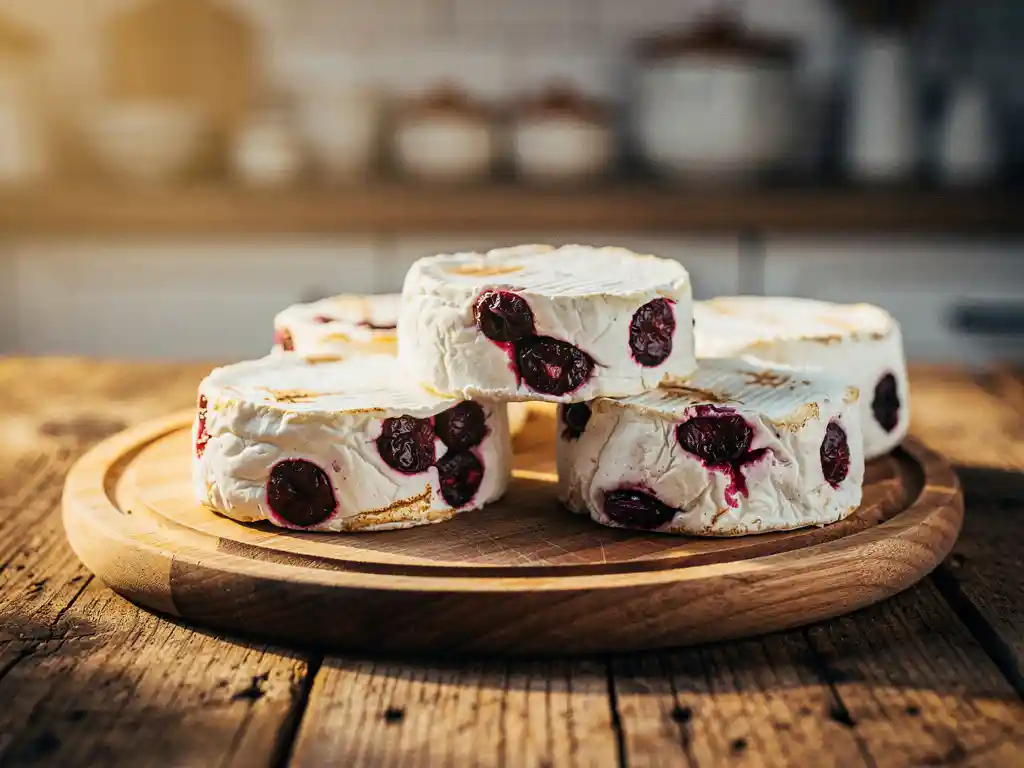
The food industry continuously seeks innovative ways to process goat cheese in ready-made products, pizzas, and other applications. Flavor variants play a crucial role here, as they not only add taste but must also meet strict technical requirements for industrial processing. From classic herbs to surprising fruit combinations – the possibilities are endless, but which variants are truly successful in large-scale production?
What are the most demanded flavor variants of goat cheese in the food industry?
The most demanded flavor variants in the food industry are Mediterranean herbs, honey-thyme, cranberry-cinnamon, fig-walnut, and pure natural goat cheese. These five variants dominate because they perform excellently both taste-wise and processing-wise in industrial applications such as pizzas, salads, and ready meals.
Mediterranean herbs remains the absolute number one due to its versatility in hot and cold applications. This variant typically combines oregano, basil, tomato, and garlic, which perfectly aligns with the popularity of Italian and Mediterranean dishes. The herb mix remains stable during heating and retains its aromatic profile.
Honey-thyme is growing strongly in popularity, especially for premium product lines. The sweet honey perfectly balances with the characteristic taste of goat cheese, while thyme adds a subtle spiciness. This combination works excellently in both savory and sweet applications.
Pure natural goat cheese remains indispensable as a base variant. Many producers prefer natural because they can develop flavor profiles themselves that perfectly align with their specific products. This offers maximum flexibility in recipe development.
Why is cranberry-cinnamon goat cheese so popular with food producers?
Cranberry-cinnamon goat cheese is popular because this variant offers a unique sweet-savory balance that appeals to consumers, while the ingredients remain stable during industrial processing. The cranberries retain their texture and color, adding visual appeal to end products without quality loss during production or shelf life.
The popularity stems from growing consumer demand for premium and artisanal flavors in ready-made products. Cranberry-cinnamon positions a product directly in the higher segment without significant additional costs in production. The combination appeals broadly: from young professionals to older consumers who value quality.
Technically speaking, this variant offers important advantages. The natural acids in cranberries work as a preservative, extending shelf life. Cinnamon has antimicrobial properties that contribute to food safety. Both ingredients are heat-resistant, keeping the flavor intact when heated to 200°C.
For seasonal products, cranberry-cinnamon is ideal. The variant performs excellently in autumn and winter assortments but also proves successful year-round in salads and wraps. This versatility makes it a safe investment for producers looking to expand their range.
How are flavor variants of goat cheese developed for industrial applications?
Flavor variants for industrial applications are developed through a systematic process of recipe development, pilot testing, and scalability analysis. This process takes an average of 3-6 months and combines culinary expertise with technical knowledge to create variants that perform optimally both taste-wise and production-wise.
The development process starts with market analysis and trend identification. Producers analyze consumer preferences, competitive products, and emerging flavor trends. Subsequently, concept recipes are developed in the laboratory, taking into account flavor balance, texture, and processing properties.
Critical factors during development are:
- Ingredient stability at different temperatures and pH values
- Interaction between flavor components and the base product
- Shelf life under different storage conditions
- Cost efficiency in large-scale production
- Allergens and clean label requirements
Pilot testing takes place in small-scale production environments that simulate industrial conditions. Here, melting behavior, texture changes, and flavor retention are tested under realistic processing conditions. Parameters such as mixing speed, temperature profiles, and cooling times are optimized.
The final phase involves validation in actual production environments. Flavor variants are tested for compatibility with existing production lines, consistency between batches, and performance in end products. Sensory panels evaluate the taste after processing and throughout the entire shelf life period.
What technical properties must goat cheese flavor variants have for industrial use?
Goat cheese flavor variants for industrial use must meet specific technical properties: pH stability between 4.5-6.5, consistent fat content of 45-55%, melting point between 65-75°C, and minimum 85% flavor retention after heating. These parameters guarantee optimal performance in automated production lines and end product quality.
Texture and processability are crucial for machine processing. The cheese must have a uniform consistency that can be processed smoothly through dosing systems. The viscosity must remain constant within a temperature range of 4-25°C to prevent blockages in production equipment.
Functional properties determine success in specific applications:
- Melting behavior: Even melting without oil separation or burning
- Emulsifying properties: Stable mixing with other ingredients
- Freeze resistance: Texture retention after thawing for frozen products
- Water activity: Aw value between 0.92-0.96 for microbiological stability
- Particle size: Uniform distribution of flavor components (maximum 3mm)
Shelf life parameters are essential for supply chain management. Flavor variants must be shelf-stable for at least 60 days under refrigerated conditions (2-7°C) while maintaining organoleptic properties. Modified Atmosphere Packaging (MAP) extends shelf life to 90 days for many applications.
Quality control requires measurable standards. Each batch must perform consistently on colorimetric values, texture analysis, and microbiological parameters. Deviations greater than 5% between batches are unacceptable for industrial processors producing standardized end products.
What are the advantages of goat cheese with toppings versus pre-mixed variants?
Goat cheese with toppings offers visual appeal and texture contrast, while pre-mixed variants offer superior flavor integration and processing convenience. The choice depends on the end application: toppings excel in premium presentations, pre-mixed variants in automated production where consistency is crucial.
Toppings create a premium appearance that consumers immediately recognize. Visible cranberries, nuts, or herbs communicate quality and craftsmanship. For foodservice applications such as salads or cheese platters, toppings are ideal because they offer differentiation and improve presentation. The texture variation between soft cheese and crispy toppings enhances the eating experience.
Pre-mixed variants offer significant operational advantages:
- Uniform flavor distribution in every part of the product
- No risk of toppings coming loose during transport or processing
- Easier portioning and dosing in automated systems
- Better heat resistance because ingredients are protected in the cheese matrix
- Longer shelf life due to reduced exposure to air
Cost-wise, both options differ significantly. Toppings require an additional production step and separate ingredient streams, increasing complexity. Pre-mixed variants are more efficient in large-scale production but require initially higher development costs for the right recipe.
The trend is moving toward hybrid solutions where part of the flavor components are pre-mixed for consistency, while visually attractive elements are added as toppings. This approach combines the best of both worlds for applications such as premium pizzas or gourmet sandwiches.
How DeJong Cheese helps with innovative goat cheese flavor variants
We at DeJong Cheese have been developing goat cheese flavor variants that perfectly align with the needs of the food industry since 1995. With our expertise in traditional cheese making, combined with modern production techniques, we create solutions that excel both taste-wise and processing-wise.
Our offering for industrial processors includes:
- Custom recipe development: We collaborate with your product development team to create unique flavor variants that perfectly fit your end product
- Technical support: Our experts advise on optimal processing parameters and troubleshooting during implementation
- Flexible volumes: From pilot batches to large-scale production, we deliver according to your schedule
- Private label possibilities: Exclusive variants under your own brand
- IFS Food certification: Guaranteed food safety and quality for every delivery
Our facility in Alphen has modern equipment for developing and testing new flavor variants. We can quickly switch between different recipes and deliver consistent quality thanks to our automated production processes and strict quality controls.
Are you looking for a reliable partner for goat cheese flavor variants that elevate your products to a higher level? Contact our team of specialists. We’re happy to discuss the possibilities for your specific applications and can deliver samples for your evaluation. Visit our foodservice page for more information about our complete range, or contact us directly for a personal consultation. Also discover our sales points or visit our homepage for the latest news about our innovative goat cheese products.
Veelgestelde vragen
How can I test if a goat cheese flavor variant is suitable for my production line?
Start by requesting technical specifications and a small test sample (usually 5-10 kg) from your supplier. First test the processability in your existing equipment under normal production conditions. Then evaluate the melting behavior, texture after processing, and shelf life of the end product. Ideally plan a pilot run of at least 100 kg to validate consistency between batches before moving to large-scale implementation.
What are the main pitfalls when switching to a new goat cheese flavor variant?
The biggest pitfalls are underestimating the impact on your production process and not adequately testing shelf life. New variants may require different dosing settings, mixing speeds, or temperature profiles. Also, interactions with other ingredients in your recipe can yield unexpected results. Therefore, always test the complete production cycle including packaging and storage under realistic conditions throughout the full shelf life period.
How much extra cost should I account for premium flavor variants versus natural goat cheese?
Premium flavor variants such as cranberry-cinnamon or fig-walnut are typically 15-25% more expensive than natural goat cheese, depending on complexity and ingredient quality. However, this premium is often more than compensated by the higher sales value of the end product (30-40% price premium is common). Always calculate the total business case including marketing benefits, product differentiation, and potential volume growth in premium segments.
Can I combine different goat cheese flavor variants in one product?
Yes, combining flavor variants is technically possible and can yield unique flavor profiles. However, watch out for possible flavor conflicts and technical compatibility. For example, don’t combine strongly acidic variants with delicate herbs. Always test the stability of the combination, especially when heating, because different variants may have different melting points. Consult with your supplier about optimal ratios and processing methods for flavor combinations.
What certifications must a goat cheese supplier have for industrial applications?
Minimally required are IFS Food or BRC certification for food safety, plus HACCP implementation. For export within the EU, an EU recognition number is necessary. Additionally valuable are organic certification (if relevant), Halal/Kosher certificates for specific markets, and ISO 22000 for supply chain management. Also ask about tracking & tracing capabilities and allergen management protocols, essential for modern food production.
How long does the development process take for a completely new custom goat cheese flavor variant?
A complete development process takes an average of 4-8 months from concept to production-ready variant. This includes 4-6 weeks for initial recipe development, 6-8 weeks for laboratory and pilot testing, 4-6 weeks for production validation, and 2-4 weeks for final specifications and documentation. Complex variants or strict technical requirements may extend the process. Therefore plan well in advance and account for seasonal product launches.
Gerelateerde artikelen
- Welke vragen stel je een producent om flexibiliteit in maatwerk te testen?
- Hoe controleer je of een leverancier voldoet aan HACCP-richtlijnen?
- Waarom is een leverancier met eigen melkbronnen binnen 100 km betrouwbaarder voor de industrie?
- Hoe vergelijk je geitenkaasproducenten op kwaliteit, prijs en leverbetrouwbaarheid?
- Hoe herken je een betrouwbare kaasleverancier voor grootschalige productie?