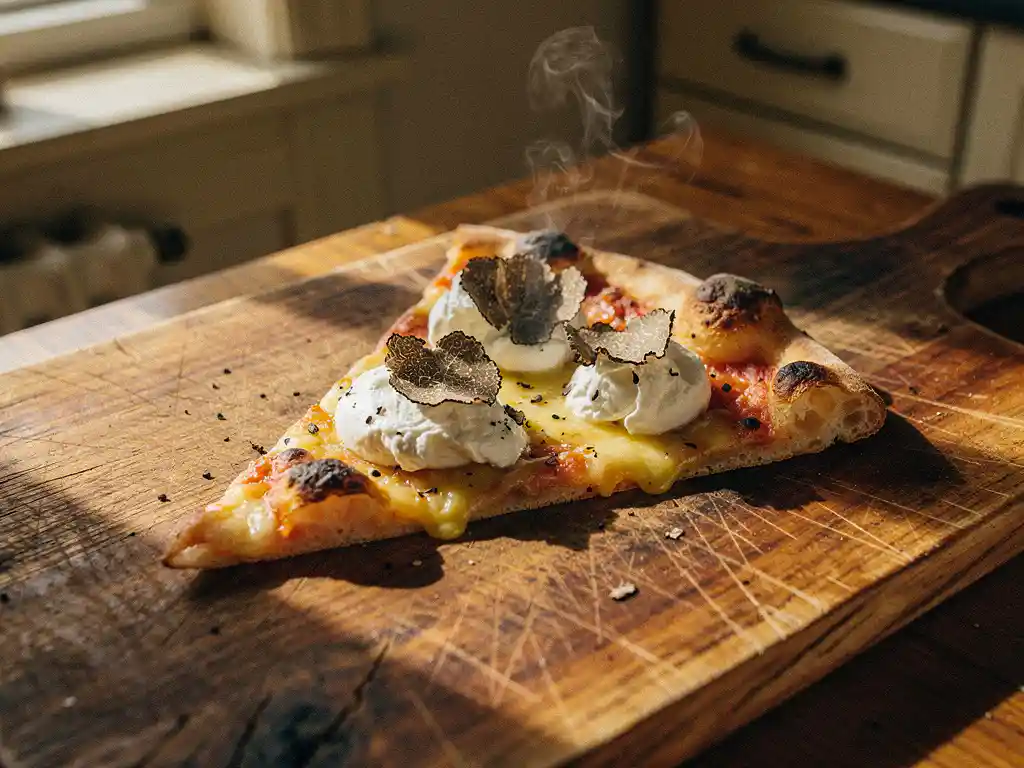
Developing a distinctive pizza concept in the competitive foodservice market requires innovative ingredients that offer both flavor and premium positioning. Truffle goat cheese combines the luxury of truffle with the unique properties of goat cheese, making it an ideal ingredient for pizza manufacturers looking to differentiate themselves. For buyers in the food industry, this ingredient offers new opportunities to develop premium pizza lines that respond to the growing demand for exceptional flavor combinations.
What makes truffle goat cheese the ideal ingredient for premium pizzas?
Truffle goat cheese distinguishes itself through the combination of creamy goat cheese with the intense aroma of truffle, instantly giving pizzas a luxurious appearance. The soft texture of fresh goat cheese melts evenly without fat separation, while the truffle adds an earthy, complex flavor layer that harmonizes perfectly with classic pizza ingredients.
The unique properties of goat cheese make it particularly suitable for premium pizza concepts. The lower lactose content and finer fat structure ensure better digestibility, which is attractive to consumers with sensitive stomachs. The natural white color of goat cheese creates visual contrast on pizzas, enhancing the presentation.
For industrial processing, truffle goat cheese offers practical advantages. The cheese maintains its structure during the baking process and doesn’t develop unpleasant odors when heated. The truffle aroma remains stable during preparation, guaranteeing a consistent flavor experience. Moreover, truffle goat cheese fits perfectly into the trend toward artisanal and craft products, where consumers are willing to pay more for authentic ingredients.
How does truffle goat cheese influence the melting behavior and texture of pizzas?
Truffle goat cheese has a softer melting point than traditional pizza cheeses like mozzarella, resulting in a creamy texture without stringiness. The cheese begins to melt around 55-60°C and spreads evenly across the pizza surface, maintaining its characteristic white color without browning like cow’s milk cheeses.
The fat content of goat cheese, typically between 20-25% for fresh varieties, provides a velvety smooth mouthfeel without the heavy, greasy aftertaste of some cow’s milk cheeses. The smaller fat globules in goat cheese contribute to a finer emulsion during melting, preventing the cheese from separating or becoming oily at high temperatures.
For pizza manufacturers, it’s important to know that goat cheese has less elasticity than mozzarella. This means it doesn’t form long strings when cut, which can actually be advantageous for pre-packaged pizzas where neat presentation is important. The cheese remains stable on the pizza and doesn’t run off the edges during baking. In industrial applications, truffle goat cheese can be applied in various forms: as crumbles for even distribution, as slices for visual impact, or as a spread for a uniform layer.
Which pizza varieties are best suited for truffle goat cheese?
White pizzas without tomato sauce form the ideal canvas for truffle goat cheese, where the delicate flavors can shine optimally. Combinations with mushrooms, spinach, caramelized onions, and walnuts create harmonious flavor profiles that strengthen the luxury positioning of the product.
Classic Italian styles like pizza bianca or focaccia-like bases work excellently with truffle goat cheese. The combination with prosciutto, arugula, and a drizzle of honey after baking creates a perfectly balanced premium pizza. For vegetarian options, combinations with grilled vegetables like eggplant, zucchini, and bell peppers offer interesting possibilities.
Modern fusion concepts open new doors for truffle goat cheese. Think of pizzas with figs, balsamic, and pine nuts, or combinations with pear and rosemary. For foodservice, individual pizzas or flatbreads are particularly popular, where truffle goat cheese functions as a signature ingredient. Seasonal variants with pumpkin in autumn or asparagus in spring offer opportunities for limited editions that emphasize exclusivity.
What are the main challenges when working with goat cheese in industrial pizza production?
The shorter shelf life of fresh goat cheese compared to hard cheeses requires adapted planning and inventory management systems in production environments. Fresh goat cheese typically has a shelf life of 4-7 weeks, making precise coordination between purchasing and production necessary to minimize waste.
Temperature control forms a critical factor during the production process. Goat cheese is more sensitive to temperature fluctuations than cow’s milk cheese, meaning the cold chain must be strictly maintained. At too high temperatures, the cheese can lose its structure, while freezing without proper techniques can lead to texture loss.
For large-scale production, specific dosing techniques are needed. Goat cheese has a softer consistency than traditional pizza cheeses, requiring adapted equipment for application on pizzas. Crumbles offer a solution here through their better dosability, but do require investments in suitable sprinkling equipment. The higher cost price of truffle goat cheese demands efficient portioning to monitor margins. Training production personnel is essential to prevent waste and ensure consistent quality.
How do you position a premium pizza line with truffle goat cheese in the market?
Successful positioning begins with emphasizing the artisanal origin and exclusivity of truffle goat cheese, focusing on natural ingredients and traditional preparation methods. Communicate the unique origin of the goat milk, the artisanal production process, and the careful selection of truffles to justify the premium value.
Pricing strategy plays a crucial role in market positioning. Premium pizzas with truffle goat cheese can be priced 20-30% higher than standard variants, provided the added value is clearly communicated. Focus on health benefits such as better digestibility, lower lactose content, and natural production methods appeals to conscious consumers.
Marketing should focus on the experience and story behind the product. Use terms like “artisanal,” “locally produced,” and “seasonal” to emphasize exclusivity. Visual presentation is essential: the white color of goat cheese contrasts beautifully with other ingredients and should be prominently featured. Collaboration with local restaurants for limited editions or seasonal menus can strengthen premium positioning and generate media attention.
What quality requirements apply to truffle goat cheese in the food industry?
Truffle goat cheese for industrial processing must meet strict microbiological standards, with total plate count remaining below 100,000 cfu/g and pathogens such as Listeria monocytogenes being absent. Producers must have IFS Food or BRC certification and work according to HACCP principles to guarantee food safety.
Consistent product quality requires standardized specifications for fat content (20-25%), moisture content (55-65%), and pH value (4.5-5.0). Truffle content must be at least 1-2% for authentic flavor experience, with uniform distribution throughout the product. Texture must be homogeneous without grains or separation, which is important for machine processing.
Packaging requirements for industrial applications include Modified Atmosphere Packaging (MAP) for optimal shelf life, with clear labeling of allergens and origin. Traceability from the milk supplier to the final product is mandatory under EU legislation. For export markets, additional certifications such as Halal or Kosher may be required. Suppliers must be able to guarantee consistent batch quality with regular quality reports and the possibility for audits by customers.
How DeJong Cheese helps with premium pizza concepts
As DeJong Cheese, we offer specific solutions for pizza manufacturers looking to innovate with truffle goat cheese. Our range includes various formats that perfectly align with industrial pizza production:
- Fresh goat cheese log Truffle (1kg) for foodservice with 23 weeks shelf life
- Aged goat cheese log Truffle (1kg) with more intense flavor for premium concepts
- Goat cheese Crumbles for optimal dosability in large-scale production
- Goat Brie Truffle (1.3kg) for unique pizza variants
- Custom industrial packaging up to 15kg with adaptable specifications
Our technical expertise helps optimize recipes and production processes. We offer support in determining the right cheese type and quantity for your specific pizza concept, including advice on melting behavior and shelf life. With our IFS Food certification and complete traceability from our DGZK-certified milk suppliers, we guarantee consistent quality for your production line.
Are you interested in developing a premium pizza line with our truffle goat cheese? Contact us for a personal consultation. Visit our foodservice page for more information about our complete range. For direct orders, you can visit our sales points. Discover all possibilities on our website.
Veelgestelde vragen
How do I prevent truffle goat cheese from losing its aroma during freezing for pizza production?
Freeze truffle goat cheese with a double layer of airtight packaging and use shock-freezing at -30°C to minimize aroma loss. Thaw the cheese slowly in refrigeration (24-48 hours) and use within 3 days after thawing for optimal aroma retention. For industrial applications, we recommend vacuum packaging with nitrogen flush for maximum protection of truffle aromas.
What baking temperature and time are optimal for pizzas with truffle goat cheese?
Bake pizzas with truffle goat cheese at 220-240°C for 8-12 minutes in a convection oven, or 280-300°C for 6-8 minutes in a stone oven. Add the goat cheese only in the last 3-4 minutes to prevent overheating, or use a lower temperature (200°C) with longer baking time for large-scale production where cheese is added directly.
Can I combine truffle goat cheese with other cheese types on the same pizza?
Yes, truffle goat cheese combines excellently with mild mozzarella (70/30 ratio) for optimal melting properties, or with Parmesan for extra umami. Avoid strong blue cheeses that overpower the delicate truffle aroma. Test different ratios in small batches to find the ideal balance for your target audience.
What are the most common mistakes when working with goat cheese in pizza production?
The biggest mistakes are: too high baking temperatures causing the cheese to separate, adding too early causing the aroma to evaporate, and incorrect storage leading to rapid quality deterioration. Also avoid excessive kneading or mixing of fresh goat cheese, which destroys texture, and don’t use metal tools that can affect flavor.
How do I calculate the right amount of truffle goat cheese per pizza for optimal cost price?
Use 60-80 grams of truffle goat cheese for a 30cm pizza as main cheese, or 30-40 grams as accent cheese in combination with mozzarella. For premium positioning with 25% higher selling price, cheese cost must remain below 35% of total ingredient costs. Consider portion packages of 50g for consistent dosing and minimal waste.
What certifications are essential for export of pizzas with truffle goat cheese?
Besides IFS Food or BRC certification, specific certificates are often needed for export: Halal for the Middle East, EU export certificates for non-EU countries, and FDA registration for the US. Ensure complete ingredient declarations including truffle origin and allergen information according to local legislation of the export country.
Gerelateerde artikelen
- Wat zegt bedrijfsgrootte van een producent over leverzekerheid op lange termijn?
- Wat zijn de kosten van een leverancierswissel bij industriële geitenkaas wrongel?
- Hoe werk je samen met een geitenkaasproducent aan de ontwikkeling van nieuwe pizza-ingrediënten?
- Hoe werkt samenwerking met een kaasproducent voor maatwerkontwikkeling van wrongel?
- Hoe verschilt de houdbaarheid van geitenkaas per verpakkingsformaat in de industrie?