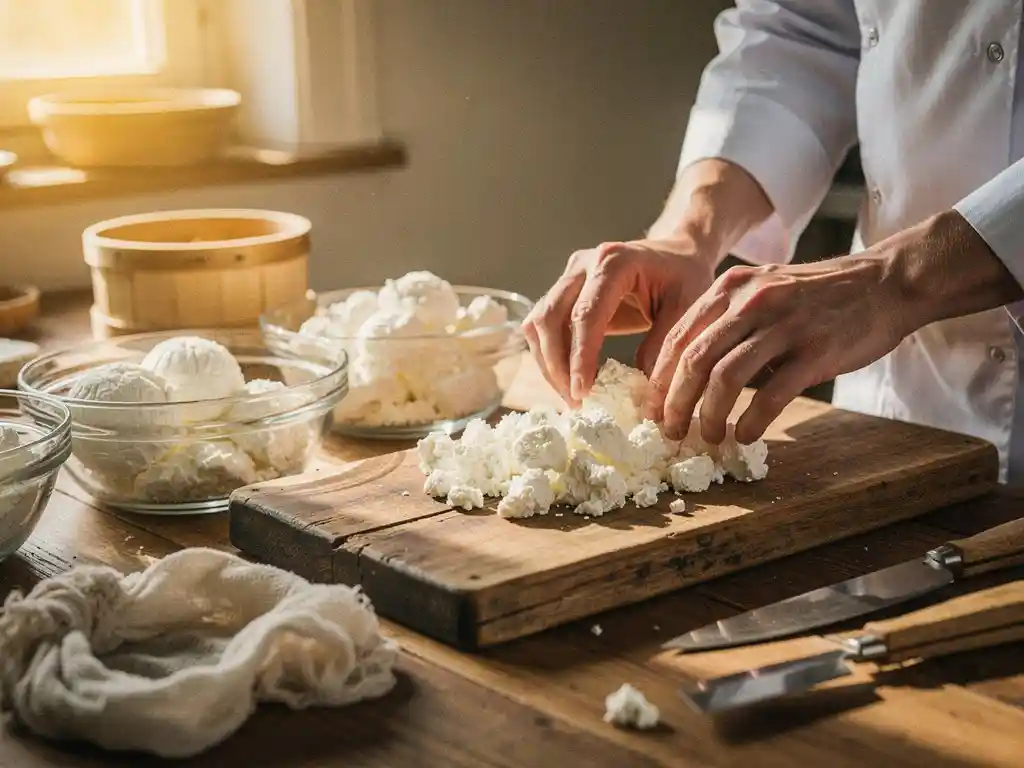
Testing goat cheese crumbles before proceeding to large-scale purchasing is a crucial process that guarantees the quality and suitability of the product for your specific application. As a producer in the food industry, you know that a wrong choice can lead to production problems, quality fluctuations, and dissatisfied end users. At DeJong Cheese, we understand that every industrial application places unique demands on goat cheese crumbles, whether it’s for pizza toppings, salad mixes, or ready-to-eat meals.
What are the key properties of goat cheese crumbles that you need to test?
The key properties of goat cheese crumbles that you need to test are structure and crumbliness, melting behavior when heated, fat content and moisture balance, shelf life under various conditions, and flavor stability during processing. These properties directly determine how the crumbles behave in your production line and end product.
Structure and crumbliness determine how easily the crumbles can be dosed in automatic production systems. Crumbles that are too fine may stick together, while pieces that are too coarse become unevenly distributed. Melting behavior is essential for heated applications like pizzas or casseroles. Some goat cheese crumbles retain their shape when heated, while others melt completely.
Fat content affects not only flavor but also the texture and mouthfeel of the end product. Higher fat content provides creaminess but can also lead to fat separation during heating. Moisture balance is crucial for shelf life and prevents dehydration or moisture migration to other ingredients in your product.
Shelf life under different storage conditions must be tested, especially if your product will be frozen or stored at refrigerated temperatures for extended periods. Our goat cheese crumbles, for example, have a shelf life of 23 weeks fresh and up to 2 years frozen, remaining fresh for another 23 weeks after thawing.
How do you conduct a small-scale product test with goat cheese crumbles?
You conduct a small-scale product test with goat cheese crumbles by first requesting test batches of 5-10 kg, processing them in pilot production lines under realistic conditions, and then evaluating the end products for taste, texture, and shelf life for at least two weeks. This process provides reliable data without major investments.
Start by requesting representative samples. For industrial applications, our 5 kg bags of crumbles are ideal for testing. This package size offers sufficient product for multiple test runs without having to purchase large volumes immediately. Make sure to test both natural and any flavored variants to explore the full potential.
During pilot production, it’s important to simulate all relevant process steps. Test the dosability in your machines, check whether the crumbles remain evenly distributed during transport on conveyor belts, and monitor behavior during any heating steps. Document every step carefully, including temperatures, times, and processing speeds.
The evaluation phase should last at least two weeks to get a good picture of shelf life. Test the products immediately after production, after one week of refrigeration, and after two weeks. Watch for changes in taste, texture, moisture content, and microbiological stability. Also involve your quality department and possibly a taste panel in the assessment.
What quality tests are essential before purchasing goat cheese crumbles on a large scale?
Essential quality tests for goat cheese crumbles include microbiological analyses, functional tests such as melting behavior and oil separation, sensory evaluations, nutritional verification, and compatibility tests with other ingredients in your product. These tests ensure consistent quality and predictable performance in large-scale production.
Microbiological testing is fundamental for food safety. Test for pathogens such as Listeria monocytogenes, Salmonella, and E. coli, but also for yeasts and molds that can affect shelf life. Request certificates from the supplier and conduct random spot checks yourself. Our products are tested according to IFS Food standards as standard.
Functional tests focus on the behavior of crumbles during processing. Test the melting point and melting pattern at different temperatures, measure oil separation during heating, and check stability during freeze-thaw cycles if relevant to your application. These tests help optimize your production processes.
Sensory evaluations should cover both raw crumbles and the end product. Assess taste, odor, texture, and appearance. Pay particular attention to any off-flavors that may develop during storage or processing. A trained taste panel can detect subtle differences that could later lead to complaints.
Nutritional verification is important for correct labeling. Check whether the stated values for fat, protein, salt, and other nutrients match your analyses. This prevents problems with legislation and consumer information.
What is the difference between laboratory tests and production tests for goat cheese crumbles?
The difference between laboratory tests and production tests lies in scale and realism: laboratory tests analyze specific properties under controlled conditions with small samples, while production tests evaluate the behavior of crumbles in actual production lines with realistic volumes, speeds, and environmental factors. Both are necessary for complete validation.
Laboratory tests focus on exact measurements of individual parameters. Think of determining exact fat content via Soxhlet extraction, moisture content via drying ovens, or pH measurements for acidity determination. These tests often use only grams of product but deliver very precise data that serves as a reference for quality control.
Production tests, on the other hand, evaluate how crumbles behave in the complex reality of your factory. How do they react to vibrations from dosing machines? Do they remain well distributed in a mixture with other ingredients? How do they perform when the production line runs at full speed? These tests reveal practical problems that aren’t visible in the lab.
Interaction with other ingredients is a crucial difference. In the lab, you test crumbles in isolation, but in production they come into contact with sauces, vegetables, meat, or dough. These interactions can have unexpected effects on taste, texture, or shelf life that only emerge in realistic production tests.
Time scale is also an important distinction. Laboratory tests can often be performed within hours or days, while production tests can take weeks to evaluate the complete production cycle including shelf life. Plan both types of testing in your validation process for optimal certainty.
How do you evaluate cost savings when switching to new goat cheese crumbles?
You evaluate cost savings with new goat cheese crumbles by calculating the total cost per kilogram of end product, including purchase price, processing efficiency, waste, shelf life, and labor costs. Compare at least three months of data from the current product with test results from the new product for a reliable cost-benefit analysis.
Start with a detailed cost analysis of your current situation. Note not only the purchase price per kilogram but also how much product you actually use per unit of end product. Loss through waste, incorrect dosing, or quality problems can significantly increase actual costs. Also measure the time operators spend handling the product.
For new crumbles, you need to project the same parameters based on test data. If the new crumbles dose better in your machines, for example, this can lead to less waste and more consistent products. Longer shelf life, like our 23-week fresh shelf life, can reduce inventory costs and write-offs.
Processing efficiency is often a hidden cost item. Crumbles that produce less dust, flow better, or cake less in machines can make the production line run faster and reduce cleaning time. Measure productivity in units per hour and cleaning time per production run.
Quality improvements can yield indirect savings. Fewer complaints means lower costs for complaint handling and possibly higher selling prices for a superior end product. Also include the value of consistent quality in your calculations, especially if this leads to better customer retention.
How DeJong Cheese helps with testing goat cheese crumbles
At DeJong Cheese, we understand that transitioning to new goat cheese crumbles is an important decision for your production process. That’s why we offer a comprehensive support program specifically tailored to the needs of industrial processors like you.
Our support includes:
- Free 5 kg samples for initial laboratory and production tests
- Technical specification sheets with all relevant parameters for your quality department
- Support in setting up test protocols adapted to your specific application
- Flexible delivery options: fresh (23 weeks shelf life) or frozen (2 years shelf life)
- Possibility of recipe adjustments for your unique requirements
Our range of goat cheese crumbles is specially developed for industrial applications, with consistent quality that you can expect from a family business with more than 25 years of experience. We deliver worldwide to foodservice and industry, both under our own Alphenaer brand and private label.
Are you ready to improve the quality and efficiency of your products with our goat cheese crumbles? Contact our team today for a no-obligation consultation and receive test samples that perfectly match your production needs. Visit our foodservice page for more information about our complete industrial range, or go directly to our contact page to make an appointment. Would you like to taste our products yourself first? Check out our sales points or visit our website for a complete overview of our capabilities.
Veelgestelde vragen
How long does the complete testing process take before we can switch to large-scale purchasing?
A complete testing process takes an average of 6-8 weeks, including sample requests, laboratory tests, pilot production, and shelf life evaluation. For complex applications with multiple product variants, this can extend to 12 weeks. Plan sufficient time for seasonal products where you want to test different production conditions.
What are the most common mistakes when testing goat cheese crumbles in industrial applications?
The biggest mistakes are testing under ideal laboratory conditions without accounting for production stress, ignoring interactions with other ingredients like acids or salts, and evaluating shelf life too briefly. Always test under worst-case scenarios like maximum production speed, temperature fluctuations, and longest storage times to prevent surprises.
Can we test different suppliers simultaneously and how do we organize this efficiently?
Yes, parallel testing of 2-3 suppliers is even advisable. Use identical test protocols, code samples blindly for objective assessment, and test on the same day under equal conditions. Create a scorecard with weighted criteria like price (30%), functionality (40%), taste (20%), and service (10%) for systematic comparison.
What documentation should we request for certification and quality assurance?
Request at minimum: IFS/BRC certificates, halal/kosher certification if relevant, specification sheets with microbiological standards, allergen declarations, GMO-free declarations, and traceability documents. For organic applications, EKO/EU-Bio certificates are essential. Also check whether the supplier undergoes GFSI-recognized audits for supply chain security.
How do we determine the optimal packaging size for our production volumes?
First calculate your daily consumption and inventory rotation. For volumes up to 100 kg per day, 5 kg bags are ideal; at 100-500 kg per day, consider 10-15 kg packages. Above 500 kg daily consumption, bulk in 600-1000 kg containers pays off. Consider ergonomics for operators, storage space, and shelf life after opening the package.
What are the best methods to prevent cross-contamination during testing of different cheese types?
Implement strict separation: use dedicated test equipment per product, clean machines according to a validated CIP protocol between tests, and schedule allergen-containing products last. Train personnel in correct sampling techniques, use color-coded materials per product type, and document all cleaning steps for traceability during the testing phase.
How can we justify the ROI of premium goat cheese crumbles to management?
Calculate the Total Cost of Ownership including: lower waste (often 2-5% improvement), reduced labor costs through better processability, higher selling price of end product through premium positioning, and lower complaint costs. Present a 12-month projection with break-even point, where quality improvement and market differentiation are weighted as strategic advantages alongside direct cost savings.
Gerelateerde artikelen
- Welke rol speelt storytelling rond ambachtelijke productie in productontwikkeling?
- Hoe test je houdbaarheid van een nieuw geitenkaasconcept in de praktijk?
- Hoe beïnvloedt het rijpingsproces van gerijpte geitenkaas de smaak in een eindproduct?
- Welke duurzaamheidscertificeringen zijn relevant bij de inkoop van geitenkaas voor de voedingsindustrie?
- Hoe bewaak je de leveranciersprestaties van een producent van industriële geitenkaas?