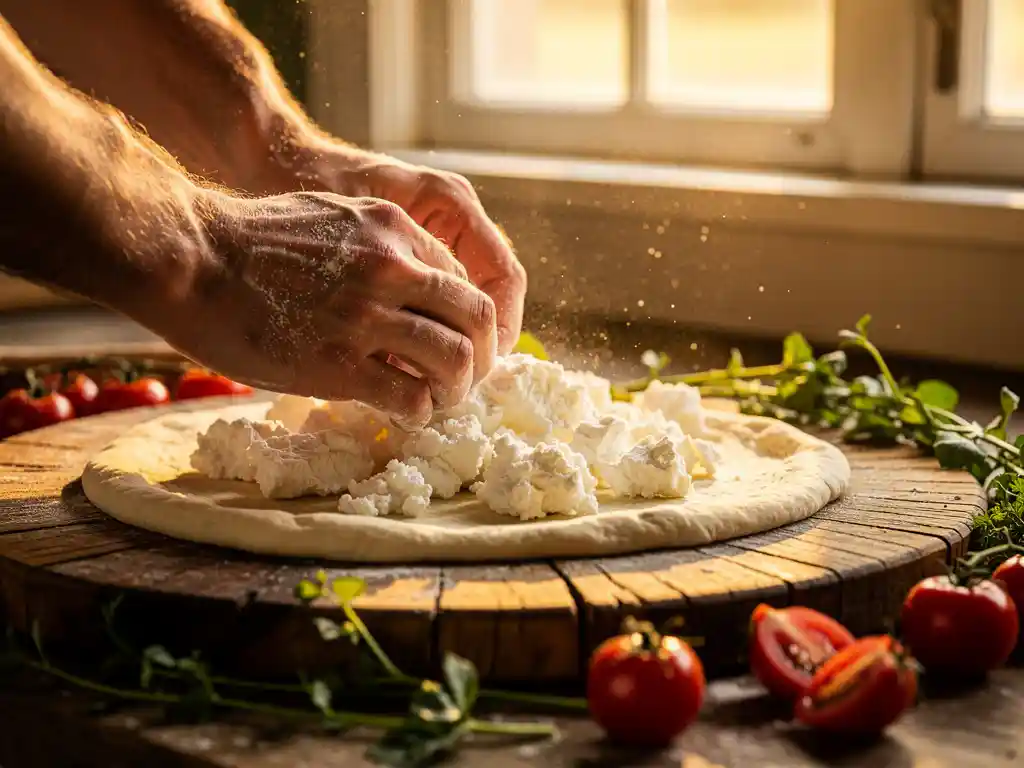
Developing new pizza ingredients requires more than just a supplier – it requires a partner who thinks along, innovates and delivers reliably. For pizza producers who want to innovate with goat cheese, collaboration with an experienced goat cheese producer is essential. From selecting the right cheese type to perfecting melting behavior and flavor profile – every step in the development process requires specialized knowledge and close collaboration.
In the food industry, where consistency and scalability are crucial, goat cheese offers unique opportunities for product differentiation. But how do you find the right partner for this development? And what technical aspects should you consider when integrating goat cheese into industrial pizza production? This article answers the most important questions about collaborating with a goat cheese producer for the development of new pizza ingredients.
What are the advantages of goat cheese as a pizza ingredient?
Goat cheese offers pizza producers distinctive advantages: a unique, creamy flavor profile that is milder than traditional cheeses, excellent melting properties at lower temperatures, and premium positioning that enables higher margins. Additionally, goat cheese is more digestible for consumers with lactose intolerance.
The soft, creamy character of fresh goat cheese creates a luxurious mouthfeel that perfectly contrasts with crispy pizza bases and savory toppings. Unlike hard cheeses such as mozzarella, goat cheese retains its characteristic flavor during baking without becoming bitter. This makes it ideal for gourmet pizzas where flavor complexity is central.
For industrial processing, goat cheese offers practical advantages. The cheese is available in various forms – from crumbles to slices and spreadable variants – enabling flexible application in production processes. Modern goat cheese products are specially developed for stability during freezing and heating, while maintaining quality and texture.
From a marketing perspective, goat cheese taps into growing consumer trends. The association with artisanal production, local origin and traditional preparation methods aligns with the demand for authentic foods. This enables pizza producers to develop premium product lines that differentiate themselves in a competitive market.
How do you find the right goat cheese producer for product development?
You find the right goat cheese producer for product development by looking for companies with industrial experience, technical expertise in cheese modification, flexible production capacity and willingness for co-creation. Also essential are certifications such as IFS Food and a proven track record in large-scale delivery.
Start by evaluating the technical capabilities of potential partners. A suitable producer has knowledge of various cheese preparation methods and can advise on adjustments for specific applications. Ask about their experience with developing industrial cheese products, such as curd or specially modified variants for processing purposes.
Production flexibility is crucial for successful collaboration. Look for producers who can handle both small test batches and large-scale production. This enables you to test new formulations without large investments, after which scaling to full production can proceed smoothly. Also pay attention to willingness to develop private label products.
Quality certifications provide assurance about food safety and process control. In addition to standard certifications such as IFS Food, specific accreditations such as EC approval, the DGZK quality mark for sustainable goat dairy, and possibly Halal or Kosher certification are valuable. These certifications simplify compliance and reduce risks in your own production chain.
Also evaluate the producer’s willingness to collaborate. A good partner actively thinks along about product development, shares knowledge about market developments and is transparent about possibilities and limitations. Ask for references from other industrial customers and inquire about their experiences with flexibility and problem-solving ability.
What technical specifications are important for goat cheese for pizza?
For pizza application, the most important technical specifications of goat cheese are: dry matter content (35-45%), melting behavior at 180-220°C, pH value for stability, fat content for texture, and moisture retention during baking. These parameters determine how the cheese performs in industrial pizza production.
Dry matter content directly influences melting behavior and stability during processing. For pizza applications, a dry matter content between 35% and 45% works optimally. Lower percentages can lead to excessive moisture loss during baking, while higher percentages can reduce meltability. Industrial goat cheese products can be specifically adjusted within this range.
Melting characteristics are essential for the end result. Goat cheese must melt evenly without oil separation or burning. The ideal goat cheese for pizza retains its creamy texture at baking temperatures between 180°C and 220°C. Test melting behavior under different conditions: pre-baked bases, frozen pizzas, and fresh production each require adjusted specifications.
Shelf life and stability during storage deserve special attention. For industrial processing, freeze-stable variants are available that can be frozen without quality loss. These products retain their functional properties after thawing, providing flexibility in production planning. Fresh variants typically have a shelf life of 4-7 weeks, while frozen products are shelf-stable for up to 2 years.
- Consistency in grain size for crumbles (uniformity for even distribution)
- Pumpability for automated production systems
- Microbiological stability for food safety
- Flavor stability during heating and cooling
- Compatibility with other ingredients and preservatives
How does the development process of new goat cheese formulations work?
The development process of new goat cheese formulations starts with briefing and target specification, followed by laboratory tests, pilot production, taste panels, technical validation and final scaling. This iterative process typically takes 3-6 months, depending on complexity and desired adjustments.
The first phase begins with a detailed briefing in which product goals, technical requirements and commercial parameters are established. Discuss the intended flavor profile, desired texture, application temperatures and shelf life requirements. An experienced goat cheese producer translates these wishes into concrete formulation proposals, taking into account feasibility and cost considerations.
Laboratory development forms the heart of the process. Cheese masters experiment with different milk types, starter cultures, ripening times and additions to achieve the desired profile. For pizza applications, the focus is on optimizing melting behavior, adjusting parameters such as protein structure, fat content and moisture binding. Small test batches enable rapid iterations.
Pilot production tests the scalability of successful laboratory formulations. Production batches of 50-100 kg validate whether the formulation is consistently reproducible. During this phase, packaging options are also tested, especially for industrial applications where Modified Atmosphere Packaging (MAP) or bulk packaging is common.
Application tests under realistic conditions are crucial for success. Test the new goat cheese formulation on different pizza bases, with different toppings and under production conditions that mimic your actual process. Evaluate not only the fresh product, but also performance after freezing, thawing and different storage times. Document all findings systematically for further optimization.
What are the main challenges when working with goat cheese in pizza production?
The main challenges with goat cheese in pizza production are moisture control during baking, cost management due to premium positioning, adaptation of production processes for soft cheese types, and retaining characteristic flavor at high temperatures. These challenges require specific technical solutions.
Moisture control poses the biggest technical challenge. Goat cheese naturally has a higher moisture content than traditional pizza cheeses, which can lead to soggy bases or uneven baking results. Solutions include using pre-dried goat cheese crumbles, adjusting the pizza base formulation for better moisture absorption, or strategic placement of cheese in combination with moisture-absorbing ingredients.
The premium price position of goat cheese requires careful cost management. While goat cheese is more expensive than standard mozzarella, the added value can be justified by positioning as a premium product. Optimize usage by combining goat cheese with other cheeses, focus on efficient dosing, and explore possibilities for long-term contracts with fixed price agreements.
Production processes often require adjustment for the unique properties of goat cheese. Standard dosing equipment for hard cheeses may not work optimally with soft goat cheese products. Invest in adapted dosing systems or choose specially developed industrial variants that are pumpable and automatically dosable. Train production staff in the specific handling of goat cheese products.
Flavor retention during the baking process requires formulation adjustments. The delicate flavor of goat cheese can be overwhelmed by strong herbs or lost at too high temperatures. Experiment with:
- Adding goat cheese in the final baking phase for flavor retention
- Combination with complementary ingredients such as honey or figs
- Using aged goat cheese for more intense flavor profiles
- Adjusting baking temperature and time for optimal results
What agreements do you make about quality assurance and delivery reliability?
Essential agreements about quality assurance include specification sheets with tolerances, quality control protocols, traceability systems and deviation procedures. For delivery reliability, arrange minimum stock levels, backup production capacity, communication protocols and contractual guarantees for continuity.
Quality specifications form the basis of any professional collaboration. Establish detailed product specifications including acceptable tolerances for critical parameters such as dry matter content, pH value, microbiological standards and organoleptic properties. Determine measurement methods, control frequencies and reporting formats. Request Certificates of Analysis (CoA) with each delivery.
Implement robust traceability systems that enable complete tracking from milk supplier to end product. This is essential for rapid response to quality issues and meets legal requirements. Modern goat cheese producers work with digital systems that provide real-time insight into production data, temperature logs and quality measurements.
Delivery reliability requires proactive planning and clear agreements. Discuss seasonal influences on milk availability, plan buffer stocks for peak periods, and make agreements about minimum stock levels at the producer. For critical products, consignment stock or vendor managed inventory (VMI) can provide additional security.
Contractual guarantees protect both parties. Important elements are:
- Service Level Agreements (SLA) with delivery reliability percentages
- Force majeure clauses with clear definitions and procedures
- Quality guarantees with liability arrangements
- Price agreements with indexing mechanisms for raw materials
- Exclusivity agreements for co-developed products
- Exit clauses with reasonable notice periods
How DeJong Cheese helps with innovative pizza ingredients
As a family business with more than 25 years of experience in goat cheese production, we at DeJong Cheese offer the perfect combination of artisanal quality and industrial expertise. Our extensive range of industrial goat cheese products is specifically developed for large-scale processing, where we flexibly respond to your unique product requirements.
Our specialized support for pizza producers includes:
- Technical expertise: Advice on optimal cheese selection for your specific pizza application, from melting behavior to flavor profile
- Custom solutions: Development of private label products and customized formulations according to your specifications
- Flexible delivery forms: From freeze-stable curd to ready-to-use crumbles, in packages from 1 kg to 15 kg
- Quality guarantee: IFS Food-certified production with full traceability and consistent quality
- Sustainable production: 100% DGZK-certified milk from local goat farmers within 100 km
Our industrial range offers solutions for every pizza application. The fresh goat cheese log (2.6 kg) in natural or honey is perfect for own processing, while our goat cheese crumbles (5 kg bags) are ready to use. For innovative applications, we offer spreadable goat cheese in 10 kg buckets and specially developed curd that is freeze-stable and pumpable.
Are you ready to differentiate your pizza products with premium goat cheese? Contact us today for a no-obligation conversation about your possibilities. Visit our foodservice page for more information about our complete range, or schedule an appointment directly via our contact page. For inspiration and product applications, you can also visit our showroom – check the opening hours and location. Discover how our expertise and quality products elevate your pizza production to the next level at dejongcheese.nl.
Veelgestelde vragen
How long does goat cheese stay good on a pizza after preparation?
Fresh pizzas with goat cheese stay good for 2-3 days when refrigerated (max. 4°C). For frozen pizzas with goat cheese, shelf life is up to 6 months at -18°C, provided freeze-stable goat cheese products are used. Note: after thawing, the pizza must be consumed within 24 hours for optimal quality and food safety.
What minimum order size do goat cheese producers maintain for industrial customers?
Most industrial goat cheese producers maintain a minimum order size of 100-200 kg per product variant. For test batches during product development, smaller quantities are often possible (from 25-50 kg). With long-term contracts, more favorable minimum order quantities can be negotiated, especially with regular purchase.
How do you prevent goat cheese from becoming too dominant in the flavor balance of pizza?
Dose goat cheese strategically: use 60-80 grams per pizza (30cm) instead of the usual 100-120 grams regular cheese. Combine goat cheese with mild mozzarella in a 30/70 ratio for balance. Add the goat cheese only in the last 2-3 minutes of baking time, or use aged variants that are less intense in flavor after heating.
What are the main differences between Dutch and French goat cheese for pizza application?
Dutch goat cheese generally has a milder, creamier flavor profile and better melting properties due to higher moisture content. French goat cheese is often drier and more intense in flavor, which works better as a finishing touch. For industrial pizza production, Dutch goat cheese offers practical advantages: more consistent quality, better availability and lower cost price with comparable premium positioning.
Can pizza bakeries modify goat cheese themselves for better performance?
Small adjustments are possible: mix fresh goat cheese with 5-10% cornstarch for better moisture binding, or add 2% milk powder for improved melting behavior. For structural improvements, however, collaboration with a producer is essential. They have specialized equipment for homogenization, pH adjustment and texture modification that are not feasible in a pizza kitchen.
What certifications must a pizza producer have when working with goat cheese?
HACCP certification is minimally required for any food producer. For export within the EU, IFS Food or BRC certification usually suffices. For specific markets, additional certifications may be needed: Halal/Kosher for religious target groups, or organic when using organic goat cheese. Ensure your certifications align with those of your goat cheese supplier for seamless compliance.
How do you calculate the right cost price when switching to goat cheese?
Calculate not only the direct ingredient costs (goat cheese costs 40-60% more than mozzarella), but also the total product value. Premium pizzas with goat cheese can justify 20-30% higher selling prices. Also factor in: lower dosages (20-30% less needed), possibly higher turnover rate through differentiation, and reduce waste through better planning with your supplier.
Gerelateerde artikelen
- Wat zijn de gevolgen van een te hoog vochtgehalte in geitenkaas wrongel?
- Welke technische specificaties vraag je op voor geitenkaas bestemd voor verhitting?
- Hoe vergelijk je de total cost of ownership van geitenkaas crumbles versus een log?
- What documentation must a cheese supplier be able to provide immediately?
- Hoe zet je geitenkaas crumbles in als finishing touch in gekoelde maaltijdconcepten?