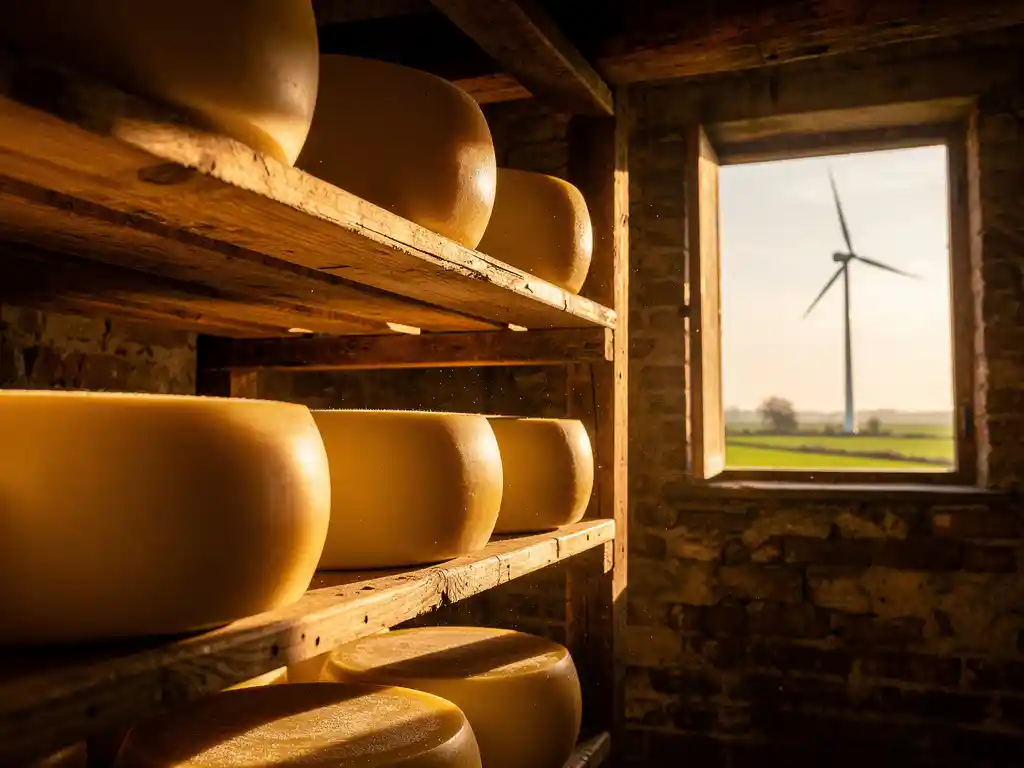
Sustainability plays an increasingly important role in the food industry, and cheese producers are actively seeking ways to reduce their ecological footprint. As a traditional family business since 1995, we at DeJong Cheese see how wind energy is transforming cheese production. The use of renewable energy sources like wind energy not only offers environmental benefits but also has a direct impact on operations, product quality, and cost management. In this article, we answer the most important questions about wind energy in cheese production.
What does it mean when a cheese producer uses 70% wind energy?
A cheese producer that uses 70% wind energy covers seventy percent of their total energy consumption with electricity generated by wind turbines. This means that processes such as milk processing, cooling, aging, and packaging largely run on clean, renewable energy instead of fossil fuels.
In practice, this translates to a significant reduction in CO2 emissions per kilogram of cheese produced. For a medium-sized cheese producer that annually produces several million kilograms of cheese, this can mean a CO2 reduction of thousands of tons per year. The remaining 30% of energy often comes from other sources, with producers striving for further sustainability through solar energy or green electricity from the grid.
The percentage of wind energy is usually calculated over a full year, as wind output can vary seasonally. Modern cheese producers often combine wind energy with energy storage systems or grid connection to ensure continuity. For industrial customers like Marco Visser, this means they can purchase from a supplier that demonstrably contributes to sustainability goals without compromising delivery reliability.
How does wind energy affect cheese quality?
Wind energy has no direct influence on the intrinsic quality of cheese, as the energy type does not change the biochemical processes during cheese making. Milk acidification, coagulation, and aging proceed identically, regardless of whether the energy comes from wind, fossil fuels, or other sources.
Indirectly, wind energy can contribute to quality preservation through a stable energy supply for critical processes. Modern wind energy installations with backup systems ensure constant temperature control during storage and aging, which is essential for consistent product quality. For fresh goat cheese, for example, which must be stored at specific temperatures, a reliable energy supply means that delicate flavor profiles are preserved.
Producers who invest in wind energy often show a broader commitment to quality and sustainability. These companies usually also implement other quality improvements such as modern production technology and strict quality controls. For aged goat cheese, where the aging process must be precisely controlled for months, the combination of wind energy with modern climate control provides optimal conditions for flavor development.
What are the environmental benefits of wind energy in the cheese industry?
The main environmental benefits of wind energy in the cheese industry are drastic CO2 reduction, reduced dependence on fossil fuels, and lower emissions of particulate matter and nitrogen oxides. A cheese producer that switches to 70% wind energy can reduce the CO2 footprint per kilogram of cheese by approximately 60-65%.
The dairy industry is naturally energy-intensive due to processes such as pasteurization, cooling, and climate control in aging chambers. Traditionally, these processes are powered by natural gas and electricity from fossil sources. Wind energy completely eliminates emissions during electricity generation, resulting in:
- No direct CO2 emissions during energy generation
- No consumption of finite fossil resources
- No water consumption for cooling as with traditional power plants
- Minimal impact on local air quality
- Preservation of biodiversity through less pollution
For the complete lifecycle of cheese production, wind energy also means indirect environmental benefits. Transport of fossil fuels becomes unnecessary, which provides additional emission reduction. Moreover, demand for wind energy stimulates further investments in renewable infrastructure, making the entire energy system more sustainable.
How much can companies save with wind energy for cheese production?
Companies can save between 15% and 40% on energy costs with wind energy for cheese production over a period of 15-20 years, depending on scale, location, and financing structure. The initial investment is usually recovered within 7-12 years through lower operational costs and more stable energy prices.
The cost savings come from various sources:
- Lower energy costs per kWh: Wind energy has minimal operational costs after installation, while fossil fuels are subject to price fluctuations
- Tax benefits: Many countries offer tax advantages and subsidies for investments in renewable energy
- Avoided CO2 taxes: With increasing CO2 taxes, fossil fuels are becoming increasingly expensive
- Energy security: Own wind energy protects against price increases in the energy market
For a medium-sized cheese producer with an annual energy consumption of 5 million kWh, the switch to 70% wind energy can yield annual savings of $150,000 to $300,000 after the payback period. These savings can be reinvested in product development, quality improvement, or further sustainability. Industrial customers benefit indirectly as producers can translate these cost advantages into more stable prices for products like fresh goat cheese, aged goat cheese, and specialties.
Why are more and more cheese producers choosing wind energy?
More and more cheese producers are choosing wind energy because of the combination of economic benefits, sustainability requirements from customers, regulations, and social responsibility. The technology has proven reliable, become financially attractive, and is essential for future-proof business operations.
The drivers for this transition are diverse:
- Market demand: Retailers and foodservice customers increasingly impose sustainability requirements on suppliers
- Cost stability: Wind energy offers protection against volatile energy prices
- Regulation: Tightened climate targets and CO2 taxes make fossil energy unattractive
- Competitive advantage: Sustainably produced cheese has added value in the market
- Technological progress: Modern wind turbines are more efficient and reliable than ever
For family businesses in the cheese sector, generational thinking also plays a role. Investments in wind energy are investments in the continuity of the business for future generations. The combination with traditional cheese-making techniques creates a unique proposition: artisanal quality produced with modern, sustainable energy. This resonates strongly with both consumers and professional buyers who value authenticity and responsibility.
How DeJong Cheese helps with sustainable cheese production
At DeJong Cheese, we combine our traditional cheese-making expertise since 1995 with a strong focus on sustainability and innovation. For industrial partners such as buyers in the food industry, we offer concrete solutions that contribute to their sustainability goals without compromising quality or delivery reliability.
Our approach to sustainable cheese production includes:
- Energy-efficient production processes: Optimization of our production processes for minimal energy consumption for fresh goat cheese, aged specialties, and industrial applications
- Local milk suppliers: Collaboration with farms in the region for shorter transport distances and fresher raw materials
- Flexible packaging solutions: From bulk packaging for industry to Modified Atmosphere Packaging for optimal shelf life with minimal packaging materials
- Transparent communication: Clear information about our sustainability efforts and product specifications for your own reporting
For more information about how our sustainable production processes align with your specific needs, we invite you to contact us. Discover our complete range of goat cheese specialties on our foodservice page, or visit one of our sales points to taste our products. More information about DeJong Cheese and our vision on sustainable cheese production can be found on our homepage.
Veelgestelde vragen
How can I as a buyer verify that a cheese producer actually uses wind energy?
Ask for certificates such as Guarantees of Origin (GOs) or green certificates that show how much renewable energy is used. Serious producers can also provide energy audits, sustainability reports, or independent verifications. Many companies publish their energy mix in annual reports or on their website, and some work with recognized sustainability labels that include energy use.
What happens to cheese production when there is no wind?
Modern cheese producers with wind energy always have backup systems such as grid connection, battery storage, or hybrid energy systems. Production is never interrupted because critical processes such as cooling and aging require continuous energy. Many companies work with energy contracts where excess wind energy is delivered to the grid and energy is taken back when needed, ensuring 100% supply security.
Are there specific cheese types that benefit more from sustainable energy sources?
Energy-intensive cheese types such as long-aged hard cheeses benefit most from wind energy due to their months-long aging process in climate-controlled spaces. Fresh cheeses that require continuous cooling also have great advantage. For goat cheese specifically, both fresh and aged varieties benefit from stable energy supply, with cost savings being greatest for products with long aging times or special storage conditions.
How does wind energy affect cheese prices for industrial customers?
In the short term, cheese from producers with wind energy may be comparably priced, but in the long term it offers price stability because producers are less dependent on fluctuating energy prices. This translates into more stable contract prices and better predictability for purchasing budgets. Moreover, future CO2 taxes on traditionally produced cheese can be avoided, providing a competitive advantage.
What other sustainable technologies combine well with wind energy in cheese production?
Wind energy combines excellently with heat recovery from production processes, solar panels on roofs of aging warehouses, and biogas from whey waste streams. Many producers also implement water recycling, LED lighting in aging chambers, and electric vehicles on the company premises. This integrated approach maximizes energy savings and creates synergy between different sustainability measures.
How can I as a foodservice company inform my customers about wind energy in our cheese products?
Ask your cheese supplier for communication materials such as infographics about their energy mix, CO2 savings figures per product, or stories about their sustainability journey. Use this information on menu cards, websites, or in marketing campaigns. Many producers also offer tours or videos that you can share. Concrete figures like ‘70% wind energy means X kg less CO2 per cheese board’ appeal to customers and support your own sustainability communication.
Gerelateerde artikelen
- Hoe blijf je op de hoogte van wijzigingen in voedselveiligheidswetgeving?
- Hoe stel je objectieve acceptatiecriteria op voor geitenkaas wrongel?
- Wat doe je als een leverancier van geitenkaas pucks niet aan je kwaliteitseisen voldoet?
- Hoe beheer je de houdbaarheidsdatum van verse geitenkaas pucks in een productieomgeving?
- Wat is het Kwaligeit-keurmerk en wat zegt het over de melkkwaliteit van geitenkaas?