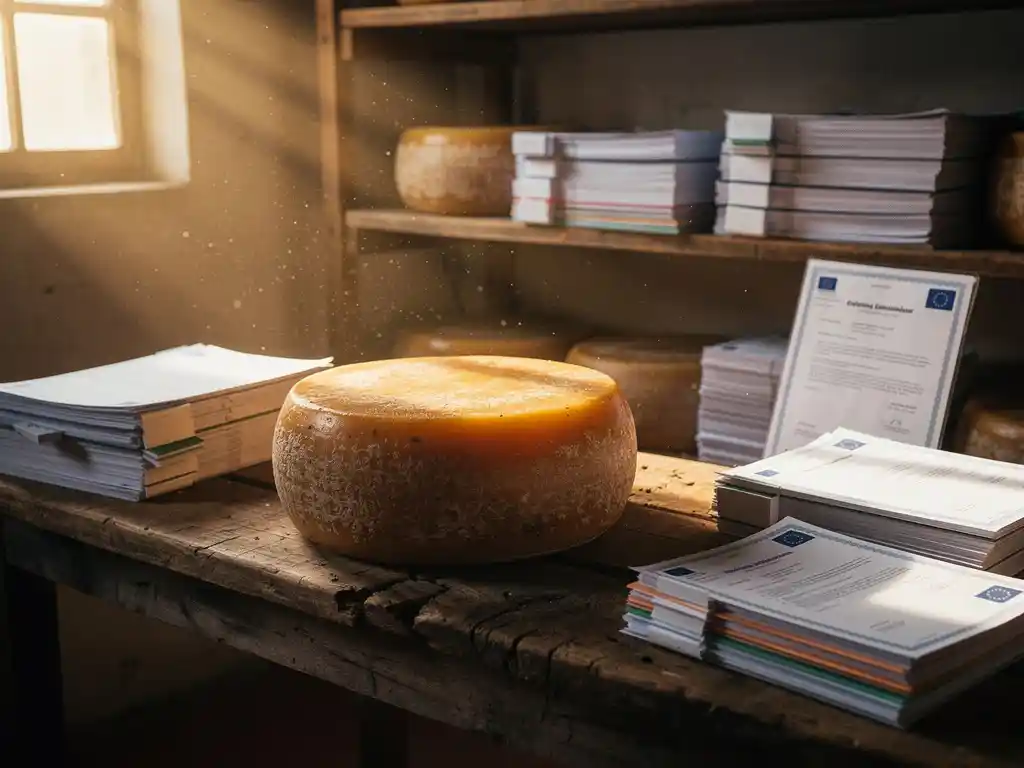
The EU Taxonomy regulation has a significant impact on how food companies report on their sustainability performance, including the procurement of cheese products. For purchasers in the food industry, this means new reporting obligations and the need to collect sustainability data from suppliers. This article provides practical guidelines for correctly reporting on sustainable cheese procurement according to the EU Taxonomy framework.
What is the EU Taxonomy framework for sustainable cheese procurement?
The EU Taxonomy framework is a classification system that determines which economic activities are considered environmentally sustainable, with cheese procurement falling under the category of food processing and distribution. The framework requires companies to report on six environmental objectives: climate mitigation, climate adaptation, water and marine resources, circular economy, pollution prevention, and biodiversity.
For the cheese industry, this specifically means that purchasers must demonstrate how their purchasing decisions contribute to these environmental objectives. This includes evaluating the sustainability performance of cheese suppliers in terms of energy consumption, water usage, packaging materials, and transportation methods. Companies with more than 250 employees or revenue above 40 million euros must comply with mandatory reporting according to these guidelines from 2024.
The reporting requires quantitative data on the percentage of cheese procurement that meets the taxonomy criteria. This means purchasers must collect detailed information about the production processes, certifications, and sustainability initiatives of their suppliers. For fresh goat cheese and aged specialties, specific criteria around animal welfare and pasture management must also be included in the assessment.
What sustainability criteria apply to cheese according to EU Taxonomy?
The EU Taxonomy establishes four main criteria for sustainable cheese production: minimal CO2 emissions per kilogram of product, responsible water and energy consumption, circular packaging solutions, and demonstrable animal welfare according to recognized certifications. These criteria must comply with the principle of ‘do no significant harm’ to other environmental objectives.
For CO2 emissions, there is a threshold value that is tightened annually. Cheese suppliers must be able to demonstrate that their production process stays below this limit, including emissions from transportation and packaging. This requires life cycle assessments (LCAs) of products such as fresh goat cheese logs, cheese crumbles, and spreadable varieties. Suppliers who use renewable energy or CO2 compensation score better on this criterion.
Water usage must be monitored per kilogram of final product, with reuse of process water and water treatment counting positively. For packaging, at least 80% must be recyclable and preferably made from recycled materials. Modified Atmosphere Packaging (MAP) must comply with specific guidelines for gas composition and material selection.
Animal welfare is assessed based on recognized certifications such as organic, the Better Life quality mark, or comparable standards. For goat cheese producers, this means they must be able to demonstrate that their milk suppliers meet strict welfare standards, including pasture access, stable space per animal, and natural feed.
How do you collect the right data from your cheese suppliers?
Start by creating a standardized questionnaire that covers all EU Taxonomy criteria, including CO2 footprint, water consumption, energy sources, packaging materials, and animal welfare certifications. Ask suppliers for quarterly reports with measurable KPIs and supporting documentation such as certificates and audit reports.
Implement a digital platform or supplier portal where cheese suppliers can upload their sustainability data. This system should accommodate different product categories such as fresh cheese products, aged varieties, and industrial applications. Provide clear instructions on which units of measurement to use and how calculations should be performed.
Specifically ask for scope 1, 2, and 3 emissions according to the GHG Protocol. For cheese producers, this includes direct emissions from the production site, indirect emissions from purchased energy, and emissions from dairy farming and transportation. Suppliers of specialties such as goat cheese with herbs or truffle must also include the impact of these ingredients.
Validate the received data through spot checks and comparison with industry averages. Request external verification of important claims, especially from suppliers who represent a significant portion of your procurement volume. Build long-term relationships with suppliers who are transparent about their sustainability performance and willing to work together on improvements.
What is the difference between CSRD and EU Taxonomy for cheese procurement?
The Corporate Sustainability Reporting Directive (CSRD) is the overarching reporting framework that requires companies to report on all sustainability aspects, while the EU Taxonomy specifically defines which economic activities qualify as environmentally sustainable. CSRD requires broader ESG reporting, EU Taxonomy focuses only on environmental impact with concrete threshold values.
For cheese procurement, CSRD means you must report on social aspects such as working conditions at suppliers, supply security, and impact on local communities. This goes beyond the environmental focus of EU Taxonomy and also includes governance aspects such as anti-corruption policies and transparency in the supply chain. Companies must integrate both frameworks into their reporting.
CSRD requires double materiality: both the company’s impact on sustainability themes and the impact of sustainability risks on the company. For cheese procurement, this means you not only report on the environmental impact of your suppliers, but also on how climate change can affect your supply security, for example through drought affecting milk production.
Practically speaking, you use EU Taxonomy data as input for your CSRD reporting. The quantitative metrics from EU Taxonomy (percentage of sustainable procurement) are combined with qualitative information about strategy, risk management, and governance. For large food companies, this means the procurement department must work closely with sustainability and finance teams.
What tools do you use for EU Taxonomy reporting on cheese?
Specialized ESG software such as Sphera, Enablon, or SAP Sustainability Control Tower offer modules specifically for EU Taxonomy reporting, including templates for food procurement and automatic calculation of alignment percentages. These platforms integrate with ERP systems to directly link procurement data to sustainability criteria.
For medium-sized companies, cloud-based solutions such as Ecovadis IQ or IntegrityNext are suitable. These tools offer pre-configured questionnaires for cheese suppliers and dashboards for monitoring compliance. They often contain industry-specific benchmarks that allow you to compare your suppliers’ performance with sector averages.
Excel-based templates remain an option for smaller organizations, but require manual data entry and calculations. The European Commission offers free Excel tools for EU Taxonomy calculations, but these must be adapted for specific product categories. For cheese procurement, this means adding relevant KPIs such as milk origin, cold chain management, and packaging ratios.
Regardless of the chosen tool, data integration is essential. Link procurement systems, supplier databases, and sustainability platforms to avoid duplicate entry. Implement APIs where possible and ensure regular data validation. For fresh products with short shelf life such as goat cheese spread or crumbles, real-time tracking of sustainability performance is especially important.
How do you avoid common mistakes in sustainability reporting for cheese procurement?
The most common mistake is using generic emission factors instead of supplier-specific data, which leads to inaccurate reporting and possible non-compliance. Always collect primary data from your cheese suppliers about their specific production processes, energy consumption, and transportation methods.
A second common mistake is ignoring scope 3 emissions, especially the impact of milk production which often accounts for 80-90% of the total CO2 footprint of cheese. For goat cheese and cow cheese products, you must include the entire chain, from feed production to final product. Suppliers who only report their direct production emissions provide an incomplete picture.
Inconsistent measurement methods between suppliers form a third risk. Standardize how water consumption, energy consumption, and waste streams are measured. For industrial cheese products such as 15kg curd bags or 10kg spread buckets, it must be clear whether packaging material is included in the calculations or not.
Finally, many companies underestimate the documentation requirements. EU Taxonomy requires not only data, but also evidence of claims. Store certificates, audit reports, and methodology descriptions systematically. Implement a document management system where all relevant sustainability documentation is stored per supplier and product and regularly updated.
How DeJong Cheese helps with EU Taxonomy-compliant cheese procurement
DeJong Cheese actively supports purchasers in meeting EU Taxonomy reporting requirements by providing transparent sustainability data for our complete range of goat cheese and cow cheese products. We deliver detailed information about our production processes, energy consumption, water usage, and packaging materials, specifically tailored to EU Taxonomy criteria.
Our sustainability approach includes:
- Complete CO2 footprint calculations for all product lines, from fresh goat cheese logs to industrial curd products
- Transparency about milk origin from local farms with animal welfare certification
- Quarterly reports with KPIs according to EU Taxonomy standards
- Support with data integration into your ESG reporting systems
- Proactive communication about improvement initiatives and new sustainable packaging solutions
As a family business since 1995, we combine traditional cheese making with modern sustainability standards. Our IFS Food certification and focus on local sourcing make it easy to include our products in your sustainable procurement strategy. Whether you’re looking for fresh goat cheese for retail, aged specialties for foodservice, or industrial applications, we provide the data you need for correct EU Taxonomy reporting.
Contact our team to discuss how we can simplify your sustainability reporting. Visit our website for more information about our sustainability policy or find one of our sales points to experience our products.
Veelgestelde vragen
What software should I use as a small company for EU Taxonomy reporting on cheese procurement?
For smaller companies, cloud-based solutions such as IntegrityNext or Ecovadis IQ are most suitable due to their user-friendliness and lower costs. As a budget-friendly alternative, you can start with the free Excel templates from the European Commission, supplemented with a structured supplier questionnaire. More important than the tool itself is setting up a consistent process for data collection and validation with your cheese suppliers.
How do I deal with suppliers who cannot or will not share sustainability data?
Start with an open dialogue about why this data is needed for your compliance and offer support in collecting the information. Consider a phased approach where you start with basic KPIs such as energy consumption and certifications. If suppliers structurally refuse to cooperate, temporarily use industry averages for your reporting, but document this transparently. In the long term, it is wise to gradually switch to suppliers who are transparent about their sustainability performance.
Do I need to assess all cheese products individually or can I use product categories?
You can use product categories for EU Taxonomy reporting, provided the products within a category have comparable sustainability characteristics. For example, group fresh goat cheese products, aged cheeses, and industrial applications separately. Within each category, you can use average values for CO2 emissions and resource consumption. However, ensure you collect representative data for each category and clearly document what assumptions you make when grouping.
What are the consequences if my cheese procurement does not meet EU Taxonomy criteria?
There are no direct fines for not meeting EU Taxonomy criteria for cheese procurement. However, you must transparently report what percentage of your economic activities are ’taxonomy-aligned’. A low percentage can lead to reputational damage, higher financing costs, and loss of customers who prioritize sustainability. Therefore, focus on an improvement plan: set realistic goals for increasing sustainable procurement and communicate your progress transparently to stakeholders.
How often should I update the sustainability data from my cheese suppliers?
For EU Taxonomy reporting, annual updating is the minimum, but quarterly reports are recommended for fresh products such as goat cheese. Plan an annual complete data update where suppliers provide new certificates, LCA studies, and process improvements. Request quarterly updates for critical KPIs such as energy consumption and transport emissions. With significant changes in production processes or supplier changes, you must immediately request new data.
Can organic cheese products automatically be considered EU Taxonomy-compliant?
No, organic certification alone is not sufficient for EU Taxonomy compliance. While organic cheese often scores well on animal welfare and biodiversity, you still need to assess CO2 emissions, water and energy consumption, and packaging sustainability. Organic production can sometimes even have a higher environmental impact due to lower efficiency. Therefore, treat organic products no differently than conventional cheese in your EU Taxonomy assessment, but collect the same set of sustainability data for both.
Gerelateerde artikelen
- Hoe ontwikkel je een fenugreek- of kruidenvariant binnen het Alphenaer-assortiment?
- Welke laboratoriumtesten zijn relevant om kwaliteit van geitenkaas te verifiëren?
- Hoe weet je of een geitenkaasproducent ook op lange termijn aan je eisen kan voldoen?
- Wat zijn de gevolgen van inconsistente kaaskwaliteit in een pizzaproductielijn?
- Welke documentatie verwacht een afnemer bij de inkoop van gecertificeerde geitenkaas?