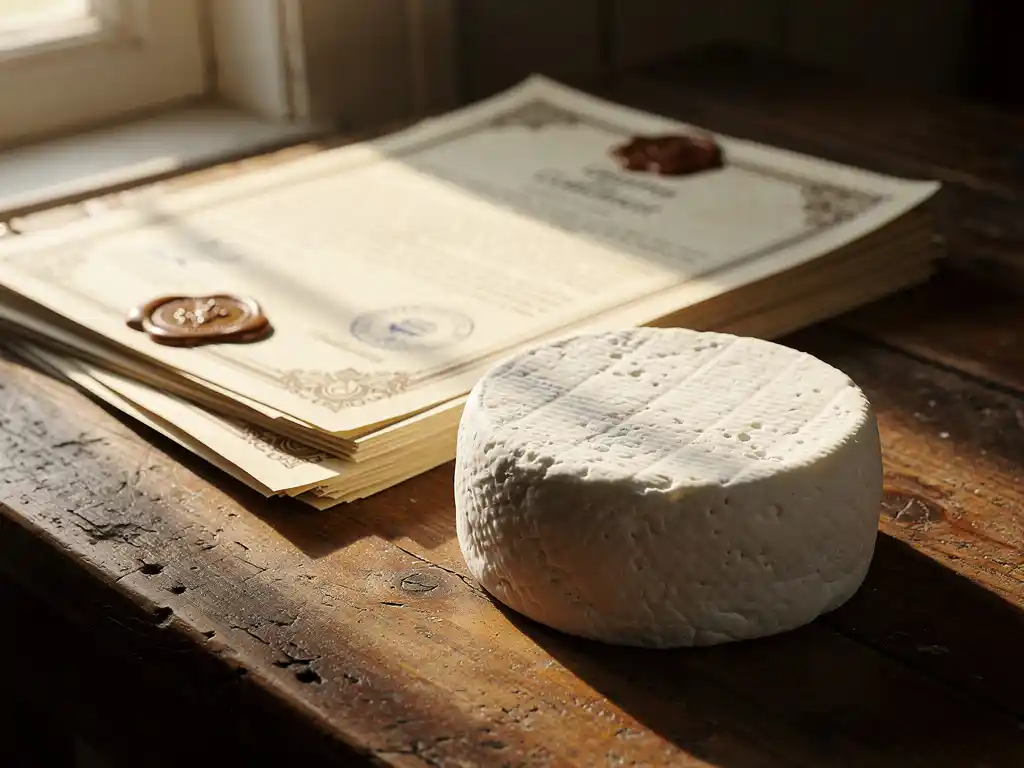
Documenting supplier certifications is a critical component of quality management in the food industry. For buyers working with goat cheese producers, properly managing these documents forms the foundation for food safety, compliance, and risk management. This article covers the essential steps for requesting, verifying, and integrating certifications into your own quality system.
What certifications should a goat cheese producer have for industrial supply?
A goat cheese producer for industrial supply must have at minimum an FSSC 22000 or IFS Food certification, supplemented with a HACCP certificate and relevant export certificates for international deliveries. These basic certifications guarantee that the producer meets international food safety standards and is suitable for large-scale processing.
Beyond these core certifications, there are additional documents that strengthen a supplier’s reliability. The DGZK mark (Dutch Goat Cheese Quality Mark) specifically confirms the quality and origin of Dutch goat cheese. For organic products, a SKAL certification is required, while Halal or Kosher certificates are needed for specific markets.
Producers supplying to retail or foodservice often must also have a BRC Global Standards certificate. This certificate specifically focuses on product safety, quality, and operational criteria. For sustainability requirements, certifications like Planet Proof or comparable ESG-related certificates are increasingly requested.
For industrial applications, pay special attention to certificates that guarantee the technical properties of the cheese. Consider specification sheets for melting behavior, fat content, and microbiological parameters. This technical documentation is essential for correctly processing goat cheese in products like pizzas, ready meals, or bakery products.
How do you request certifications from a new goat cheese producer?
Start by sending a formal supplier questionnaire specifically asking for all relevant certifications, including validity date and certifying body. Always request copies of original certificates, not summaries or self-declarations from the supplier.
Structure your request systematically by using a standard template. Clearly state which certifications are mandatory for your organization and which are additionally desired. Indicate what application you intend to use the goat cheese for, so the producer can include relevant technical documentation.
Communicate directly with the producer’s quality department, not just the sales department. They have access to the most current certifications and can answer specific questions about production processes and quality systems. Also ask about their procedure for updating certifications and how they inform you of changes.
Set a deadline for document delivery and specify in what format you wish to receive them. Digital PDF files are most practical for archiving in your own system. Preferably request English versions of certificates if you operate internationally, as this facilitates internal audits and customer communication.
What are the key checkpoints for goat cheese certificates?
Certificate validity is the first checkpoint: verify the issue date and expiration date, and check that the certificate is valid for at least three months to ensure continuity. Additionally, check whether the certificate scope specifically covers goat cheese production and not just general dairy processing.
Verify certificate authenticity by checking the certificate number with the issuing body. Many certifying organizations offer online databases where you can verify validity. Pay attention to the exact company name and production location on the certificate – these must match your supplier data.
Check whether the product categories on the certificate match the products you purchase. Different requirements may apply for fresh goat cheese, aged varieties, and industrial applications like curd or crumbles. Ensure that all product forms you order are explicitly mentioned in the scope.
Also assess the certifying body itself. Recognized organizations like DNV, SGS, Bureau Veritas, or Lloyd’s Register have international accreditation. Check whether the auditor was qualified for the specific standard and whether there are no major non-conformities outstanding that could affect validity.
How do you integrate supplier certificates into your own quality system?
Create a central digital database where all supplier certificates are systematically stored with metadata such as expiration date, product category, and risk classification. Implement an automatic alert system that notifies you three months before expiration of the need for renewal.
Link certificates to your supplier assessment by developing a scorecard. Factor in elements like certification level, number of certifications, and compliance history in your total supplier score. Distinguish between critical certifications (like FSSC 22000) and nice-to-have documents (like sustainability certificates).
Integrate certificate control into your purchasing procedure by setting up the system so orders can only be placed with suppliers holding valid certifications. Ensure a clear escalation procedure when certificates expire or fail to meet requirements.
Train your purchasing team and quality staff in correctly interpreting certificates. Develop a checklist for new suppliers and a standard procedure for processing certificate updates. Document all communication about certifications in your supplier file for traceability during audits.
When should you update or re-verify supplier certifications?
Supplier certifications should be checked at least annually, but for critical suppliers a semi-annual review is recommended. Plan updates three months before expiration to allow sufficient time for requesting and verifying new documents.
Immediate re-verification is needed for significant events such as product warnings, quality complaints, changes in production location, or supplier ownership. Also, when expanding your product range with new goat cheese products, you must check whether these fall under existing certification.
Implement a risk-based approach where suppliers of high-risk products or large volumes are checked more frequently. For goat cheese products processed directly into consumer products, we recommend quarterly verification of critical certificates.
External triggers for re-verification are legislative changes, new customer requirements, or updates to certification standards. When a new version of IFS Food is released, for example, you must verify that your supplier transitions to the new standard in time. Also consider seasonal influences – check before grilling season that all certificates are current for your goat cheese pizza toppings.
How De Jong Cheese helps with supplier certifications
We understand like no other how important correct documentation is for industrial customers. Our quality team keeps all certifications up-to-date and proactively makes them available to our customers. With our IFS Food certification and comprehensive documentation for industrial applications, we make it easy for you to meet your own compliance requirements.
Our support includes:
- Direct access to all valid certificates through a secure customer portal
- Automatic notifications when certifications are renewed
- Technical specification sheets for all industrial goat cheese products
- Dedicated quality assurance contact person for certification questions
- Annual supplier audit support on-site
For Marco Visser and other buyers in the food industry, we offer complete transparency about our production processes and quality systems. Our tradition since 1995 guarantees reliable documentation and consistent quality. Contact our team to discuss how we can simplify your certification process, or visit our foodservice page for more information about our complete range and accompanying documentation.
Veelgestelde vragen
How often should I conduct physical audits at my goat cheese producers besides checking certificates?
For strategic suppliers we recommend at least one physical audit per year, supplemented with quarterly document reviews. For new suppliers or after significant quality incidents, an additional on-site audit is advisable. Combine these audits with product visits to increase efficiency and build a risk matrix based on supplier performance and product volumes.
What do I do if a supplier refuses to share certain certificates due to 'confidentiality'?
This is a red flag that requires further investigation. Standard food safety certificates contain no confidential information and must be shareable. Ask specifically for the reason for refusal and consider alternatives like an NDA or anonymized versions. With continued refusal, we recommend classifying the supplier as high-risk or even excluding them.
What digital tools or software can I use for managing supplier certificates?
Popular solutions are SAP Ariba for large organizations, or more accessible tools like Supplier.io, SafetyChain, or Intact. For smaller companies, a well-configured SharePoint or Google Workspace with automatic reminders can suffice. Choose a system that supports API integrations for linking with your ERP and automatic validation with certifying bodies.
How do I handle certificates from foreign goat cheese producers that use different standards?
Create an equivalency table indicating which foreign certifications you accept as alternatives to Dutch/EU standards. SQF from the US or FSSC 22000 are often equivalent to IFS Food. Always request a gap analysis when different certifications are offered and consider additional product-specific testing for missing certifications.
What are the financial and operational risks of working with non-certified suppliers?
Risks range from direct fines during NVWA inspections ($1,000-$10,000) to product recall actions that can cost millions. Operationally, you risk production stops, loss of your own certifications, and reputational damage with customers. Insurers may reject claims for damage from non-certified ingredients, so savings on purchase price rarely outweigh these risks.
How do I train new employees in correctly assessing supplier certificates?
Start with basic training on different certification standards and their logos, followed by practical exercises with real certificates. Have new employees shadow during supplier audits and certificate checks. Develop a mentorship program where experienced colleagues supervise the first 10-15 certificate assessments and create a decision tree for complex situations.
Gerelateerde artikelen
- Wat zijn de voordelen van een leverancier met eigen productiefaciliteiten?
- Welke impact heeft droogte of extreem weer op de beschikbaarheid van geitenkaas?
- Welke rol speelt storytelling rond ambachtelijke productie in productontwikkeling?
- Hoe beïnvloedt dierenwelzijn op de geitenboerderij de consistentie van geitenmelk?
- Wat zijn de voordelen van een exclusief partnerschap met een gespecialiseerde geitenkaasproducent?