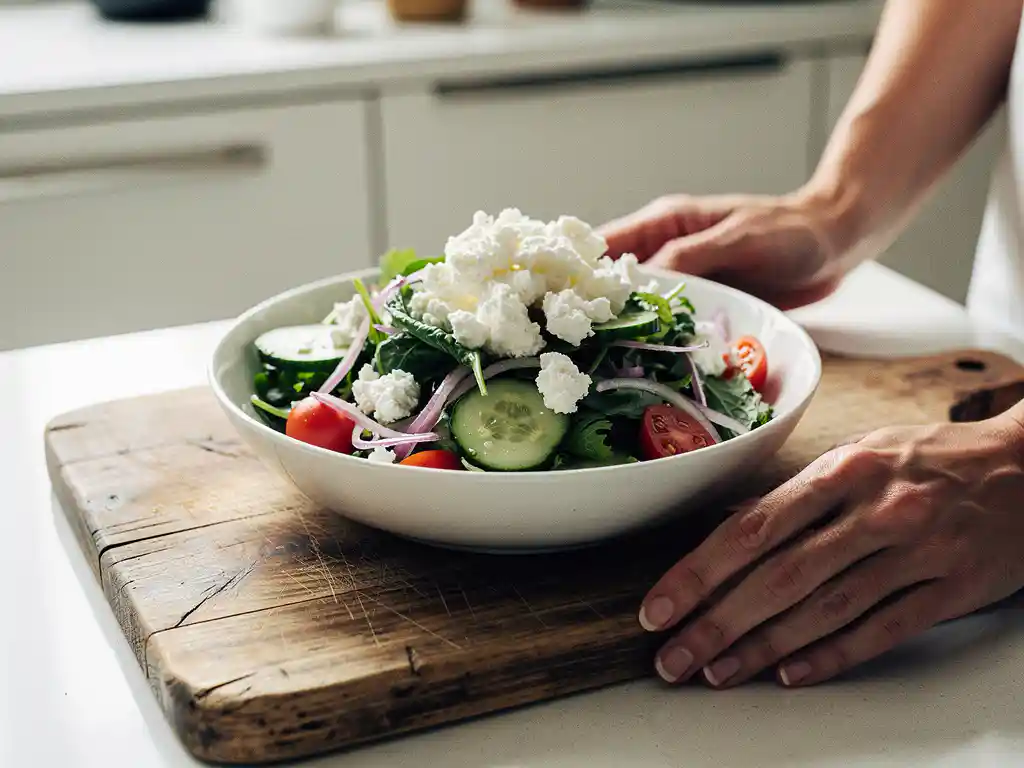
Goat cheese crumbles are a versatile finishing touch that are becoming increasingly popular in professional kitchens. This convenient cheese format offers countless possibilities for enriching chilled meal concepts, from salads to ready-to-eat meals. For food industry producers seeking consistent quality and practical application possibilities, goat cheese crumbles offer unique advantages that we discuss extensively in this article.
What are goat cheese crumbles and why are they ideal for cold applications?
Goat cheese crumbles are small, loose pieces of fresh goat cheese that have been specially crumbled for direct application in dishes. This pre-processed cheese format retains the characteristic creamy texture and mild flavor of goat cheese, while the crumbled form enables perfect portioning and even distribution without additional processing steps.
The ideal properties for cold applications stem from the natural structure of goat cheese. Unlike hard cheeses that lose their flavor at low temperatures, goat cheese crumbles retain their full, creamy flavor profile even at refrigerator temperature. The soft texture ensures that the crumbles become immediately smooth in the mouth, without the grainy structure that some cheeses can develop at cold temperatures.
For industrial processing, crumbles offer practical advantages. They are available in 5-kilogram bags with a shelf life of 23 weeks refrigerated, or even 2 years frozen. After thawing, they remain fresh for another 23 weeks, providing flexibility in production and inventory planning. The pre-crumbled form eliminates labor-intensive preparation steps and guarantees consistent piece size in every end product.
Which types of chilled meal concepts benefit most from goat cheese crumbles?
Premium salads and bowl concepts benefit most from goat cheese crumbles because they add a luxurious appearance and creamy texture. The crumbles function as a protein-rich topping that combines perfectly with green leafy vegetables, nuts, and dried fruits, providing both visual appeal and flavor depth to ready-to-eat salad meals.
Wraps and sandwiches form a second important category. Here, goat cheese crumbles offer a mild, creamy counterpart to more intense flavors such as grilled vegetables, sun-dried tomatoes, or spicy sauces. The crumbles melt slightly from the heat of other ingredients without completely losing their shape, ensuring recognizable cheese texture in every bite.
Mediterranean and vegetarian meal boxes are particularly suitable for goat cheese crumbles. Think of couscous salads, quinoa bowls, or mezze-like concepts where the crumbles function as a premium protein source. The neutral to slightly acidic flavor of goat cheese harmonizes excellently with typical Mediterranean ingredients such as olives, peppers, and fresh herbs.
Finally, cold pasta and grain salads are ideal applications. The crumbles maintain their structure among other ingredients and add a luxurious element to, for example, orzo salads, bulgur dishes, or cold pasta salads. For producers, this means they can upgrade multiple product lines to a premium segment with one ingredient.
How do you determine the right amount and distribution of crumbles in a meal concept?
The optimal amount of goat cheese crumbles is between 15 and 30 grams per serving, depending on the type of meal and desired flavor intensity. For salads, you typically use 20-25 grams, for wraps 15-20 grams, and for premium bowl concepts this can increase to 30 grams to truly position the cheese as a main ingredient.
In distribution, uniformity is crucial for consistent flavor experience. For salads and bowls, a “top-layer” approach works best, where approximately 70% of the crumbles are sprinkled on top and 30% are mixed through the dish. This ensures visual appeal while every bite still contains cheese.
For scale production, it’s important to consider the packaging method. With seal packaging, it’s best to place the crumbles in a separate compartment or on top of stable ingredients to minimize crumbling during transport. With MAP packaging (Modified Atmosphere Packaging), the crumbles can be distributed more directly over the product because the protective atmosphere better preserves the structure.
The timing of addition is also important. Always add crumbles as the last ingredient, after any dressings or sauces. This prevents them from absorbing moisture and losing their characteristic crumbly texture. For automated production lines, dosing systems with vibrating plates are ideal to guarantee consistent portioning and distribution.
What are the technical advantages of goat cheese crumbles for production and logistics?
Goat cheese crumbles offer superior processability through their pre-processed form that enables direct application without cutting, grating, or crumbling. This eliminates labor-intensive preparation steps and reduces the risk of cross-contamination because the cheese no longer comes into contact with cutting equipment, which is especially important in allergen management in production facilities.
The long shelf life forms a significant logistical advantage. With 23 weeks refrigerated shelf life and the possibility of freezing for 2 years, crumbles offer flexibility in inventory planning and seasonal production. After thawing, they maintain their quality for another 23 weeks, providing buffer for production planning and preventing waste during demand fluctuations.
For automated production lines, crumbles are ideal due to their uniform structure and sprinkling properties. They can easily be dosed via standard filling equipment without modifications. The consistent particle size ensures predictable fill weights and even distribution, which is essential for standardized portioning.
Transport and storage are optimized because crumbles are delivered in bulk packaging of 5 kilograms. These bags take up less space than traditional cheese blocks and are stackable on pallets (48 boxes per pallet). The flexible packaging adapts to available space, enabling more efficient use of cooling and freezing space.
How do you combine goat cheese crumbles with other ingredients for optimal flavor experience?
Goat cheese crumbles harmonize best with ingredients that offer contrast in texture and flavor, where sweet-sour combinations with honey, cranberry, or figs enhance the creamy mildness of the cheese. Add crunchy elements like walnuts, pumpkin seeds, or toasted pine nuts for texture contrast, and combine with fresh vegetables like arugula or spinach for a balanced flavor profile.
For Mediterranean concepts, goat cheese crumbles work excellently with sun-dried tomatoes, grilled peppers, olives, and fresh herbs like basil or oregano. The mild cheese flavor functions as a binding element between the more intense flavors. Balsamic vinegar or a light citrus dressing enhances the natural freshness of the goat cheese without overpowering it.
In combination with grains and legumes, crumbles offer a creamy counterpart to the firm bite of quinoa, bulgur, or lentils. Add roasted vegetables like pumpkin, beet, or carrot for natural sweetness that beautifully contrasts with the slightly acidic undertone of goat cheese. A drizzle of honey-mustard dressing binds all flavors together.
For optimal flavor experience, the temperature of accompanying ingredients is crucial. Combine cold crumbles with ingredients at room temperature for the best flavor development. Avoid too-cold dressings that can mask the creaminess of the cheese. With warm ingredients like grilled vegetables, let them cool to lukewarm first before adding the crumbles, so they retain their shape while becoming slightly soft for extra creaminess.
What quality requirements do you set for goat cheese crumbles for consistent end products?
Essential quality requirements for goat cheese crumbles include a uniform crumble size between 5-8 mm, a consistent moisture content of 55-60%, and a fat content that remains stable throughout the entire shelf life period. The crumbles must be free-flowing without clumping, with a bright white to light ivory color indicating fresh, high-quality goat milk as raw material.
Microbiological stability is crucial for food safety in ready-to-eat meals. Look for suppliers with IFS Food certification that guarantee the product meets strict hygiene standards. The pH value must remain stable between 4.2 and 4.6 to ensure both safety and flavor throughout the entire chain from production to consumption.
Sensory consistency requires that each batch has the same mild, slightly acidic flavor without bitter or sharp undertones. The texture must be creamy upon consumption, not grainy or dry. Test regularly for flavor stability after thawing if you work with frozen product, as freezing can affect texture if the process is not carried out correctly.
Documentation and traceability are indispensable for industrial processing. Demand complete batch information, allergen declarations, and nutritional data per delivery. Ask for consistent delivery times and predictable quality throughout the year, regardless of seasonal influences on milk production. A reliable supplier also offers technical support in product development and troubleshooting during implementation.
How DeJong Cheese helps with goat cheese crumbles for your meal concepts
As a specialist in goat cheese products since 1995, we at DeJong Cheese offer high-quality goat cheese crumbles that perfectly align with the needs of the modern food industry. Our crumbles are available in practical 5kg packages with the flexibility of both refrigerated (23 weeks) and frozen (2 years) shelf life, enabling optimal planning for your production.
Our industrial goat cheese crumbles offer concrete advantages for your production line:
- Consistent quality through traditional production with modern quality control
- IFS Food certification for guaranteed food safety
- Flexible delivery options with reliable volumes
- Technical support in product development
- Possibility for private label solutions
With our years of expertise in supplying retail, foodservice, and industry worldwide, we understand the specific challenges of large-scale food production. Our crumbles are produced according to traditional recipes with milk from local goat farms, ensuring an authentic flavor that distinguishes your end products in the market.
Are you interested in applying our goat cheese crumbles in your chilled meal concepts? Contact our team for samples, technical specifications, and a personal consultation. Visit our foodservice page for more information about our complete range, or contact us directly through our contact page. For inspiration and products, you can also visit one of our sales points. Discover all possibilities on our website.
Veelgestelde vragen
How do I prevent goat cheese crumbles from drying out in my ready-to-eat meals?
Always use proper sealing with MAP packaging (Modified Atmosphere Packaging) or vacuum-sealing to prevent moisture loss. Place the crumbles in a separate compartment or on top of moist ingredients like lettuce or dressing, and avoid direct contact with acidic ingredients that can cause the cheese to ‘sweat’. For optimal freshness, store products with goat cheese crumbles at a constant temperature between 2-4°C.
Can I combine goat cheese crumbles with warm ingredients in meal prep concepts?
Yes, but timing is essential. Let warm ingredients like grilled vegetables or pasta cool to a maximum of 40°C before adding the crumbles. At higher temperatures, the crumbles melt too much and lose their characteristic texture. For optimal results, package warm and cold components separately and instruct end users to add the crumbles just before consumption.
What is the difference between regular goat cheese and industrial crumbles in terms of functionality?
Industrial goat cheese crumbles are specially developed with a lower moisture content (55-60%) and more stable structure than fresh goat cheese, making them more resistant to mechanical processing and providing longer shelf life. They are pre-treated to prevent clumping and have a uniform particle size that is essential for automated dosing, while regular goat cheese must be manually crumbled with varying results.
How do I calculate the cost price when switching from regular cheese to goat cheese crumbles?
Calculate not only the purchase price per kilo, but also include labor savings, reduced waste, and longer shelf life. Goat cheese crumbles eliminate 15-20 minutes of preparation time per 5 kg product, have no cutting loss (often 5-8% with block cheese), and the longer shelf life reduces waste by approximately 30%. Including these factors, the total cost price is often 10-15% lower despite a higher per-kilo price.
Which allergens must I mention when using goat cheese crumbles?
Goat cheese crumbles contain milk (lactose) and must always be listed as an allergen, even though goat milk contains different protein structures than cow’s milk. Although some people with cow’s milk allergy can tolerate goat cheese, this is no guarantee. Always state ‘contains milk (goat)’ on your label and check with your supplier whether cross-contamination with other allergens is possible during production.
How do I implement goat cheese crumbles in existing HACCP procedures?
Treat goat cheese crumbles as a high-risk ingredient due to their dairy nature. Establish a Critical Control Point (CCP) for temperature control during receipt, storage, and processing (max. 4°C). Implement First-In-First-Out procedures, register batch numbers for traceability, and train staff in hygienic handling of open dairy products. Conduct regular microbiological tests on end products, especially in the first weeks after implementation.
Gerelateerde artikelen
- Hoe onderhandel je een vaste prijs af met een geitenkaasproducent?
- Hoe test je geitenkaas crumbles in een nieuw product voordat je overgaat tot grootschalige inkoop?
- Hoe draagt de DGZK-certificering bij aan duurzame geitenkaasproductie?
- Wat zijn de voordelen van geitenkaas spread in een emmer van 10 kg voor snackvullingen?
- Is geitenkaas ontstekingsremmend?