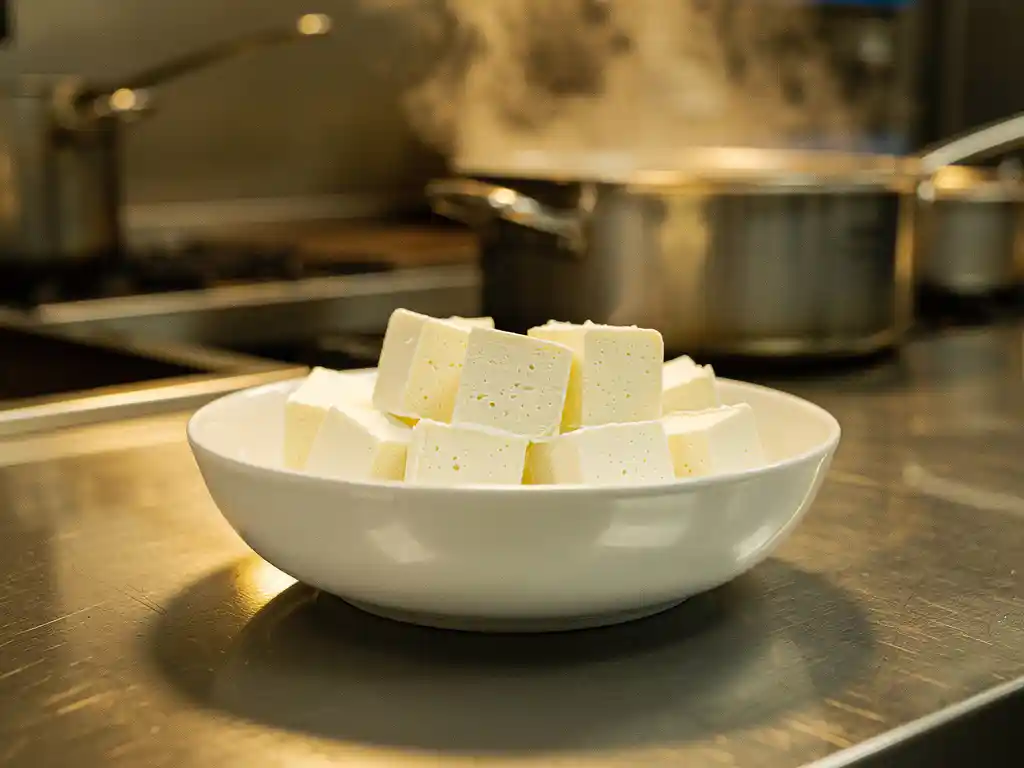
As a buyer for the food industry, you know that choosing the right goat cheese can make the difference between a successful ready-made product and a disappointing result. Goat cheese offers unique properties that perfectly align with the growing demand for premium convenience food. With our years of experience since 1995, we are happy to share our knowledge about the best goat cheese options for industrial processing.
What are the key properties of goat cheese for industrial processing?
The key properties of goat cheese for industrial processing are the lower melting point, creamy texture when heated, natural white color without additives, longer shelf life than comparable cow’s milk cheeses, and the unique flavor profile that remains mild during the production process.
These properties make goat cheese particularly suitable for modern production lines. The lower melting point means the cheese melts faster and more evenly, saving energy and reducing cycle time. The creamy texture provides a luxurious mouthfeel in the final product, while the natural white color is visually appealing without artificial colorants.
For industrial applications, consistent quality is especially crucial. Goat cheese from controlled sources offers stable fat contents between 45-50% in dry matter, guaranteeing predictable results. The protein content typically ranges around 18-22%, contributing to good binding and structure in composite products.
The pH value of fresh goat cheese usually lies between 4.2 and 4.6, supporting natural preservation and increasing microbiological stability. This is especially important for ready-made meals with longer shelf life. Additionally, goat cheese naturally has a lower lactose content, meeting the growing demand for lactose-reduced products.
Which types of goat cheese are suitable for heating in ready-made meals?
For heating in ready-made meals, fresh goat cheese, goat cheese curd, soft ripened goat cheeses like brie-style, and specially developed meltable goat cheese blocks are most suitable due to their excellent melting behavior and stable texture during the production process.
Fresh goat cheese is the most versatile option for industrial processing. With a moisture content of approximately 60%, this cheese melts evenly without separating. The neutral flavor makes it possible to use the product in various formulations, from lasagnas to stuffed pasta. At temperatures between 60-80°C, fresh goat cheese maintains its creamy structure without oil separation.
Goat cheese curd offers unique advantages for specific applications. This unripened form has a crumbly texture that is perfect for toppings on pizzas or as filling in wraps. The curd doesn’t melt completely but becomes soft and creamy, providing interesting texture variation in the final product.
For premium ready-made meals, soft ripened goat cheeses like brie-style are an excellent choice. These cheeses melt luxuriously and deliver a rich, full flavor. They are ideal for gratins, quiches, and other oven dishes where a premium appearance is desired. The ripening process creates more complex flavors that hold up well during industrial heating.
Specially developed industrial goat cheese blocks combine the best properties for machine processing. These have an optimized moisture content around 52%, ensuring excellent cutting and grating properties while maintaining melting behavior. They are designed for consistent performance in large-scale production.
How do goat cheese and cow’s milk cheese differ in industrial applications?
The main difference between goat cheese and cow’s milk cheese in industrial applications lies in the smaller fat globules of goat milk that provide better digestibility, faster melting behavior, whiter color without titanium dioxide, and a milder flavor that is less dominant in composite products.
The molecular structure of goat cheese differs fundamentally from cow’s milk cheese. Goat milk fat has fat globules averaging 3.5 micrometers versus 4.5 micrometers in cow’s milk. This results in more homogeneous distribution during the production process and prevents fat separation during heating. For industrial applications, this means more stable emulsions and better texture in the final product.
Nutritionally, goat cheese contains more medium-chain fatty acids (MCTs), which are absorbed faster by the body. This makes products with goat cheese more attractive to health-conscious consumers. The protein profile also differs: goat cheese contains less αs1-casein, reducing allergenicity and making the cheese suitable for a broader target group.
In production processes, goat cheese behaves differently during freezing and thawing. Due to its finer structure, frozen goat cheese better retains its texture after thawing, which is crucial for frozen meals. Cow’s milk cheese can become grainy after a freeze-thaw cycle, while goat cheese remains creamy.
In terms of flavor profile, goat cheese is more subtle in ready-made meals. Where cow’s milk cheese often dominates, goat cheese adds a soft, creamy flavor without overpowering other ingredients. This makes it ideal for complex flavor profiles where balance is important.
What are the key quality requirements for goat cheese in the food industry?
The key quality requirements for goat cheese in the food industry are IFS Food certification, consistent microbiological values below legal standards, stable pH between 4.2-4.6, standardized fat content, traceability of milk suppliers, and compliance with HACCP principles with complete documentation.
Microbiological safety is paramount in industrial processing. Goat cheese must meet strict standards for Listeria monocytogenes (absent in 25g), Salmonella (absent in 25g), and E. coli (< 100 cfu/g). Regular monitoring through accredited laboratories is essential, with at least weekly analyses of production batches.
Physical-chemical parameters must remain within narrow tolerances for predictable processing results. Moisture content may deviate at most 2% from specification, salt content must be consistent (typically 0.8-1.2%), and texture must be uniform without hard grains or moisture pockets. This consistency prevents production problems and guarantees uniformity in the final product.
Sensory quality requires objective measurement methods. Color is measured via colorimetry (L*a*b* values), where deviations of more than 2 points are unacceptable. Taste and odor are evaluated by trained panels according to established protocols. Off-flavors such as bitter, sour, or rancid lead to batch rejection.
Documentation and traceability are legally mandatory and commercially crucial. Each production lot must be traceable to individual milk suppliers, with complete recording of temperatures, pH values, and process parameters. Certificates of analysis must be available for each delivery, including allergen declarations and nutritional values. Suppliers must be able to provide complete traceability data within 4 hours for recalls or quality issues.
How do you choose the right goat cheese supplier for industrial volumes?
When choosing a goat cheese supplier for industrial volumes, a production capacity of at least 500 kg per day, proven delivery reliability with 98%+ on-time delivery, flexibility in packaging formats, technical support, and financial stability are the most important selection criteria for successful long-term partnerships.
Production capacity and scalability determine whether a supplier can grow with your needs. Ask about current capacity utilization, expansion possibilities, and seasonal capacity. A professional supplier has buffer stocks and multiple production lines to guarantee continuity. Check if they have experience with volumes comparable to your needs and whether they can handle peaks.
Technical competence distinguishes professional suppliers from traders. They must be able to adapt product specifications to your process, such as optimizing moisture content for your specific application. Ask about their R&D capabilities, testing facilities, and willingness to collaborate on product optimization. A good supplier offers trial productions and helps with troubleshooting.
Supply chain robustness is often underestimated but crucial for business continuity. Research their milk supplier network, geographical distribution, and risk management. Ask about business continuity planning, insurance, and track record during crises. Suppliers with their own transport or reliable logistics partners offer more security.
Evaluate potential suppliers systematically through audits, reference visits, and trial orders. Test not only product quality but also responsiveness, problem-solving ability, and administrative processes. Start with small volumes to evaluate the collaboration before entering long-term contracts. A reliable partner invests time in understanding your specific needs and grows with your success.
What innovations are there in goat cheese for the convenience food sector?
Important innovations in goat cheese for convenience food include lactose-free variants, functional goat cheese blends with improved melting behavior, Modified Atmosphere Packaging for extended shelf life, plant-based hybrid goat cheeses, and cleanroom production for ready-to-eat applications without further heating.
Lactose-free goat cheese opens new markets for ready-made meals. Through enzymatic treatment, lactose is broken down into glucose and galactose while maintaining functional properties. This innovation makes premium convenience food accessible to lactose-intolerant consumers, a growing market segment of approximately 15% of the population.
Functional goat cheese blends combine traditional goat cheese with natural emulsifiers and stabilizers for superior processing properties. These blends melt more uniformly, don’t separate during temperature changes, and maintain texture during transport. Innovations like microencapsulated salt crystals provide flavor experience without increased sodium content in the final product.
Modified Atmosphere Packaging (MAP) extends the shelf life of fresh goat cheese to 60 days without preservatives. Through optimal gas mixture ratios (typically 30% CO2, 70% N2), the cheese stays fresh while unwanted microorganisms are inhibited. This technology makes longer distribution chains and export possibilities feasible.
Sustainability innovations focus on packaging reduction and circularity. New mono-material packaging is fully recyclable while maintaining excellent barrier properties. Some producers are experimenting with edible coatings based on milk proteins that make packaging unnecessary for certain applications. Carbon-neutral production processes are becoming increasingly important for retailers and end consumers.
How De Jong Cheese helps with industrial goat cheese solutions
As a family business since 1995, we offer reliable goat cheese solutions for the food industry. With our IFS Food certified production, flexible packaging options, and technical expertise, we help you find the perfect goat cheese for your ready-made meals.
Our industrial service includes:
- Custom product specifications adapted to your production process
- Consistent quality through 100% DGZK-certified milk suppliers
- Flexible packaging from 1 kg blocks to 10 kg industrial formats
- Technical support in product development and troubleshooting
- Reliable delivery with our own transport within the Netherlands and Belgium
- Private label possibilities for your own brand
With our production capacity and 30 years of experience, we can deliver volumes from 500 kg to several tons per week. Our fresh goat cheese, curd, and ripened specialties are optimized for industrial processing with predictable melting behavior and long shelf life.
Are you looking for a reliable partner for high-quality goat cheese in your production? Contact our team of specialists through our contact page or visit our foodservice page for more information about our complete range. For direct products, you can visit our sales points or discover more about our company on our homepage.
Veelgestelde vragen
How can I test if goat cheese is suitable for my specific production process?
Start with a small trial production of 10-25 kg to evaluate melting behavior, texture, and flavor stability under your specific process conditions. Ask your supplier for technical support and test different product specifications, such as varying moisture content or ripening degree. Document temperatures, times, and results carefully to determine the optimal variant for your application.
What are the most common mistakes when processing goat cheese in industrial kitchens?
The biggest mistakes are processing temperatures that are too high (above 85°C) which can cause the cheese to separate, heating times that are too long which damage the delicate structure, and using the wrong goat cheese types for specific applications. Also avoid adding acidic ingredients directly to warm goat cheese and ensure gradual temperature transitions to achieve the best results.
How much goat cheese should I order to handle seasonal fluctuations?
Plan for at least 20-30% extra volume during peak periods such as the holidays and summer months when salads are popular. Work with rolling forecasts of 12 weeks and discuss with your supplier the possibility of flexible call-off contracts. Fresh goat cheese has a maximum shelf life of 8 weeks under optimal conditions, so inventory buildup has limits – focus on good agreements about delivery flexibility.
Which food safety certifications should I require from my goat cheese supplier?
At minimum IFS Food or BRC certification at Higher Level, plus HACCP implementation according to Codex Alimentarius guidelines. For export outside the EU, additional certifications such as FSSC 22000 or SQF may be required. Also ask for specific analyses such as aflatoxin M1 monitoring, veterinary drug residues, and complete allergen declarations including cross-contamination risks.
How do I integrate goat cheese into existing recipes without adjusting the entire production process?
Start with 1:1 replacement of comparable cheese types but adjust the processing temperature 10-15°C downward due to the lower melting point. Compensate for the higher moisture content by reducing binding agents by 5-10%. Test first in small batches and gradually adjust proportions until the desired texture and flavor are achieved without major process changes.
What are the cost savings when using goat cheese versus premium cow's milk cheeses?
While the purchase price of goat cheese is 15-25% higher, there are indirect savings through 20% shorter process times, 10-15% less energy consumption due to lower melting temperatures, and potentially 30% less product loss due to better stability. The premium positioning often justifies a 20-40% higher selling price, improving total margin despite higher raw material costs.
How do I prevent quality loss of goat cheese during transport and storage in my warehouse?
Maintain a constant temperature between 2-4°C with maximum 1°C fluctuation, use FIFO principle strictly, and prevent temperature fluctuations during loading and unloading. Store goat cheese separately from strongly scented products due to absorption sensitivity. Invest in temperature loggers and alarms, and train warehouse staff in specific handling of dairy products to ensure quality.
Gerelateerde artikelen
- Hoe zorg je voor een goede back-up leverancier voor wrongel in je productieketen?
- Hoe beoordeel je een productcatalogus van een geitenkaasproducent als inkoper?
- Welke vragen stel je een producent van wrongel bij een eerste kennismaking?
- Welke vorm van geitenkaas werkt het beste in een geautomatiseerd sandwichconcept?
- Zit er stremsel in geitenkaas?