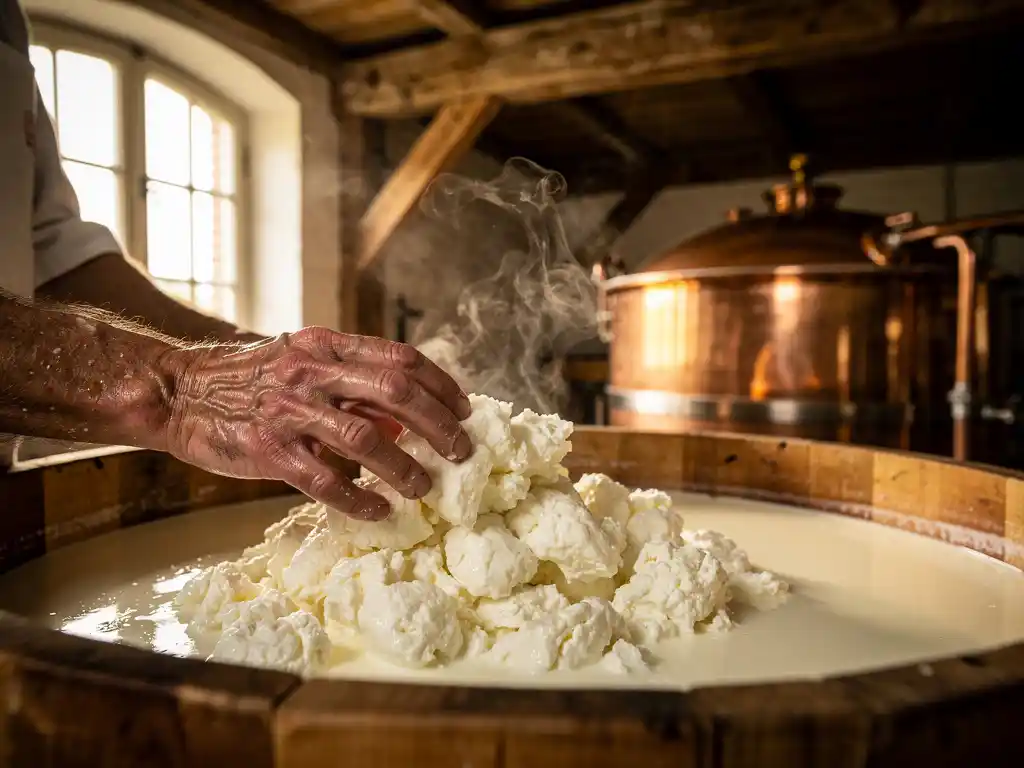
As a purchaser in the food industry, you know that choosing the right curd producer can be decisive for the success of your products. Whether you make pizzas, ready meals, or bakery products, curd often forms an essential ingredient that determines the taste, texture, and quality of your end product. But how do you ask the right questions to find a reliable supplier? In this article, we cover the most important questions you should ask during an initial meeting with a curd producer.
What is curd and why is the choice of producer so important?
Curd is the fresh, unpressed product that forms during the cheese-making process when milk is coagulated and the whey is separated. It has a soft, crumbly texture and is widely used in the food industry because of its versatility, neutral taste, and excellent processing properties.
The choice of producer is crucial because curd is a very fresh product with limited shelf life. A good producer guarantees consistent quality, reliable delivery, and the right technical specifications for your production process. Wrong choices can lead to production downtime, quality problems, or food safety risks.
Curd is used in various industrial applications such as fillings for bakery products, ingredient in ready meals, base for spreads and dips, and component in pizzas and snacks. The specific properties such as dry matter content, pH value, and microbiological quality must perfectly match your production process.
What quality certificates should a curd producer be able to provide?
A professional curd producer must at minimum have IFS Food certification, a HACCP system, EC accreditation for dairy production, and regular inspections by official bodies such as the COKZ. These certificates guarantee that the producer meets the highest food safety and quality standards.
Additionally, supplementary certifications are valuable depending on your specific needs. Think of Halal and Kosher certification for specific markets, GMP+ certification for certain applications, and sustainability certificates such as participation in sustainable dairy chains. Always ask about the validity of certificates and whether they cover the specific product curd.
Also pay attention to traceability systems and the producer’s EC number. This oval label with company number and country name must be on all dairy products and guarantees that the producer complies with European legislation. Ask for examples of product specifications and technical data sheets to verify that all relevant information is available.
How do you test the consistency of curd deliveries?
Test consistency by analyzing at least three consecutive deliveries for dry matter content, pH value, microbiological parameters, and sensory properties. Ask the producer for historical quality data from the past six months to assess natural variations.
Set up incoming goods control where you check each delivery for temperature upon arrival, visual characteristics such as color and texture, and functional properties in your specific application. Document all measurements systematically to identify trends.
Discuss with the producer what quality controls they perform and how often. Professional producers test every batch on standard parameters and store reference samples. Ask about their procedure for deviations and how they communicate about quality issues. A good producer has a track record of consistent deliveries and can demonstrate this with data.
What are realistic delivery times and minimum order quantities for curd?
Realistic delivery times for fresh curd are between 24 and 72 hours after ordering, depending on production capacity and distance. Minimum order quantities usually vary between 100 and 500 kilograms, with many producers working with packaging units of 15 or 20 kilograms.
For industrial customers, fixed delivery agreements are essential. Discuss the possibility of weekly or bi-weekly deliveries on fixed days. This gives both parties planning certainty. Also ask about flexibility for sudden volume changes and the lead time for additional orders.
Inquire about the possibilities for frozen curd as a buffer for peak moments. Frozen curd often has a shelf life of up to two years and retains the same functional properties after thawing. This can help optimize inventory levels and reduce waste.
What technical specifications are crucial for curd in your production process?
The most important technical specifications are dry matter content (usually 35-45%), pH value, fat content, protein composition, and microbiological parameters. These determine how the curd behaves during processing, heating, and the shelf life of your end product.
For specific applications, additional properties are relevant. When used in bakery products, water-binding capacity is crucial. For pumpable systems, the curd must have a certain viscosity. In freeze-resistant products, stability after freezing and thawing is essential. Discuss these specific requirements in detail with the producer.
- Melting behavior when heated for pizza and oven applications
- Emulsifying properties for sauces and spreads
- Structural stability during mechanical processing
- Compatibility with other ingredients in your recipe
- Flavor profile and possible off-flavors after processing
How do you deal with price fluctuations and contract agreements for curd?
Discuss pricing models that account for milk price fluctuations, such as quarterly contracts with price indexing or fixed prices for certain volumes. Many producers work with a base price plus a variable milk price surcharge that is adjusted monthly.
Contract agreements must provide clarity about volumes, quality guarantees, delivery conditions, and pricing mechanisms. Consider multi-year contracts for price stability, but build in flexibility for volume adjustments. Ask about volume discounts and the possibility to lock in prices for large purchases.
Also discuss payment terms and possible early payment discounts. Some producers offer interesting conditions for advance payment or quick payment. Ensure all agreements are recorded in writing, including procedures for dispute resolution and quality complaints.
How De Jong Cheese helps with curd deliveries for industry
As a traditional family business since 1995, we at De Jong Cheese understand the specific needs of industrial processors. Our curd, both cow and goat, is specially developed for large-scale processing with properties that perfectly match modern production processes.
- Firm and freeze-stable curd that remains stirrable and pumpable
- Adjustable dry matter content between 35% and 45% according to your specifications
- Possibility for additions such as salt, preservatives, fruit, or herbs
- Packed in Modified Atmosphere Packaging (MAP) or practical 15 kg buckets
- IFS Food certified with complete traceability
- Flexible deliveries from our location in Alphen, North Brabant
With our years of experience in supplying bakeries, ready meal producers, and snack factories worldwide, we can think along about the best solution for your production process. Our curd is suitable for various applications such as fillings for tapas, ingredient in cooking and semi-finished products, and base for innovative dairy applications.
Want to know more about our curd and the possibilities for your production? View our complete assortment for foodservice and industry or contact us directly for a no-obligation conversation. Our specialists are happy to think along about the best solution for your specific application. Also visit our website for more information about our company and our working methods, or visit one of our sales points to taste our products.
Veelgestelde vragen
How can I optimally extend the shelf life of curd after delivery?
Store fresh curd immediately after receipt at 2-4°C in the original packaging. For longer shelf life, you can freeze curd at -18°C, whereby the functional properties are retained for up to 24 months. Always thaw slowly in the refrigerator (24-48 hours) and use within 5 days after thawing for optimal quality.
What are the main differences between cow and goat curd for industrial processing?
Goat curd has a finer structure, whiter appearance, and milder taste than cow curd. It contains smaller fat globules which makes it emulsify better in sauces. Cow curd is firmer, has more body, and is therefore more suitable for applications where texture is important, such as pizza toppings or bakery fillings.
How do I prevent syneresis (moisture loss) in curd in my end product?
You prevent syneresis by choosing the right dry matter content (higher is more stable), not letting the pH drop too much during processing, and adding stabilizers such as locust bean gum or guar gum. Also avoid excessive mechanical processing and temperature fluctuations during production and storage.
What test batch possibilities are there before I agree to a large contract?
Most curd producers offer trial samples of 5-20 kg for product development. Ask for samples from different batches to test consistency. Some suppliers also facilitate pilot runs in their test facilities or can produce customized specifications on a small scale for validation in your production process.
How do I recognize quality problems with curd during incoming goods inspection?
Watch for abnormal odor (sour, bitter, or yeasty), discoloration (yellow or gray instead of white), visible mold or gas formation in the packaging, and a too liquid or too dry consistency. Always measure the temperature upon arrival (must be <7°C) and check the pH value which normally lies between 5.8-6.2.
Can curd be used as a lactose-free alternative in my products?
Standard curd contains lactose (2-3%), but low-lactose variants (<0.1%) are available through enzymatic treatment during production. These retain the same functional properties but are suitable for lactose intolerance claims. Discuss with your supplier the possibilities and any price differences for low-lactose curd.
What are typical pitfalls when switching curd suppliers?
Don’t underestimate the differences in product specifications between suppliers – even small variations in dry matter or pH can have a big impact on your end product. Plan a transition period with parallel deliveries, adjust recipes where necessary, and communicate changes to your quality department. Always test new curd first in pilot batches before fully switching.
Gerelateerde artikelen
- Wat zijn de mogelijkheden van private label geitenkaasconcepten voor retailpartners?
- Hoe behoud je ambachtelijke kwaliteit bij opschaling naar industriële volumes?
- Hoe beïnvloedt het rijpingsproces van gerijpte geitenkaas de smaak in een eindproduct?
- Hoe weet je of een geitenkaasproducent ook op lange termijn aan je eisen kan voldoen?
- Hoe controleer je of een kaasleverancier voldoet aan Europese hygiënenormen?