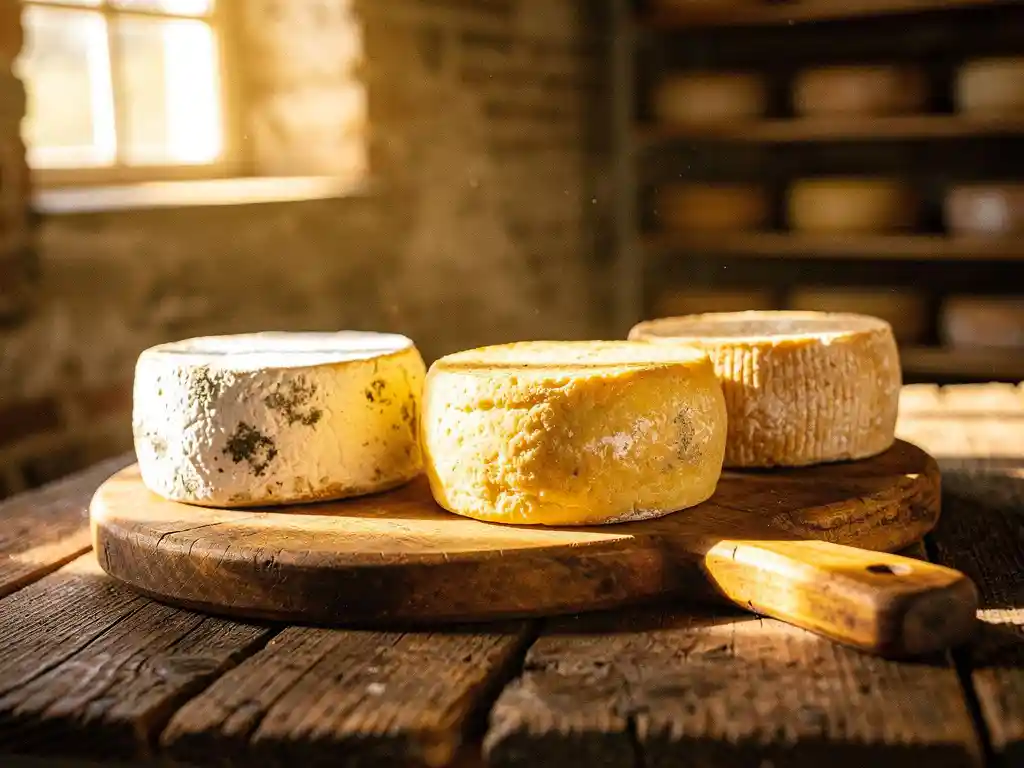
As a purchaser in the food industry, you know that choosing the right goat cheese producer is crucial for your production quality and business results. Whether you need fresh goat cheese, aged goat cheese, or special goat cheese balls for your production lines, comparing suppliers requires a systematic approach. In this guide, we discuss the key factors to consider when selecting a reliable partner for your goat cheese needs.
What are the key quality indicators for goat cheese producers?
The key quality indicators for goat cheese producers are consistent product specifications, certifications like IFS Food, traditional production methods, raw material traceability, and technical properties such as melting behavior and fat content. These factors determine whether a producer is suitable for industrial processing.
For industrial applications, consistency in product specifications is essential. This means that every batch of fresh goat cheese or goat cheese slices must have exactly the same properties in terms of texture, flavor, fat content, and moisture content. Producers who have worked according to fixed recipes for decades, such as traditional family businesses, often offer the most certainty in this area.
Certifications provide objective proof of quality standards. IFS Food certification guarantees that the producer meets international food safety standards. Additional certifications like DGZK (Sustainable Goat Cheese Chain) show that the producer also focuses on sustainability and animal welfare.
The technical properties of the cheese are especially important for processing companies. Consider:
- Melting behavior at different temperatures
- Stability during freezing and thawing
- Shelf life after opening
- Suitability for Modified Atmosphere Packaging (MAP)
- Possibility to adjust dry matter content (35-45%)
Finally, the origin and processing of the milk is an important indicator. Producers who work with milk from local farms and use traditional acidification and coagulation methods often deliver a product with a more consistent flavor profile.
How do you assess the delivery reliability of a goat cheese producer?
You assess the delivery reliability of a goat cheese producer based on their track record, inventory capacity, volume flexibility, delivery time guarantees, and communication about supply chain disruptions. Ask for references from existing industrial customers and test first with smaller orders.
A reliable producer has a proven track record in the industry. Companies that have been active for decades and deliver globally to retail, foodservice, and industry have proven their reliability. Ask specifically about their experience with your type of application, whether it’s pizza production or ready-to-eat meals.
Inventory capacity and production planning are crucial factors. A professional producer can indicate:
- Standard delivery times (for example, 4 weeks for special variants)
- Minimum order quantities (MOQ) per product type
- Possibilities for rush deliveries
- Buffer inventories for regular customers
The flexibility to deliver both small test batches and large volumes shows that a producer can grow with your needs. Producers who offer both fresh and frozen variants give you more security during unexpected demand spikes.
Transparent communication about possible disruptions is essential. A reliable partner proactively informs you about seasonal influences on milk production, planned maintenance work, or other factors that may affect deliveries. This gives you time to adjust your production accordingly.
What are realistic price differences between goat cheese producers?
Realistic price differences between goat cheese producers vary from 15% to 40%, depending on factors such as production scale, quality level, certifications, and service level. Premium producers with traditional methods and additional certifications are typically 20-30% higher than bulk producers.
The biggest price-determining factor is production scale and degree of automation. Large-scale industrial producers can offer lower prices through volumes, but often with concessions to flexibility or traditional flavor profiles. Artisanal producers with small-scale production charge higher prices but often offer superior quality and customization.
Specific product forms have different price levels:
- Fresh goat cheese in bulk (15kg bags): base price
- Goat cheese discs or slices: 15-25% premium due to additional processing
- Aged goat cheese: 30-40% premium due to aging time and storage
- Special formats like goat cheese balls: 20-35% premium due to labor-intensive production
- High-melt variants for pizza: 10-20% premium due to adapted recipe
Service and flexibility often justify a price premium. Producers who offer private label possibilities, develop customer-specific recipes, or can deliver just-in-time rightfully charge higher prices. This premium often outweighs the savings in inventory costs and production downtime.
When comparing prices, also consider total costs. A cheaper producer who regularly has quality problems or delivers unreliably ultimately costs more through production losses, complaints, and searching for emergency solutions.
What questions should you ask when selecting a goat cheese producer?
When selecting a goat cheese producer, you should ask questions about technical specifications, certifications, delivery conditions, flexibility in volumes and formats, traceability, and possibilities for product development. Focus on questions that are directly relevant to your production process and quality requirements.
Technical questions are fundamental for industrial processing:
- What are the exact specifications regarding fat content, moisture, and protein?
- How does the cheese behave when heated to our process temperatures?
- Is the cheese freeze-stable without quality loss?
- What shelf life does the product have after opening?
- Can you adjust the dry matter content to our wishes?
Questions about production capacity and flexibility:
- What are your minimum and maximum order quantities?
- Can you scale up as our demand grows?
- Do you offer both fresh and frozen variants?
- What are the standard delivery times and are rush deliveries possible?
- Do you have experience with our specific application?
Quality and safety questions are crucial:
- What certifications do you have (IFS, BRC, organic)?
- How do you ensure consistent quality between batches?
- What is your procedure for quality deviations?
- Can you guarantee complete traceability?
- How often are you audited by external parties?
Don’t forget to ask about innovation and collaboration. Can they contribute ideas for new product variants? Do they offer support in product development? Are they willing to develop exclusive recipes? A producer who thinks along as a partner is often more valuable than the cheapest option.
How do you test goat cheese before entering a long-term contract?
Test goat cheese for a long-term contract by placing small trial orders, processing the product in your own production line, checking stability across multiple batches, and evaluating end products. Plan at least 3-6 months for thorough testing including seasonal variations.
Start by requesting samples of different product variants. For pizza applications, for example, test both fresh goat cheese crumbles and high-melt variants. Ask for samples from different production batches to assess consistency. Pay specific attention to uniformity in particle size for goat cheese balls or slice thickness for goat cheese discs.
Conduct practical tests in your production line:
- Processability: how does the product behave in your dosing equipment?
- Temperature stability: does the cheese retain its properties during your process?
- Interaction with other ingredients: are there unexpected reactions?
- End product shelf life: is quality maintained?
- Sensory properties: taste, texture, and appearance after processing
Document all test results systematically. Create a scorecard with objective criteria such as melting behavior, taste consistency, and processing yield. Involve your quality department and production staff in the evaluation; they often have valuable practical insights.
Also test the service quality of the producer during the trial period. Are agreements kept? How quickly do they respond to questions? Are they willing to make adjustments? These soft factors are at least as important as product quality for a successful long-term partnership.
How De Jong Cheese helps with selecting the right goat cheese solution
As a traditional family business since 1995, we at De Jong Cheese understand the challenges that purchasers like Marco Visser face daily. Our combination of artisanal quality, industrial expertise, and personal service makes the difference in finding the perfect goat cheese solution for your production.
What we offer for industrial processors:
- Complete range: from fresh goat cheese and spreadable goat cheese to aged variants and special pizza applications
- Proven consistency: traditional recipes since 1995 guarantee constant quality
- Flexible delivery options: both fresh and frozen, in volumes from 5kg to 15kg per package
- Technical support: our experts advise on melting behavior, processing temperatures, and product optimization
- Customization possibilities: private label production and specification adjustment to your wishes
Our IFS Food certification and years of experience in global delivery to retail, foodservice, and industry give you the security of a reliable partner. Whether you’re looking for goat cheese slices for pizzas, goat cheese balls for salads, or fresh goat cheese for further processing, we’re happy to think along with you.
Start testing our products today. Contact your account manager for samples and technical specifications. Visit our product page for the complete range or contact our team for a personal consultation. Also discover our other specialties and visit one of our sales points to experience our quality yourself.
Veelgestelde vragen
How long does it take to start a partnership with a new goat cheese producer?
Starting a partnership takes an average of 3-4 months, including initial introduction, sample tests, trial orders, and contract negotiations. For complex private label projects or customized recipes, this can extend to 6 months. Therefore, plan well in advance and start the selection process at least six months before your current contract expires.
What are the biggest pitfalls when switching goat cheese producers?
The biggest pitfalls are underestimating small quality differences that have major impact on your end product, not testing under all seasonal conditions, and forgetting logistical aspects such as packaging formats that don’t fit existing equipment. Prevent these problems by conducting extensive parallel tests and involving all departments (production, quality, logistics) early on.
How do you negotiate better prices without compromising quality?
Focus negotiations on volume agreements, long-term contracts, and efficiency improvements instead of pure price reduction. Ask about tier pricing for larger purchases, discuss joint forecasting for better production planning, and explore possibilities for more direct delivery routes. Also consider alternative packaging sizes or delivery frequencies that work cost-effectively for both parties.
What role does seasonal influence play in purchasing goat cheese?
Goat milk production has natural seasonal fluctuations with peaks in spring/summer and lows in winter. This affects availability, price, and sometimes flavor profile. Professional producers buffer this with freezing capacity, but always discuss seasonal planning. Consider annual contracts with fixed prices or strategic inventory building in the high season for stable costs and availability.
How do you integrate sustainability requirements into your selection criteria?
Ask about concrete sustainability initiatives such as CO2 reduction, animal welfare certificates (Better Life quality mark), local milk purchasing, and packaging optimization. Weigh additional costs for more sustainable options against your own sustainability goals and marketing value. Producers with transparent sustainability reporting and measurable goals are often more reliable long-term partners.
What do you do if your current goat cheese producer suddenly cannot deliver?
Always develop a backup strategy with at least one alternative supplier who knows your products and can scale up quickly. Maintain strategic safety stock for 2-4 weeks of production. Make agreements with your main supplier about emergency scenarios and compensation for delivery failure. Consider dual sourcing for critical products to spread risks.
Gerelateerde artikelen
- Welke interne stakeholders betrek je bij de selectie van een kaasleverancier?
- Wat zijn de gevolgen van inconsistente kaaskwaliteit in een pizzaproductielijn?
- Hoe zorg je dat je leverancier altijd voldoet aan de laatste voedselveiligheidseisen?
- Wat zijn de kwaliteitsnormen voor geitenkaas in de voedingsindustrie?
- Hoe controleer je of een kaasleverancier voldoet aan Europese hygiënenormen?