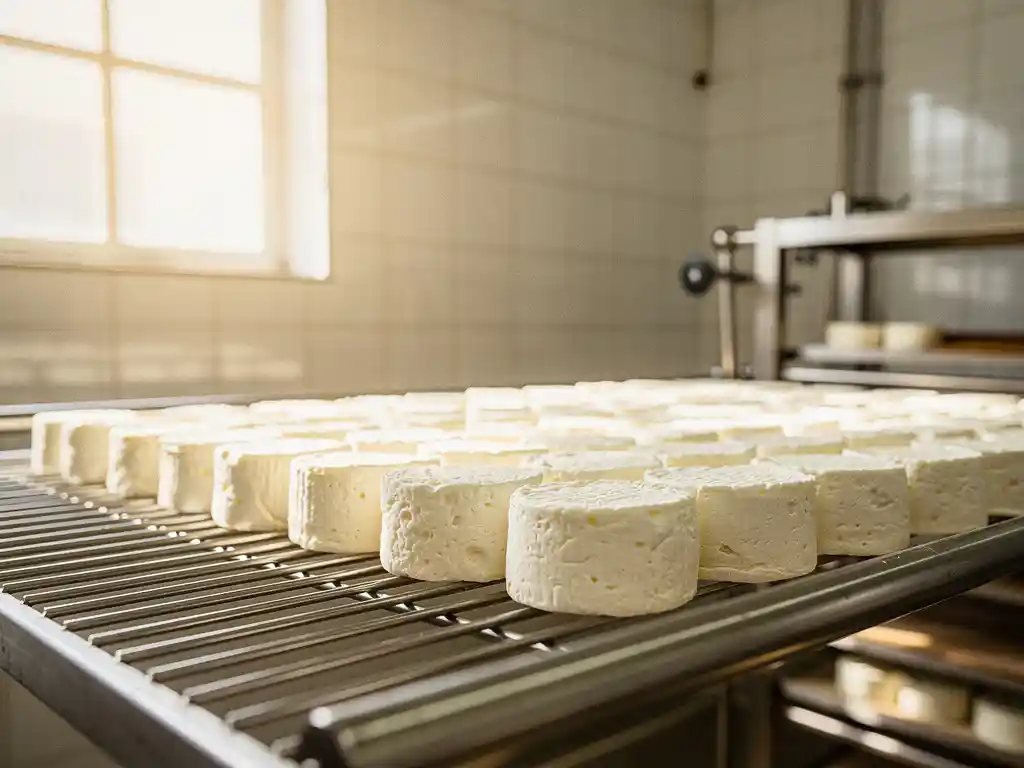
Industrial goat cheese pucks are an essential ingredient for many food manufacturers, from pizza makers to ready-meal producers. For purchasers like Marco Visser, who are responsible for procuring high-quality cheese products for their production lines, understanding minimum order quantities is crucial for successful collaboration with suppliers. These minimum quantities not only determine the feasibility of a partnership, but also influence production costs and inventory planning.
What are goat cheese pucks and how are they used in industry?
Goat cheese pucks are pre-formed, round discs of goat cheese specifically developed for industrial applications. These uniform cheese portions have a consistent size and weight, making them perfectly suited for automated production lines in the food industry.
In the food industry, goat cheese pucks are primarily used as toppings for pizzas, in ready meals, salads and sandwiches. Their pre-formed structure makes it possible to quickly and efficiently process large quantities of products without manual portioning. The pucks melt evenly when heated, ensuring consistent quality in the final product.
The technical properties of goat cheese pucks, such as fat content, moisture percentage and melting behavior, are precisely calibrated for industrial processing. This makes them ideal for manufacturers looking for reliable ingredients with predictable results. Additionally, the mild, distinctive flavor of goat cheese gives products a premium appeal, which is attractive to consumers seeking quality and variety.
What are typical minimum order quantities for industrial goat cheese pucks?
Typical minimum order quantities for industrial goat cheese pucks range between 500 kilograms and 2,000 kilograms per order, depending on the manufacturer and product type. Fresh goat cheese pucks often have lower minimum order quantities than aged variants due to their shorter shelf life.
For standard fresh goat cheese pucks, the minimum order is usually around 500 to 1,000 kilograms per delivery. This corresponds to approximately 20,000 to 40,000 individual pucks, based on an average weight of 25 grams per puck. Aged goat cheese pucks often have higher minimum order quantities of 1,000 to 2,000 kilograms due to the more complex production process and longer aging time.
For regular customers, these quantities can often be applied more flexibly. Many manufacturers offer contract agreements where the minimum order quantity can be divided across multiple deliveries within a specific period. This makes it possible for medium-sized food producers to use high-quality goat cheese pucks without having to maintain large inventories immediately.
Why do goat cheese producers maintain minimum order quantities?
Goat cheese producers maintain minimum order quantities to ensure production efficiency and deliver consistent quality. Starting up a production line for specific pucks requires considerable preparation, where small batches are not economically viable.
The production of goat cheese pucks requires specialized equipment that must be set to the exact weight, shape and composition of the product. This changeover costs time and money, where the costs must be spread over a larger production volume to remain profitable. Additionally, milk from multiple goat farms must be collected and processed, which is only efficient at larger volumes.
Quality assurance also plays an important role. Extensive quality controls are performed with each production run, from microbiological testing to taste and texture analyses. These controls represent fixed costs that are independent of batch size. By maintaining minimum order quantities, producers can optimally utilize these quality processes and consistently deliver high-quality products to their industrial customers.
How do MOQs differ between fresh and aged goat cheese pucks?
Minimum order quantities for fresh goat cheese pucks are typically 30-50% lower than for aged variants. Fresh pucks often have an MOQ of 500-1,000 kilograms, while aged pucks require a minimum of 1,000-2,000 kilograms due to the more complex production process.
The difference in MOQs stems from fundamental differences in the production process. Fresh goat cheese pucks can be delivered within a few days after production, keeping lead times short and capital investment limited. These pucks have a shelf life of approximately 4-6 weeks under refrigerated conditions, requiring quick turnover but also enabling lower minimum quantities.
Aged goat cheese pucks, on the other hand, require an aging period of several weeks to months in special aging chambers with controlled temperature and humidity. This lengthy process means producers must invest more working capital and plan larger production runs to work efficiently. However, the longer shelf life of aged pucks (often 3-6 months) compensates for this by enabling more flexible inventory planning for the customer.
What factors determine whether you can meet minimum order quantities?
The main factors that determine whether you can meet minimum order quantities are your production volume, storage capacity, cash flow and the number of products in which you process goat cheese pucks. A thorough analysis of these factors helps in making the right supplier decision.
Your monthly production volume is the primary indicator. If you produce 100,000 pizzas per month with an average of 50 grams of goat cheese per pizza, you need 5,000 kilograms monthly. This makes it feasible to meet an MOQ of 1,000-2,000 kilograms. Storage capacity is crucial, especially for refrigerated storage of fresh pucks. You must have sufficient freezer space if you choose frozen pucks, or adequate cooling capacity for fresh variants.
Cash flow considerations also play a role, as large orders require pre-financing. It’s important to align your supplier’s payment terms with your own accounts receivable. Finally, product diversification determines your flexibility. If you use goat cheese pucks in multiple product lines, you can more easily meet higher MOQs than when you only need them for one specific product.
How do you negotiate more flexible order quantities with goat cheese producers?
Successful negotiation for more flexible order quantities begins with building a long-term relationship and demonstrating growth potential. Present a clear purchasing plan with realistic growth projections to convince producers of mutual benefit.
Start by proposing a phased approach where you begin with the standard MOQ, but show commitment for regular orders. Many producers are willing to accept lower starting volumes if you sign an annual contract with guaranteed minimum purchases over the entire period. For example, instead of 2,000 kilograms per order, you could negotiate 1,000 kilograms per month with an annual commitment of 12,000 kilograms.
Combine different product variants in one order to meet the total MOQ. If you need both fresh and aged goat cheese pucks, or different flavor variants, these can often be combined. Also consider seasonal planning where you take larger volumes during peak periods and smaller quantities during quieter times. Finally, participation in product development or purchasing new product variants during the introduction phase can often lead to more favorable purchase conditions.
How De Jong Cheese helps with flexible order quantities for industrial goat cheese pucks
As a traditional family business since 1995, we at De Jong Cheese understand the challenges of industrial customers like Marco Visser. Our personal approach and flexibility in production make it possible to work together to find suitable solutions for minimum order quantities.
We offer various options to meet your specific needs:
- Phased delivery schedules where large orders are divided across multiple deliveries
- Combination possibilities of fresh and aged goat cheese pucks within one order
- Annual contracts with customized volumes based on your seasonal patterns
- Trial productions for new applications with lower starting volumes
- Technical support in optimizing your production process with our goat cheese pucks
Our IFS Food-certified production and years of experience in supplying the industry worldwide guarantee consistent quality, regardless of order volume. With 100% of our milk suppliers connected to DGZK and local milk collection within 100 kilometers, we can flexibly respond to your demand while maintaining the highest quality standards.
Are you curious about the possibilities for your specific situation? Contact our team via our contact page for a personal conversation about your needs. Discover more about our complete range of industrial goat cheese products on our foodservice page. For general information about De Jong Cheese and our tradition in artisanal cheese production, visit our homepage.
Veelgestelde vragen
How can I as a small producer still benefit from industrial goat cheese pucks?
As a small producer, you can consider collaborating with other local businesses to jointly meet minimum order quantities. Additionally, some suppliers like De Jong Cheese offer special starter packages or can refer you to a distributor that supplies smaller quantities. It’s also possible to start with frozen pucks, which have a longer shelf life and thus offer more flexibility in use.
What are the main quality differences between cheap and premium goat cheese pucks?
Premium goat cheese pucks distinguish themselves through the use of 100% goat milk without additives, consistent melting behavior and uniform portioning. Cheaper variants often contain cow milk blends or vegetable fats, resulting in less authentic flavor and unpredictable melting behavior. Premium pucks also have better functional properties like browning and stretchability after melting, which is crucial for the visual appeal of your end product.
How do I calculate optimal inventory rotation for goat cheese pucks in my production?
First calculate your daily consumption and multiply this by your supplier’s lead time plus a safety margin of 20-30%. For fresh pucks with 4-6 weeks shelf life, plan a maximum of 2 weeks inventory. For frozen pucks you can maintain up to 3 months inventory. Use the FIFO principle (First In, First Out) and implement a track-and-trace system to accurately monitor expiration dates.
What technical specifications should I request when selecting goat cheese pucks?
Always ask for the exact fat percentage (usually 45-50% in dry matter), moisture content, pH value, melting point and functional properties like stretchability and browning index. Also ask for exact dimensions, weight tolerances and packaging specifications. For automated processing, it’s important to know hardness (penetrometry values) and freeze resistance, as well as microbiological specifications and allergen information for your HACCP documentation.
What are common mistakes in storing and processing industrial goat cheese pucks?
The most common mistakes are temperature fluctuations during storage (ideal is constant 2-4°C for fresh pucks), not respecting thawing time for frozen pucks (minimum 24 hours in refrigeration), and storing opened packages too long. Also stacking boxes above the indicated height can lead to deformation of the pucks. In processing, a common mistake is using temperatures that are too high, causing the cheese to burn instead of melting nicely.
How can I optimize the total costs of goat cheese pucks beyond the purchase price?
Look beyond just the price per kilogram by also weighing processing efficiency, waste percentage and labor costs. Uniform pucks can reduce labor costs by 30-40% compared to manual portioning. Also calculate the actual costs including transport, storage and any product losses. Consider long-term contracts with price agreements to avoid price fluctuations, and ask about volume discounts for larger annual purchases.
Gerelateerde artikelen
- Hoe bereken je de werkelijke kostprijs inclusief logistiek bij geitenkaasinkoop?
- Wat zijn de mogelijkheden van private label geitenkaasconcepten voor retailpartners?
- Hoe bewaak je de leveranciersprestaties van een producent van industriële geitenkaas?
- Wat betekent IFS-certificering voor een inkoper in de voedingsindustrie?
- Hoe gebruik je geitenkaas spread als ingrediënt in industriële sauzen en dressings?