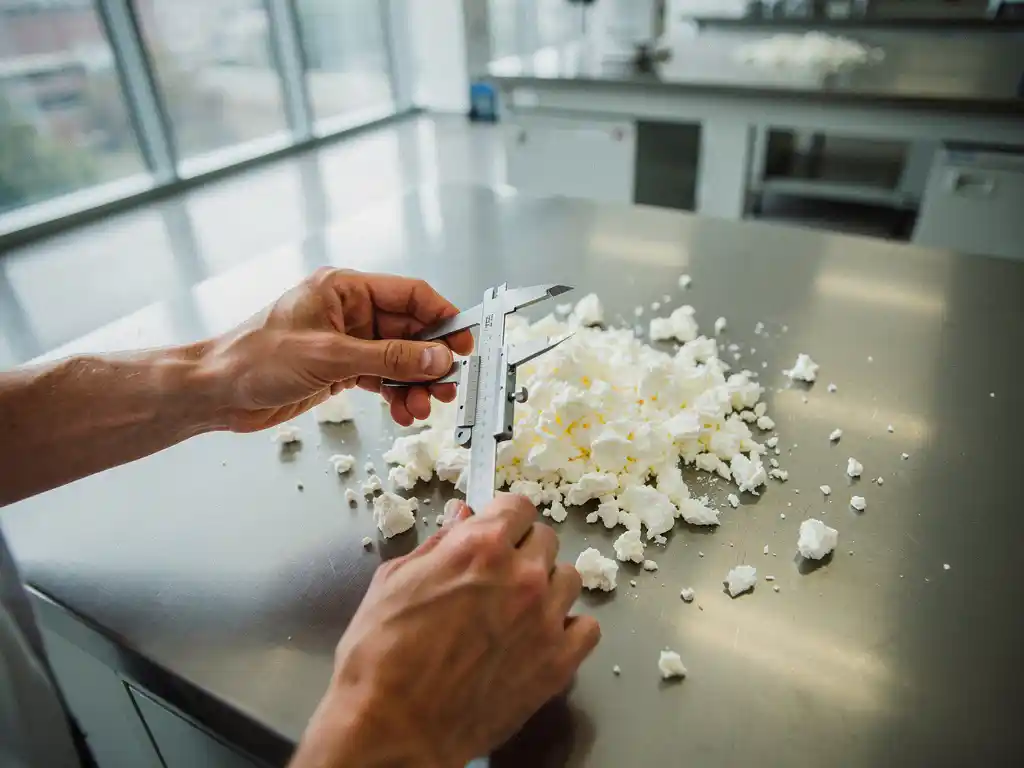
When selecting a new supplier for goat cheese crumbles, consistency is one of the most critical factors for industrial processors. A reliable supplier must not only deliver high-quality products but also guarantee that every batch has exactly the same characteristics. This article provides a complete guide for testing and evaluating the consistency of goat cheese crumbles, enabling you to make informed decisions when choosing your supplier.
What are the key consistency properties of goat cheese crumbles?
The key consistency properties of goat cheese crumbles are particle size, moisture content, texture, melting behavior, and shelf life. These five factors together determine how the crumbles behave during processing, storage, and in the final product, with each property directly affecting product quality and processability.
Particle size must be uniform, typically between 10-15mm for industrial applications. Consistent size ensures even distribution in products like pizzas or salads. Moisture content should ideally be between 45-55% and may not vary more than 2% between batches. This percentage determines not only texture but also the shelf life of the product.
Texture is crucial for processability. Good crumbles must be firm enough to maintain their shape during transport and processing, but also easily fall apart under light pressure. Melting behavior must be predictable, especially for applications involving heating. Crumbles should melt evenly without oil separation or clumping.
The shelf life of fresh goat cheese crumbles is typically 2-3 weeks from production, while frozen varieties can last up to 2 years. After thawing, quality crumbles retain the same properties as fresh products, which is essential for flexible production planning.
How do you perform an initial quality test on supplier samples?
An initial quality test begins with visual inspection, followed by texture analysis, flavor evaluation, and a simple melting test. This four-step test provides a reliable initial assessment of product quality and consistency within 30 minutes, without requiring complex laboratory equipment.
Start by visually evaluating the crumbles immediately after opening the packaging. Look for uniformity in size, color, and shape. Good crumbles have an even white to light cream color without discoloration or dry edges. Check that no clumps are present and that the crumbles easily separate from each other.
For texture analysis, take a handful of crumbles and press them lightly together. They should hold together but fall apart again when released. Test firmness by rolling some crumbles between thumb and forefinger. They should not immediately crumble to powder, but also not be too hard.
Flavor evaluation involves tasting both cold and lightly heated crumbles. Fresh goat cheese crumbles should have a mild, slightly tangy taste without bitter or unwanted off-flavors. Pay particular attention to consistency in flavor profile between different parts of the sample.
For the melting test, heat a small amount of crumbles in a pan or microwave. Observe how quickly and evenly they melt, whether oil separation occurs, and how the texture changes. Good crumbles melt evenly without discoloring or developing a rubbery texture.
Which laboratory tests are essential for consistency evaluation?
Essential laboratory tests for consistency evaluation are pH measurement, moisture content analysis, fat content test, microbiological examination, and texture profile analysis (TPA). These five tests together provide a complete picture of product quality and predict how consistently the crumbles will perform in your production process.
pH measurement is fundamental because it determines acidity, which directly affects taste, shelf life, and melting behavior. For goat cheese crumbles, the ideal pH is between 4.4 and 4.8. Deviations indicate inconsistent production or quality problems. Measure at least 5 points per batch for a reliable average.
Moisture content analysis is performed using the oven-drying method or faster with a moisture analyzer. The exact moisture percentage must remain within a margin of maximum 2% between batches. This guarantees consistent texture and prevents problems during further processing.
Fat content determines not only nutritional value but also melting behavior and mouthfeel. Standard goat cheese crumbles contain 20-25% fat in dry matter. Use the Gerber method or infrared spectroscopy for accurate measurements.
Microbiological examination tests for pathogens but also for the presence of desired lactic acid bacteria. Consistent microbiological profiles indicate controlled production conditions. Test at least for Listeria, Salmonella, E. coli, and total plate count.
Texture profile analysis objectively measures properties like hardness, cohesiveness, and elasticity. This mechanical test simulates chewing behavior and provides reproducible data on texture consistency between batches.
How do you test the processing stability of goat cheese crumbles?
Processing stability is tested by subjecting crumbles to typical processing conditions such as transport, mixing, heating, and freezing. These practical tests simulate your production process and reveal whether the crumbles maintain their properties under stress, which is crucial for consistent end products.
Begin with a transport simulation test where crumbles are exposed to vibrations and temperature fluctuations for 24-48 hours. Place samples in different packages on a vibration plate or in a climate chamber with alternating temperatures between 2-8°C. Evaluate afterwards whether the crumbles are still loose or have clumped together.
For mixing tests, combine the crumbles with typical ingredients from your production process. Test different mixing speeds and times to see if the crumbles maintain their shape or crumble. Good crumbles maintain their integrity during normal mixing but distribute evenly.
Heating tests are essential for hot applications. Test different temperatures (180-220°C for pizzas) and heating times. Monitor melting behavior, oil separation, and color change. Document at which temperature the crumbles melt optimally without burning.
Freeze-thaw cycles test stability for long-term storage. Freeze samples at -18°C and thaw them after different periods (1 week, 1 month, 3 months). Compare texture, moisture loss, and melting behavior with fresh samples. Quality crumbles maintain their properties for up to 2 years frozen.
What are the main differences between suppliers in terms of consistency?
The main differences between suppliers lie in production standardization, raw material control, quality systems, batch variation, and seasonal influences. These factors together determine how consistently a supplier can deliver, with traditional producers often having different strengths than large-scale industrial companies.
Production standardization varies greatly between artisanal and industrial producers. Large suppliers often use automated processes with strict parameters, leading to minimal batch variation. Smaller, traditional producers like family businesses may show more variation but often offer superior taste and texture through their artisanal approach.
Raw material control begins with milk suppliers. Companies working with fixed suppliers from a limited geographical area often have more consistent milk quality. The use of quality marks like DGZK (Sustainable Goat Dairy Chain) guarantees standardized production conditions among dairy farmers.
Quality systems like IFS Food certification and HACCP are indicators of process control. Suppliers with these certifications have documented procedures for every production step, reducing the chance of variation. Look especially for suppliers using real-time monitoring during production.
Seasonal influences are inevitable in dairy production. Milk composition varies with the season, affecting cheese properties. Experienced suppliers compensate for these natural variations by adjusting their recipes, while less experienced producers may show more seasonal differences.
How do you establish acceptance criteria for consistent delivery?
Acceptance criteria for consistent delivery include specification limits, test protocols, sampling plans, deviation margins, and escalation procedures. These five elements together form an objective assessment framework that provides both you and your supplier with clarity about quality expectations and helps prevent discussions about delivery quality.
Start by establishing detailed product specifications including upper and lower limits for each critical parameter. For goat cheese crumbles, this means for example: particle size 12-15mm (minimum 90% within range), moisture content 48-52%, pH 4.5-4.7, and fat content 22-24%. Also document sensory characteristics like color, odor, and flavor profile.
Develop test protocols that exactly describe how each parameter is measured. Specify equipment, test conditions, number of measurements, and calculation methods. This prevents discussions about measurement results. Share these protocols with your supplier so they can use the same methods for their quality control.
The sampling plan determines how many samples you test and how often. For new suppliers, we recommend intensive sampling: test every delivery for the first three months. With proven consistency, you can switch to statistical sampling according to ISO 2859 or comparable standards.
Define realistic deviation margins and what happens when exceeded. For example: one parameter 5% outside specification = warning, two parameters outside specification = delivery rejected. Also build in seasonal corrections for natural variations.
Escalation procedures describe the steps for quality problems. Who do you contact at the supplier? Within what timeframe do you expect a response? When do you switch to an alternative supplier? Clear agreements prevent production disruptions.
How De Jong Cheese helps with consistent goat cheese crumbles delivery
As a traditional family business since 1995, we combine artisanal expertise with modern quality systems to guarantee consistent goat cheese crumbles. Our approach is based on three pillars that together provide the reliability that industrial processors like you need.
Our consistency guarantees:
- 100% milk from DGZK-certified suppliers within 100km for constant quality
- IFS Food certified production with real-time process monitoring
- Standardized 13-gram crumbles with 23 weeks shelf life fresh
- Freezable variants with 2 years shelf life without quality loss after thawing
- Fixed specifications: natural pH, controlled moisture content, consistent melting behavior
Our complete industrial range includes besides standard crumbles also high-melt variants for pizza applications and testing possibilities for aged crumbles. We deliver in 5kg or 10kg bags, perfectly suited to industrial processing volumes.
For new customers, we offer extensive testing programs where you can evaluate our crumbles in your own production environment. Our technical specialists support you in establishing specifications and acceptance criteria that perfectly match your process.
Would you like to experience the consistency of our Alphenaer goat cheese crumbles yourself? Contact us for samples and technical documentation. Also visit our Experience Centre in Alphen for a production tour or view our complete range on our website.
Veelgestelde vragen
How long does it take to switch to a new supplier of goat cheese crumbles?
A complete switch takes an average of 3-6 months, including testing phase, specification alignment, and production adjustments. Start with small test batches in your production for 4-6 weeks, followed by gradual scaling up. Plan the transition preferably outside your peak season to handle any startup problems without production risks.
What are the costs of setting up a complete testing program for supplier consistency?
A basic testing program costs approximately €2,000-5,000 per supplier, depending on the number of laboratory tests and test duration. This includes sampling costs, laboratory analyses (€150-300 per complete test), labor hours for evaluation, and possible production tests. Many suppliers share in these costs or offer free extensive testing programs for serious prospects with substantial volumes.
What backup strategy should I maintain for delivery security of crumbles?
Ideally work with a main supplier (70-80% volume) and a secondary supplier (20-30% volume) who both meet your specifications. Always maintain 2-4 weeks safety stock, preferably frozen product that has long shelf life. Test both suppliers at least quarterly to ensure they still meet your quality requirements.
How do I prevent quality differences between summer and winter production?
Ask your supplier about their seasonal compensation strategy and specifically test crumbles from different seasons. Consider building strategic inventory in spring when milk quality is optimal. Possibly adjust your own recipes slightly to compensate for seasonal variations, for example by using 1-2% more crumbles in winter months.
What are warning signs that my current supplier has consistency problems?
Watch for increasing complaints about end product quality, frequent specification deviations (>10% of deliveries), varying delivery times, or sudden price changes that may indicate raw material problems. Also communication problems with quality issues, lack of batch traceability, or refusal to provide test samples are red flags requiring action.
Can I combine different suppliers in one production line?
Technically possible, but not recommended due to consistency risks. Different suppliers often have subtle differences in particle size, melting behavior, and flavor profile that lead to inconsistent end products. If combining is necessary, only mix crumbles with identical specifications and test the end product extensively. Document exactly which batches were mixed for traceability.
Gerelateerde artikelen
- Hoe voorkom je budgetoverschrijdingen door onvoorspelbare grondstofprijzen?
- Welke technische specificaties vraag je op voor geitenkaas bestemd voor verhitting?
- Waar let een inkoper op bij het selecteren van een producent van industriële geitenkaas?
- Wat is het verschil in houdbaarheid tussen verse en ingevroren geitenkaas spread?
- Hoe vergelijk je geitenkaasproducenten op kwaliteit, prijs en leverbetrouwbaarheid?